Base station apparatus and method in mobile communication system

base station technology, applied in the field of mobile communication system base station apparatus and a mobile communication system, can solve the problems of insufficient production of space diversity effect in the mimo system, insufficient use of power resources assigned to unused antennas, and inability of users to appropriately demodulate downlink signals, etc., to achieve the effect of effectively using power resources in the base station apparatus

US20100316156A1Inactive Publication Date: 2010-12-16NTT DOCOMO INC
4 Cites 29 Cited by

Patent Information

Authority / Receiving Office
US · United States
Current Assignee / Owner
Publication Date
2010-12-16
Estimated Expiration
Not applicable · inactive patent

Smart Images

  • Figure 1
    Figure 1
  • Figure 2
    Figure 2
  • Figure 3
    Figure 3
Patent Text Reader

Abstract

A base station apparatus used in a mobile communication system where user terminals with various numbers of reception antennas may be situated includes a providing unit configured to provide plural reference signals according to the number of transmission antennas; a precoding unit configured to replicate each of a predetermined number of input signal sequences according to the number of transmission antennas, apply a predetermined precoding vector to each of the replicated sequences, and generate output signal sequences corresponding to the number of transmission antennas; and a transmitting unit configured to transmit transmission signals including the output signal sequences from plural transmission antennas; wherein at least one of the input signal sequences includes a control signal and one of the plural reference signals.
Need to check novelty before this filing date? Find Prior Art

Description

TECHNICAL FIELD

[0001] The present invention relates to a base station apparatus and a method in a mobile communication system.BACKGROUND ART

[0002] Research and development regarding next generation mobile communication systems has been proceeding in this technical field. The W-CDMA (Wideband Code Division Multiple Access) standardization organization 3GPP (3rd Generation Partnership Project) has been discussing a communication system called Long Term Evolution (LTE) as a successor of W-CDMA, HSDPA (High Speed Downlink Packet Access), and HSUPA (High Speed Uplink Packet Access). As a radio access scheme in LTE, Orthogonal Frequency Division Multiplexing (OFDM) is under consideration for downlink, and Single-Carrier Frequency Division Multiple Access (SC-FDMA) is under consideration for uplink (see 3GPP TR 25.814 (V7.0.0), “Physical Layer Aspects for Evolved UTRA”, June 2006, for example).

[0003] In OFDM, a frequency band is divided into plural narrow frequency bands (sub-carriers), and d...

Examples

Embodiment Construction

Description of Notations

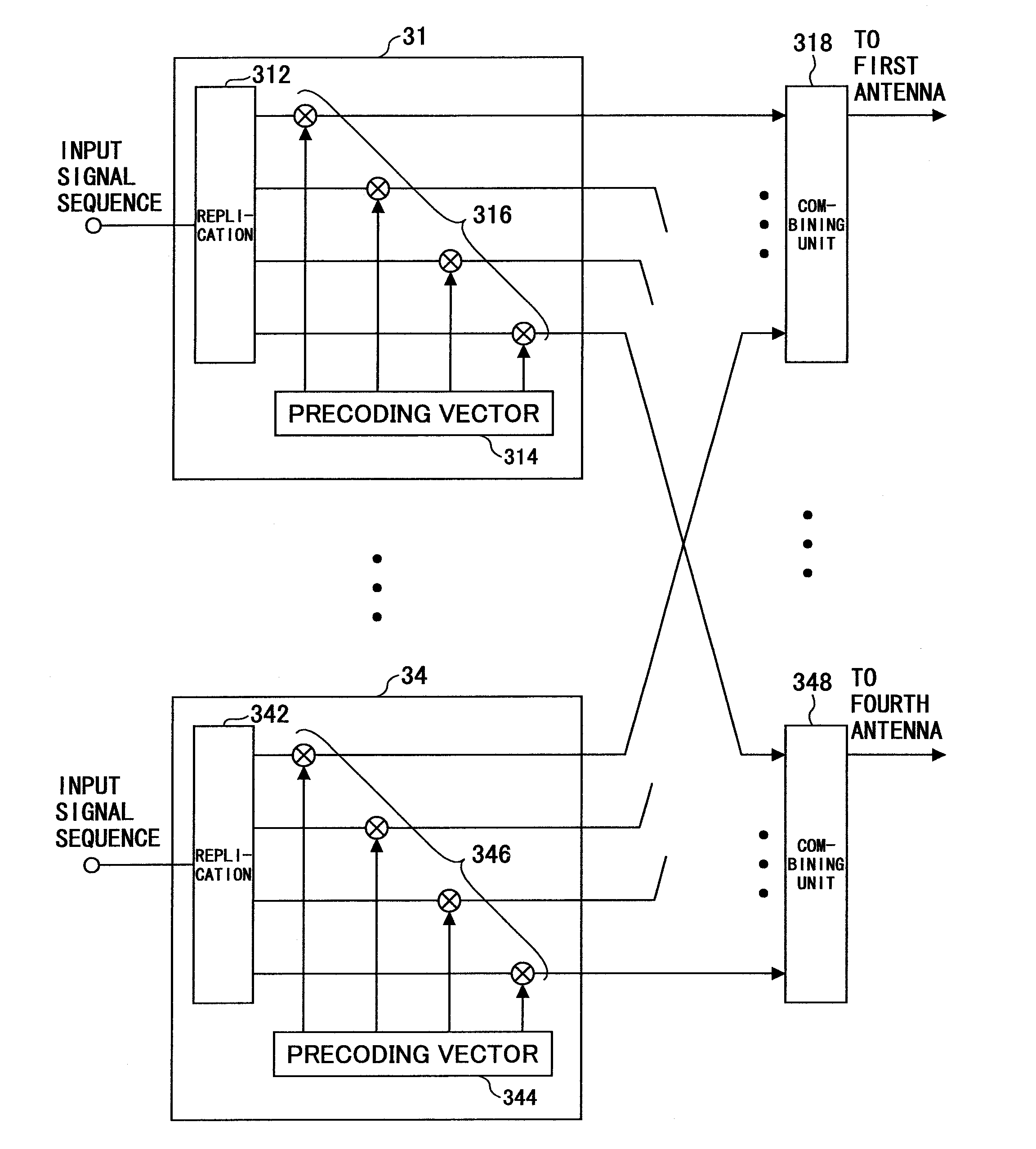
[0024]PA power amplifier[0025]31, . . . , 34 weighting and replicating unit[0026]312, . . . , 342 replicating unit[0027]314, . . . , 344 precoding vector determining unit[0028]316, . . . , 346 multiplying unit[0029]318, . . . , 348 combining unit[0030]61 transmission diversity modulation unit[0031]62 adaptive precoding unit[0032]63-1, . . . , 63-4 multiplexing unit[0033]64 synchronization channel switch[0034]65-1, . . . , 65-1 multiplexing unit[0035]66 fixed precoding unit

BEST MODE OF CARRYING OUT THE INVENTION

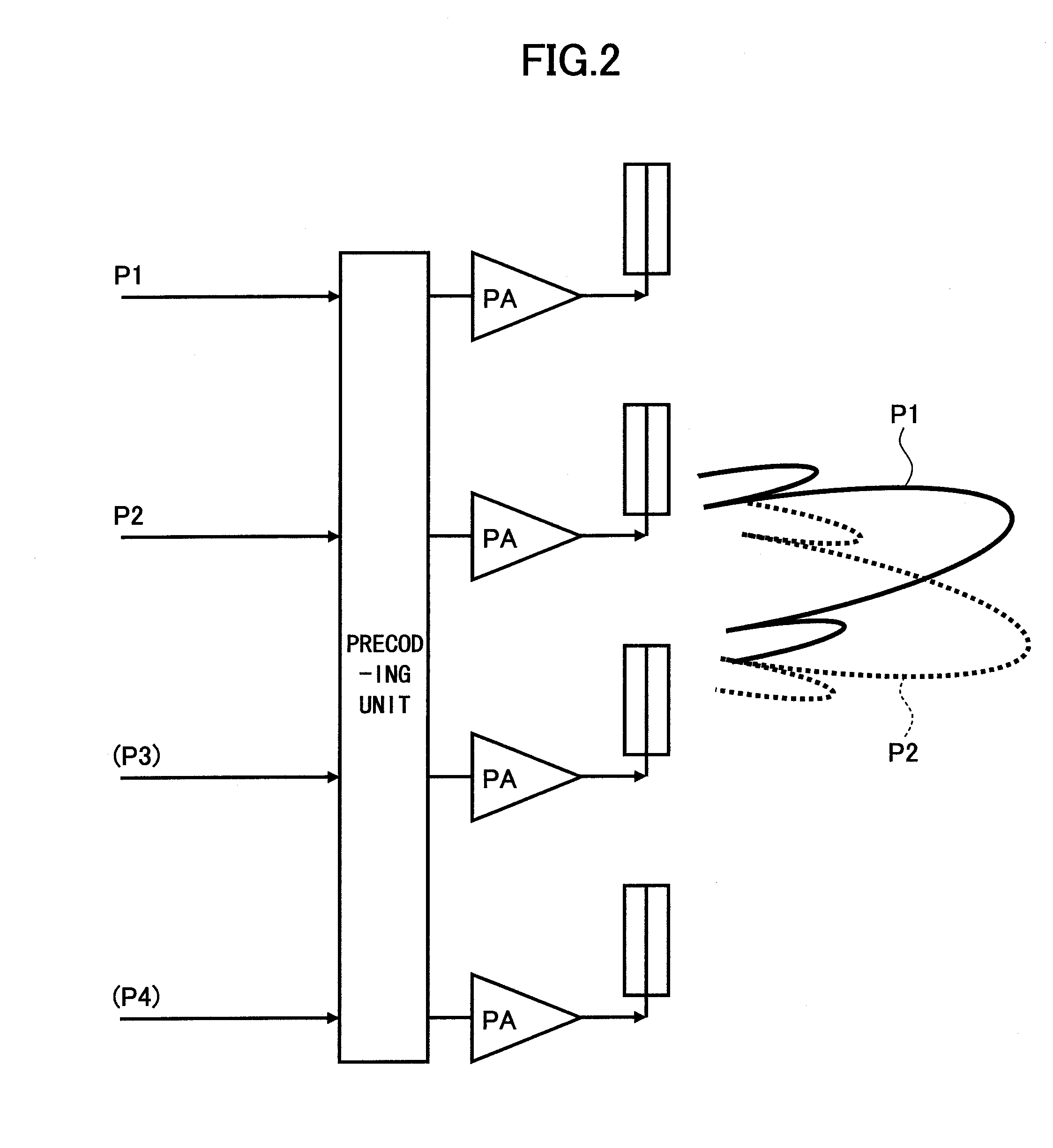
[0036]FIG. 2 shows an example where reference signals are transmitted from a base station apparatus according to an embodiment of the present invention. The base station apparatus includes four transmission antennas, each of which includes a power amplifier PA. A signal sequence supplied to each power amplifier PA corresponds to an output signal sequence from a precoding unit. Reference signals P1 and P2 are supplied as input signals to the precoding un...