Method and device for determining antenna cooperation set, method and device for determining base station cooperation set

US20110281591A1Active Publication Date: 2011-11-17CHINA MOBILE COMM GRP CO LTD
4 Cites 6 Cited by

Patent Information

Authority / Receiving Office
US · United States
Current Assignee / Owner
Publication Date
2011-11-17

Smart Images

  • Figure 1
    Figure 1
  • Figure 2
    Figure 2
  • Figure 3
    Figure 3
Patent Text Reader

Abstract

A method and device for determining an antenna cooperation set, and a method and device for determining a base station cooperation set in the mobile communication field are provided. The method includes that a signal joint processing system obtains the channel quality between a mobile terminal and at least two base stations, determines the base stations, which are corresponding to the channel quality higher than the channel quality threshold, as the cooperation base station set of the mobile terminal. Because the channel quality between the mobile terminal and the antenna of each base station is used to determine the cooperation antenna set dynamically, therefore, the determined cooperation antenna set includes the antennae that have very strong interference to the mobile terminal, or the antennae that have been strongly interfered by the mobile station. By performing signal joint processing to the antennae, signal interference among adjacent cells can be reduced, better accuracy for detecting mobile terminal signals can be obtained, the accuracy for receiving signals by the mobile station is improved, and namely the communication quality between the mobile terminal and the base stations is improved.
Need to check novelty before this filing date? Find Prior Art

Description

FIELD OF THE INVENTION

[0001] The present invention relates to the field of mobile communications and particularly to inter-cell interference mitigation technologies.BACKGROUND OF THE INVENTION

[0002] LTE-Advanced systems use Orthogonal Frequency Division Multiple Access (OFDMA) access mode. The interference among multiple users within the same cell can be avoided since users' information is carried on orthogonal different sub-carriers. But OFDMA access method itself does not have the ability to suppress inter-cell interference, thus the adjacent cell interference, i.e., inter-cell interference is the main aspect affecting the performance of the LTE-Advanced system. At the same time, in order to achieve higher spectrum efficiency, broadband mobile communication systems will be deployed with frequency reuse factor close to one. In a cellular system with networking at the same frequency, cell edge users will be interfered easier from adjacent cell, such interference severely limits cell e...

Examples

Embodiment Construction

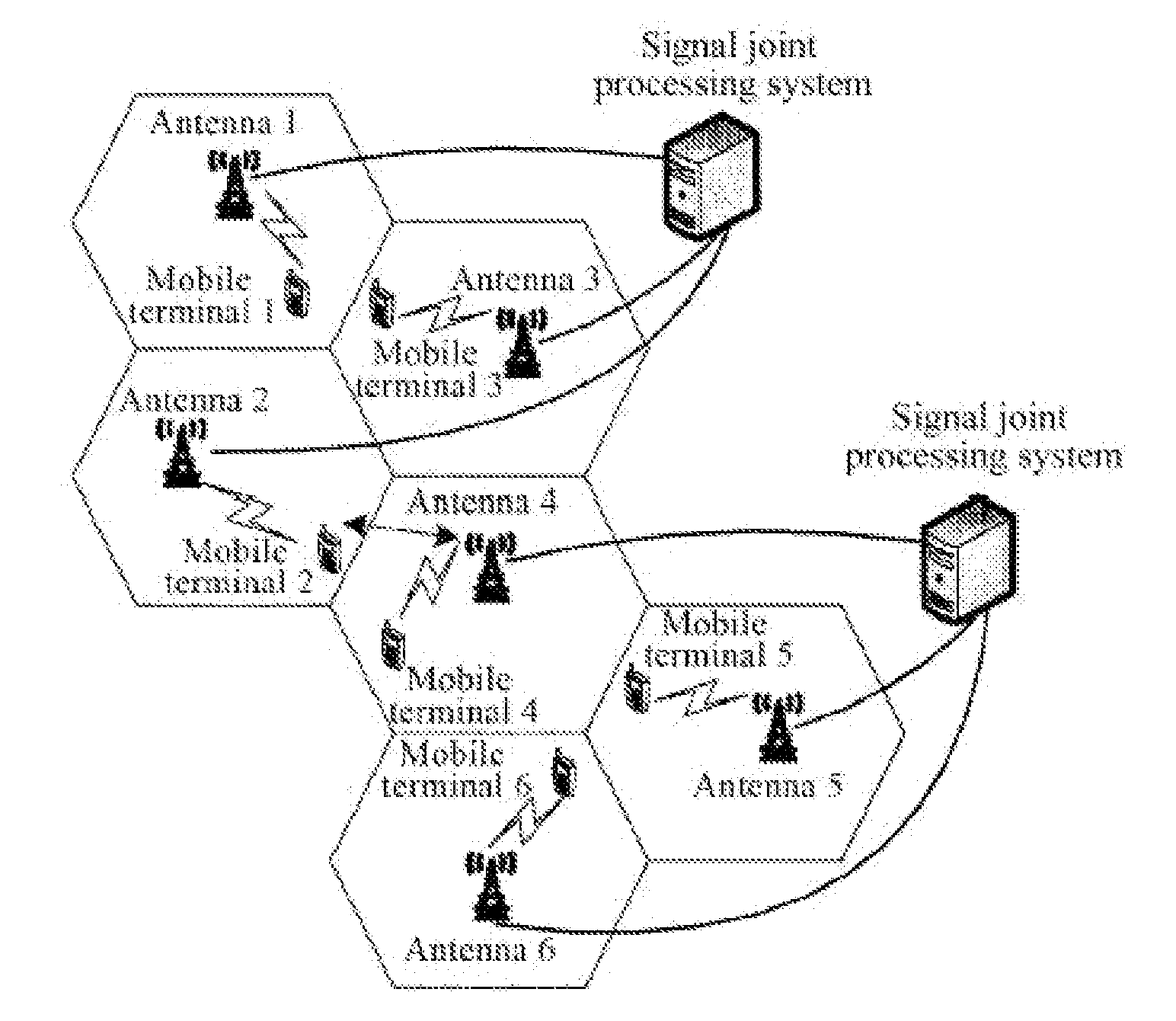
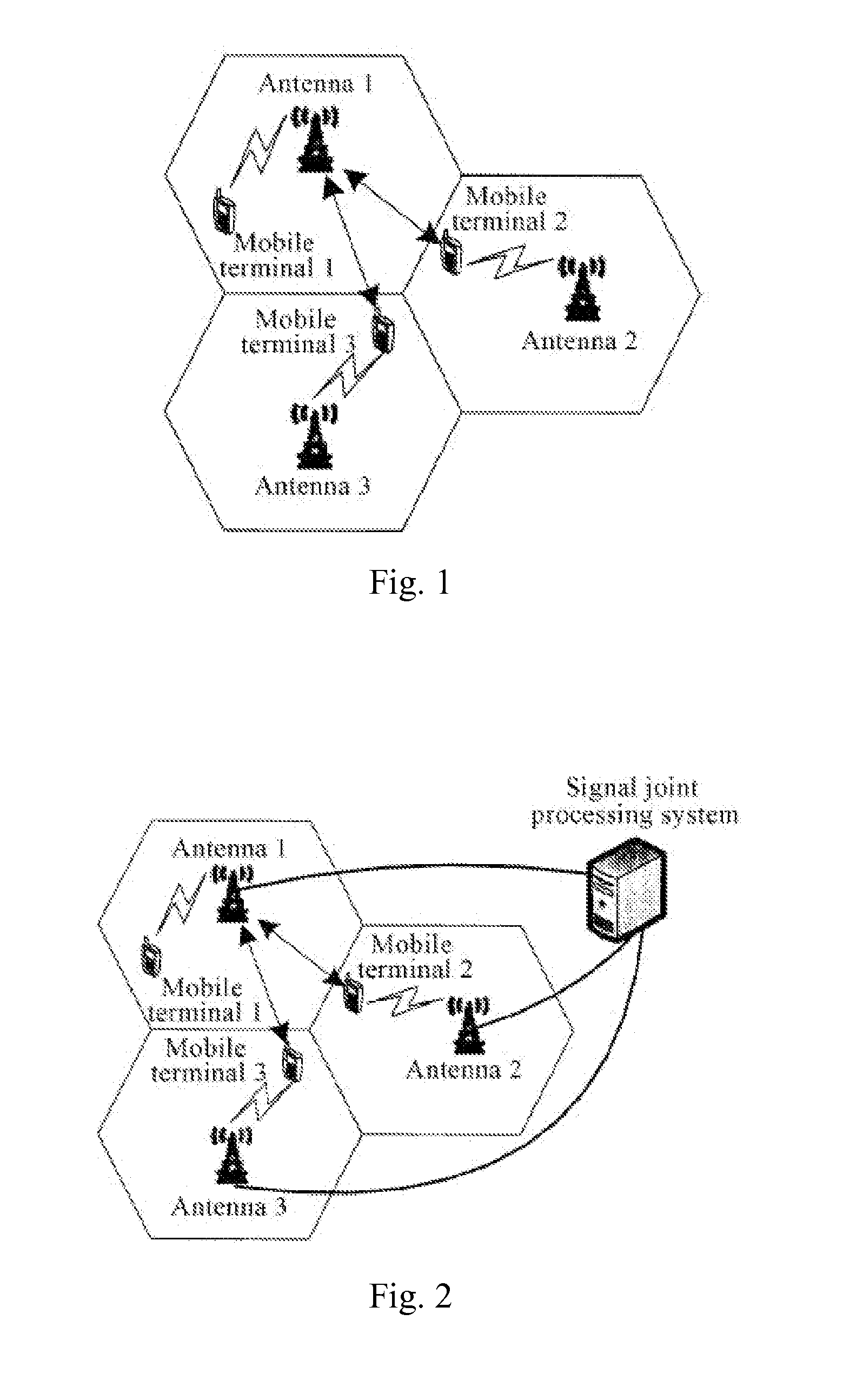
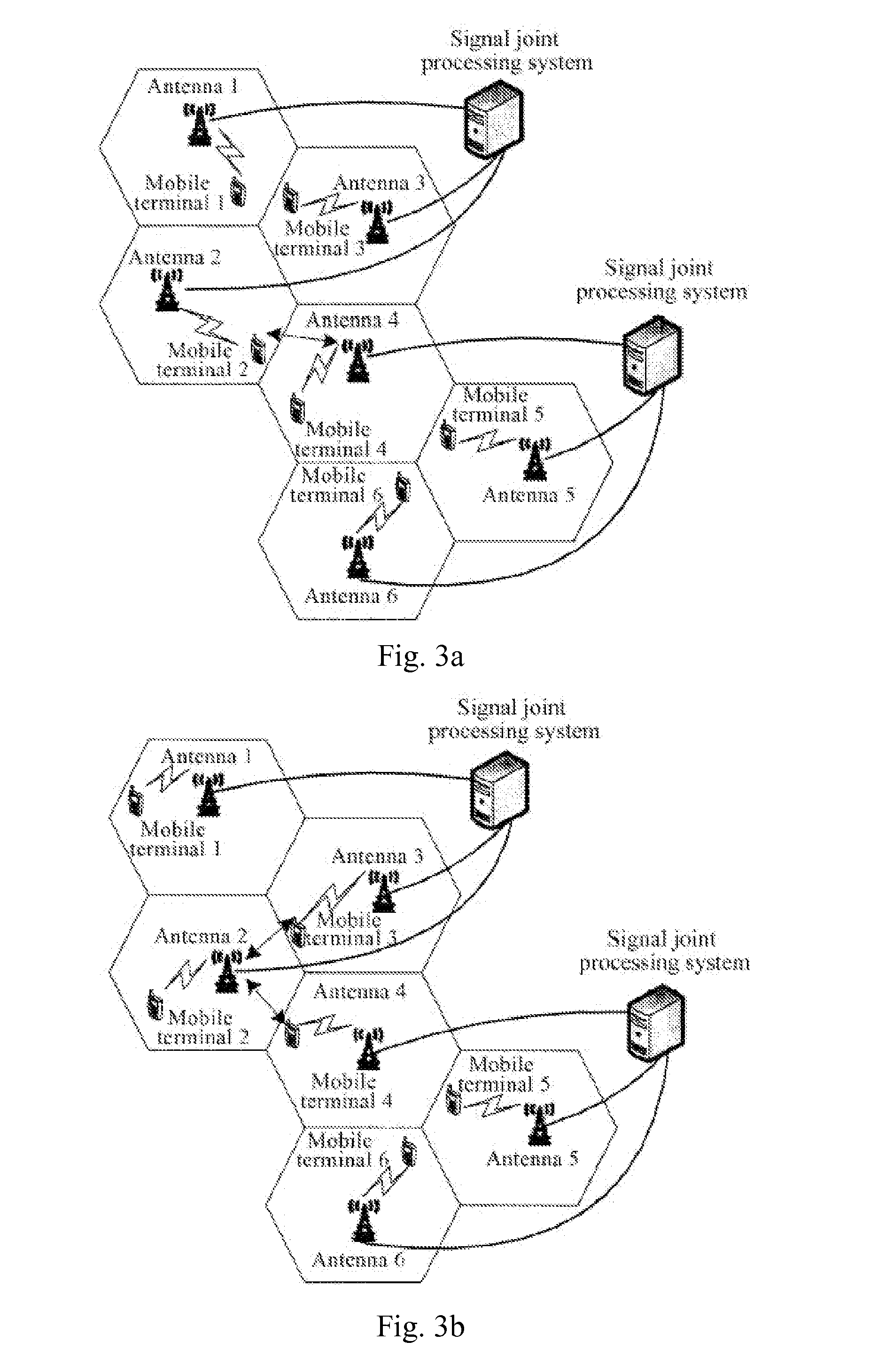
[0037]The inventors have identified that a predetermined cooperative set of antennas may not be appropriate for mobile terminals at the edge of some cell (e.g., mobile terminal 2 illustrated in FIG. 3a) although the quality of communication between mobile terminals at the edge of some other cells and an antenna can be improved in the method with a static predetermined cooperative set of antennas in the prior art, therefore this problem can be addressed in a method with a dynamic cooperative set of antennas. That is, a cooperative set of antennas can be composed for each of the mobile terminals dependent upon specific practical situation of the mobile terminal and used to improve the quality of communication between the mobile terminal and the antennas.

[0038]Furthermore, an embodiment of the invention further provides a method for dynamically determining a set of interfering mobile terminals for each of mobile terminals. The set of interfering mobile terminals for the mobile terminal...