
Operating light and a process for lighting an operating table by means of an operating light
a technology of operating light and operating light, which is applied in the direction of lighting applications, instruments, and power sources with built-ins, can solve the problems of often feeling too glaring and cold light, and achieve the effect of improving light perception
- Summary
- Abstract
- Description
- Claims
- Application Information
AI Technical Summary
Benefits of technology
Problems solved by technology
Method used
Image

Examples
Embodiment Construction
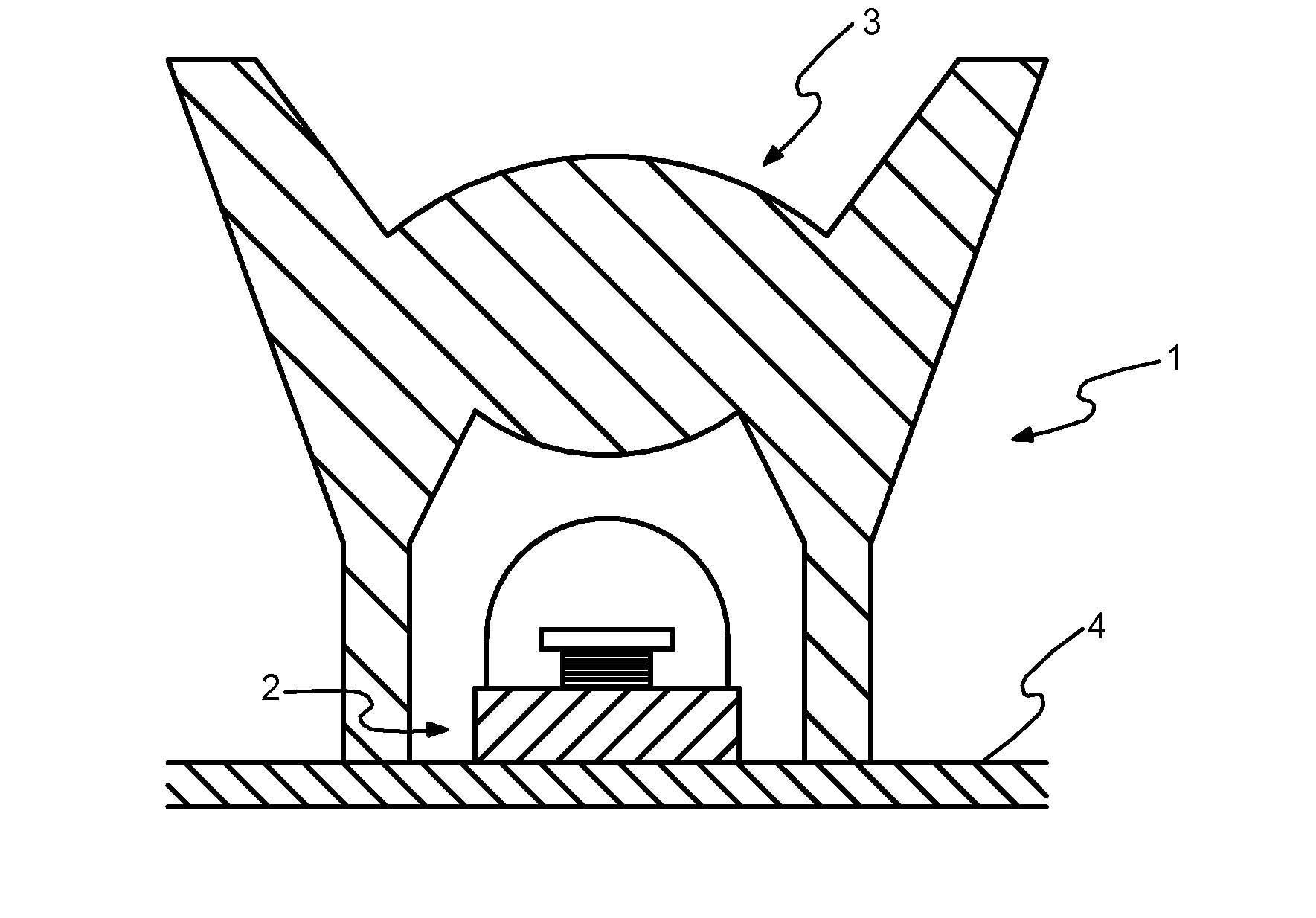
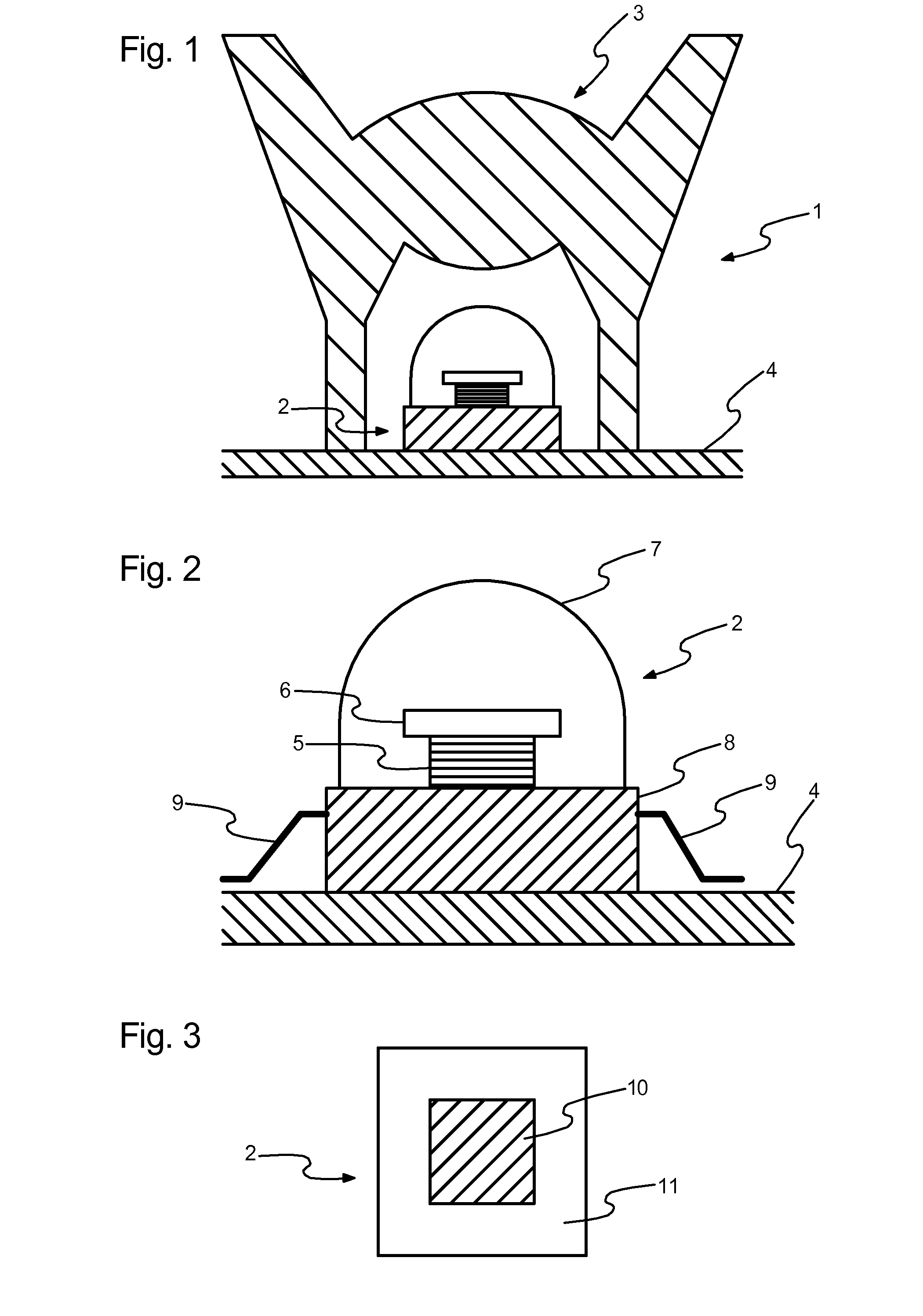
[0054]Referring to the drawings in particular, FIG. 1 shows a radiation source with an optical system as a component of an operating light according to the present invention in a cross-sectional view, as it is used, for example, in operating rooms of hospitals. The radiation source 1 comprises an LED 2 and the optical system 3, wherein the optical system 3 is arranged on a radiation-emitting side of LED 2. The orientation of LED 2 to optical system 3 can be achieved by fastening on a printed circuit board 4 by means of a base 8, for example, by soldering. The printed circuit board 4 also guarantees the power supply of LED 2 via contact tabs 9.
[0055]As is shown in FIG. 2, light source 1 comprises LED 2 emitting white light with a blue-emitting chip 5. A phosphor converting into “yellow” light, which is designed as a phosphor layer 6 here, is applied on the radiation-emitting side of LED 2. Furthermore, a primary lens 7 is provided, which increases the uncoupling efficiency. The area ...
PUM
 Login to View More
 Abstract
Description
Claims
Application Information
 Login to View More