Methods for Single Signon (SSO) Using Decentralized Password and Credential Management

US20130166918A1Active Publication Date: 2013-06-27SHAHBAZI MAJID +1
13 Cites 111 Cited by

Patent Information

Authority / Receiving Office
US · United States
Current Assignee / Owner
Publication Date
2013-06-27

Smart Images

  • Figure 1
    Figure 1
  • Figure 2
    Figure 2
  • Figure 3
    Figure 3
Patent Text Reader

Abstract

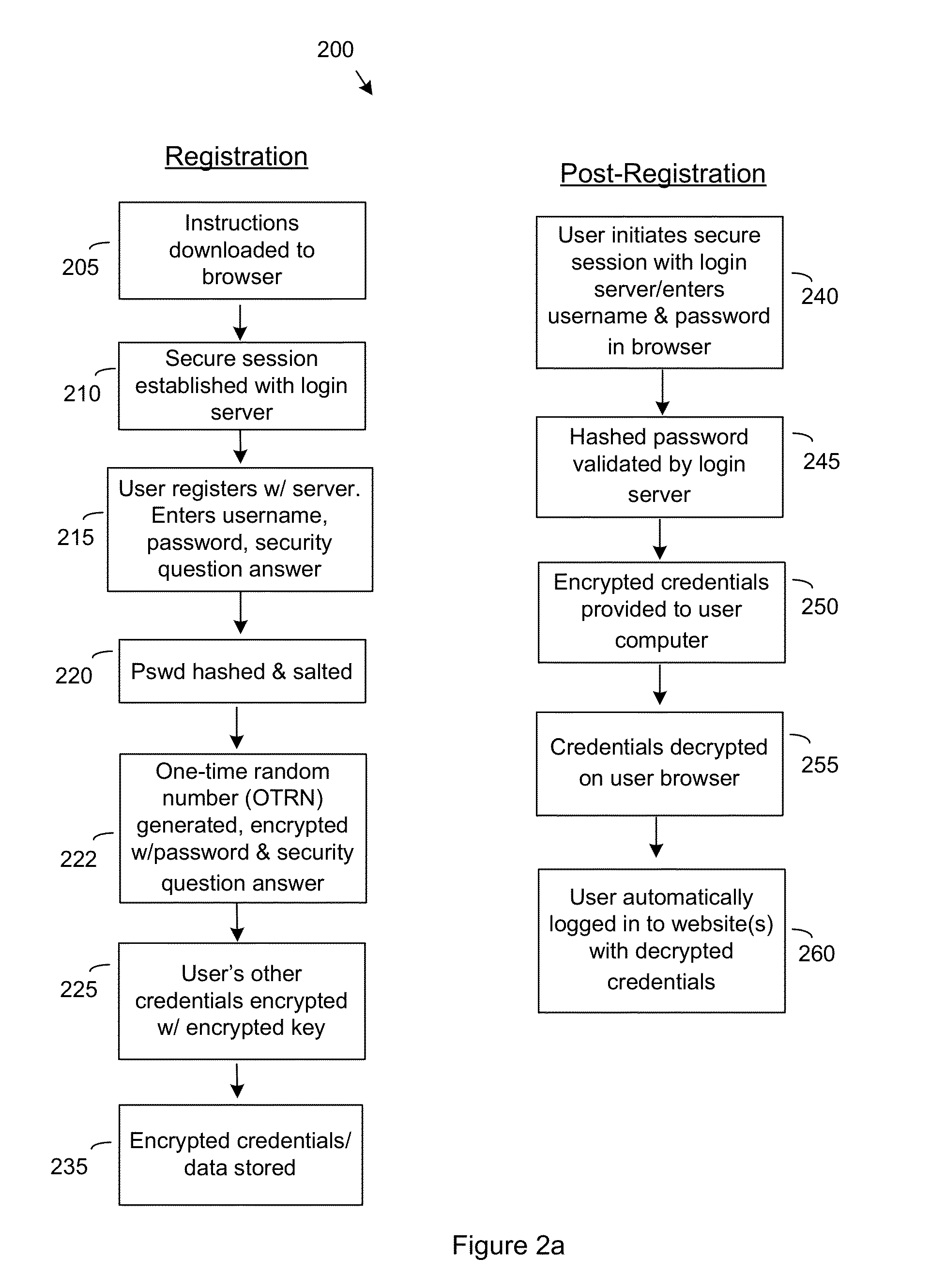
A method for single sign-on (SSO) that provides decentralized credential management using end-to-end security. Credential (and other personal user information) management is decentralized in that encryption is performed locally on the user's computer. The user's encrypted credentials may be stored by the login server and / or a plurality of distributed servers / databases (such as a cloud). The login server never has access to the user's credentials or other personal information. When the user wants to use single sign-on, he enters his password into his browser and the browser submits the encrypted / hashed password to the login server for validation. Upon validation, the browser receives the user's encrypted credentials. The credentials are decrypted by the browser and provided to relevant websites to automatically log the user in.
Need to check novelty before this filing date? Find Prior Art

Description

FIELD OF THE INVENTION

[0001] The present disclosure relates generally to secure digital communication, and more particularly to decentralized credential management.BACKGROUND OF THE INVENTION

[0002] Today, users are conducting online transactions at an ever increasing rate. In light of this phenomenon, it is not uncommon for a user to have anywhere from twenty to eighty, or more, separate online accounts. Examples of such accounts may include, email, news, social networking sites, online banking, music, movies, games, online auctions, shopping, and more. Typically, a user must possess a separate ID and password to access each of these accounts.

[0003] One ongoing dilemma concerning passwords, is that as computer processing capabilities increase, passwords must become longer and more complex to be considered “secure.” The problem is that, it is difficult for users to remember more than just a handful of different passwords at a time. As a result, users often “recycle” their passwords (oft...

Examples

Embodiment Construction

[0030]Reference will now be made in detail to various exemplary embodiments of the invention, examples of which are illustrated in the accompanying drawings. The following detailed description describes certain embodiments of the invention, and should not be considered as limiting the invention to those embodiments. In addition, it is understood that “a” refers to one, or more; and that the terms “user device” and “user computer” are referenced interchangeably. It is further appreciated that “user computer” or “user device” also encompasses background processes, webservices, etc. that can perform single sign-on and is therefore not limited to single sign-on for individuals.

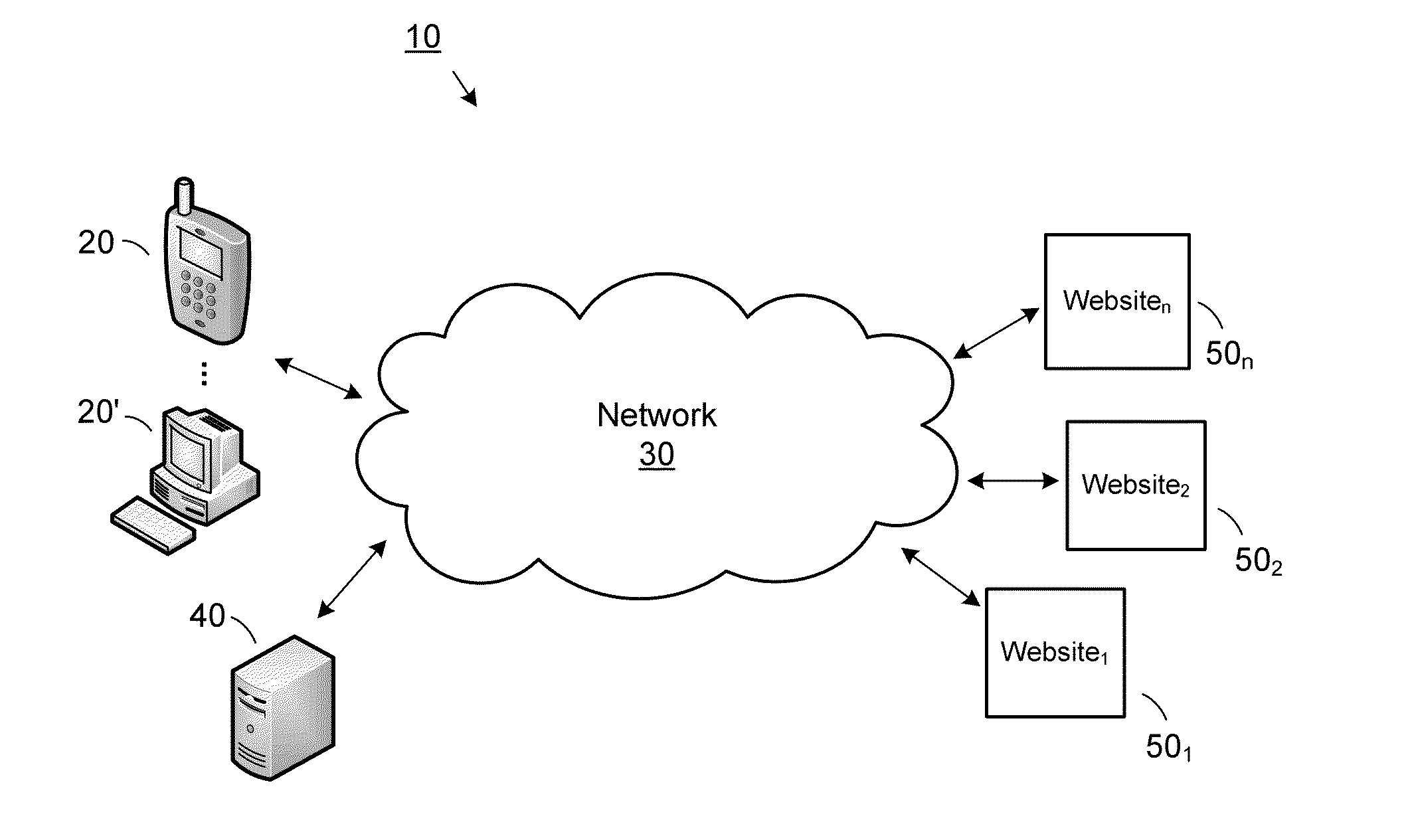
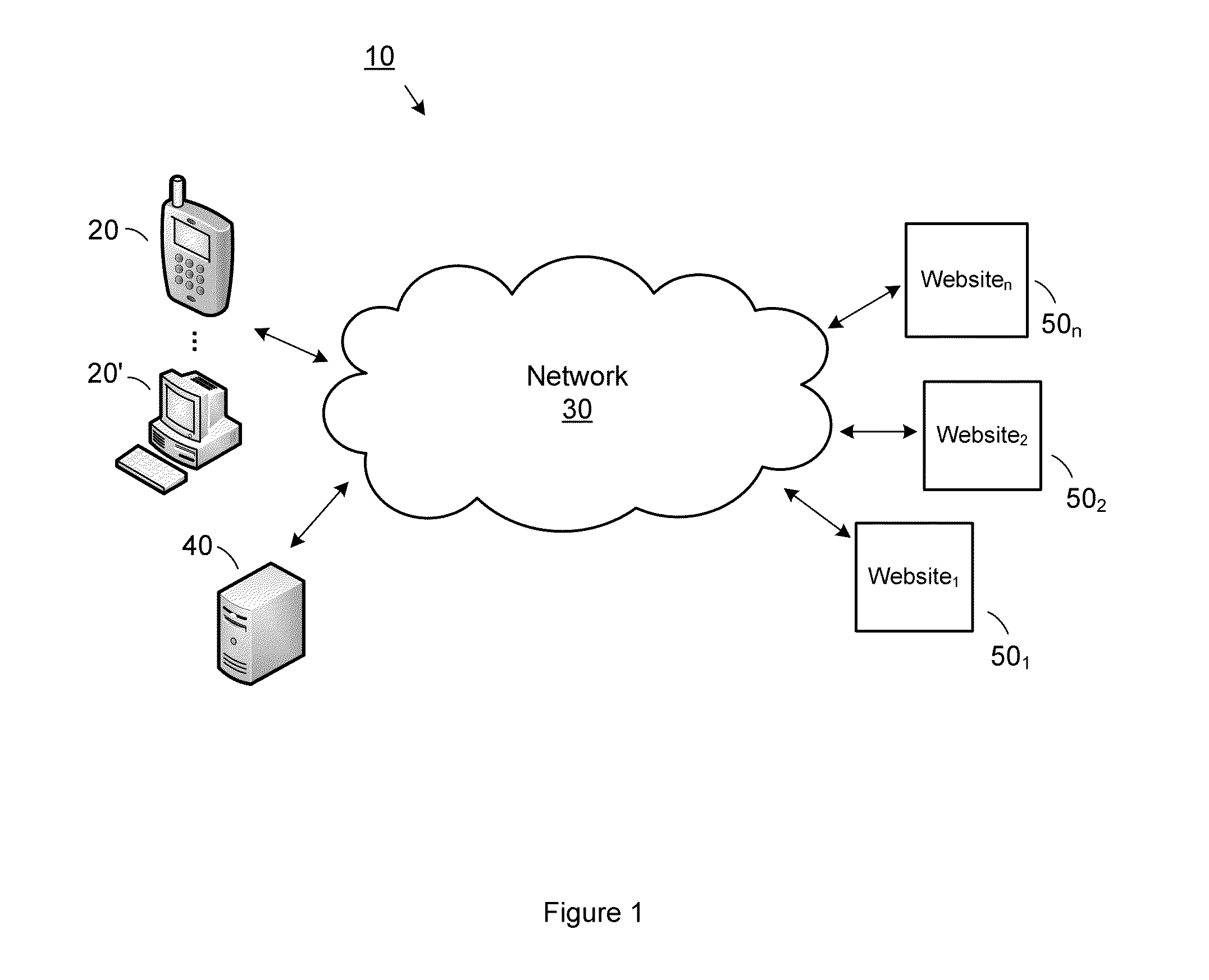
[0031]Turning now to the figures, which depict various exemplary embodiments of the invention, FIG. 1 shows a block diagram of an exemplary system in which the present disclosure may be practiced (as designated by reference numeral 10). As illustrated, the system comprises a user computer 20 communatively coupled ...