
Calibration of radiation therapy treatment plans for a system
a radiation therapy treatment plan and system technology, applied in radiation therapy, medical science, therapy, etc., can solve the problems of no unified formal proof presented, no unifying metric tool provided,
- Summary
- Abstract
- Description
- Claims
- Application Information
AI Technical Summary
Benefits of technology
Problems solved by technology
Method used
Image

Examples
application examples
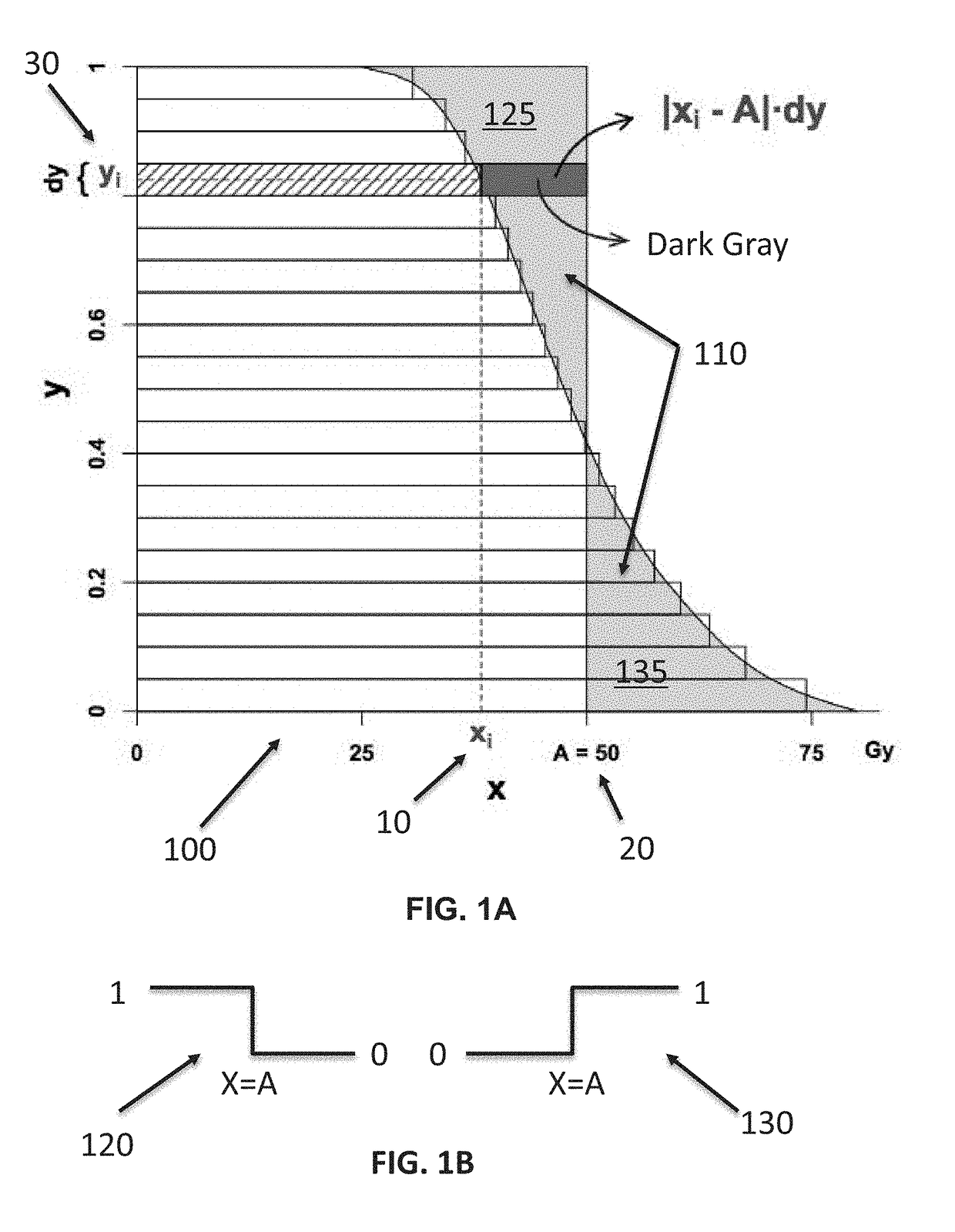
[0061]FIGS. 1A and 2 show the area M (A:A=50 Gy) for a target in which the prescribed dose is 50 Gy, any dose different from 50 Gy is a deviation from the prescription. Note that owing to the use of absolute deviation, there is no dependence on the sign of the deviation. Whether the deviation is a lack of dose (FIG. 1A) or an excess of dose (FIG. 2), the computational procedure is the same. FIG. 3 shows the area M (A:A=0 Gy) for an organ at risk. Note that physically, there can be no negative dose, hence there is no 0 to a non-target structure is an excess dose.
[0062]The MADD was applied to the case of a right breast cancer patient receiving post-conserving surgery adjuvant radiation with a volumetric arc technique. The dose prescribed to the breast was 42 Gy over 15 fractions, with a simultaneous integrated boost resulting in a cumulative dose of 51 Gy to the tumor bed. FIGS. 4A-4F shows the DVH for the breast planning target volume (“PTV”), the tumor bed, the heart, the ipsilatera...
PUM
 Login to View More
 Abstract
Description
Claims
Application Information
 Login to View More