Moreover, incorporating a mechanical unit in the apparatus for automatically conveying cartridges maintaining precision requires laborious work as well as considerable expense.
As the apparatus is designed to operate automatically, furthermore, it is required to operate unattended.
Even when the apparatus for automatically conveying cartridges is coupled to a
library unit to automatically convey the cartridges, however, it is not possible to automatically convey the cartridges when there are included cartridges from which the leader block has been pulled out or when the detector mechanisms have been broken in the apparatus for automatically conveying the cartridges.
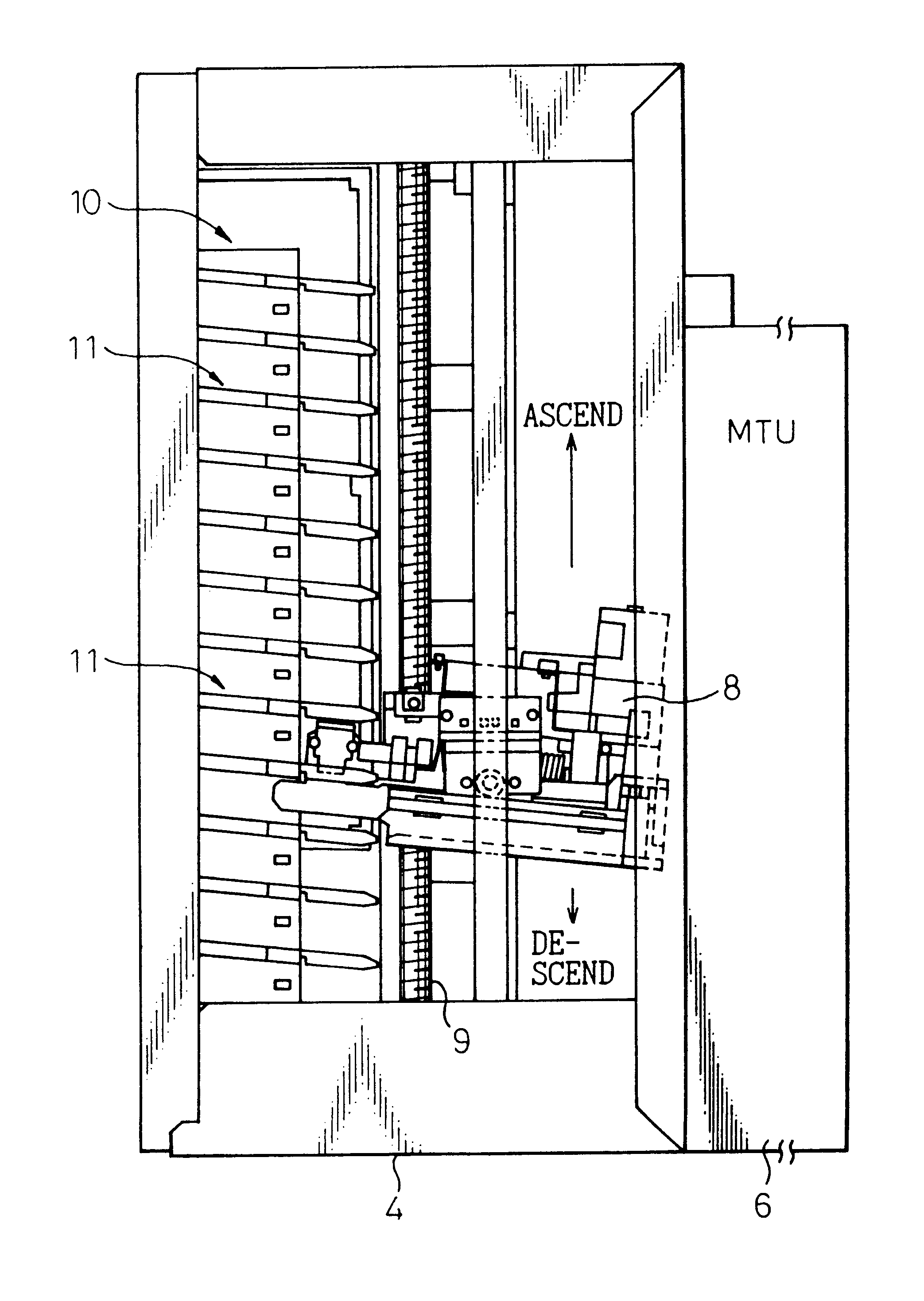
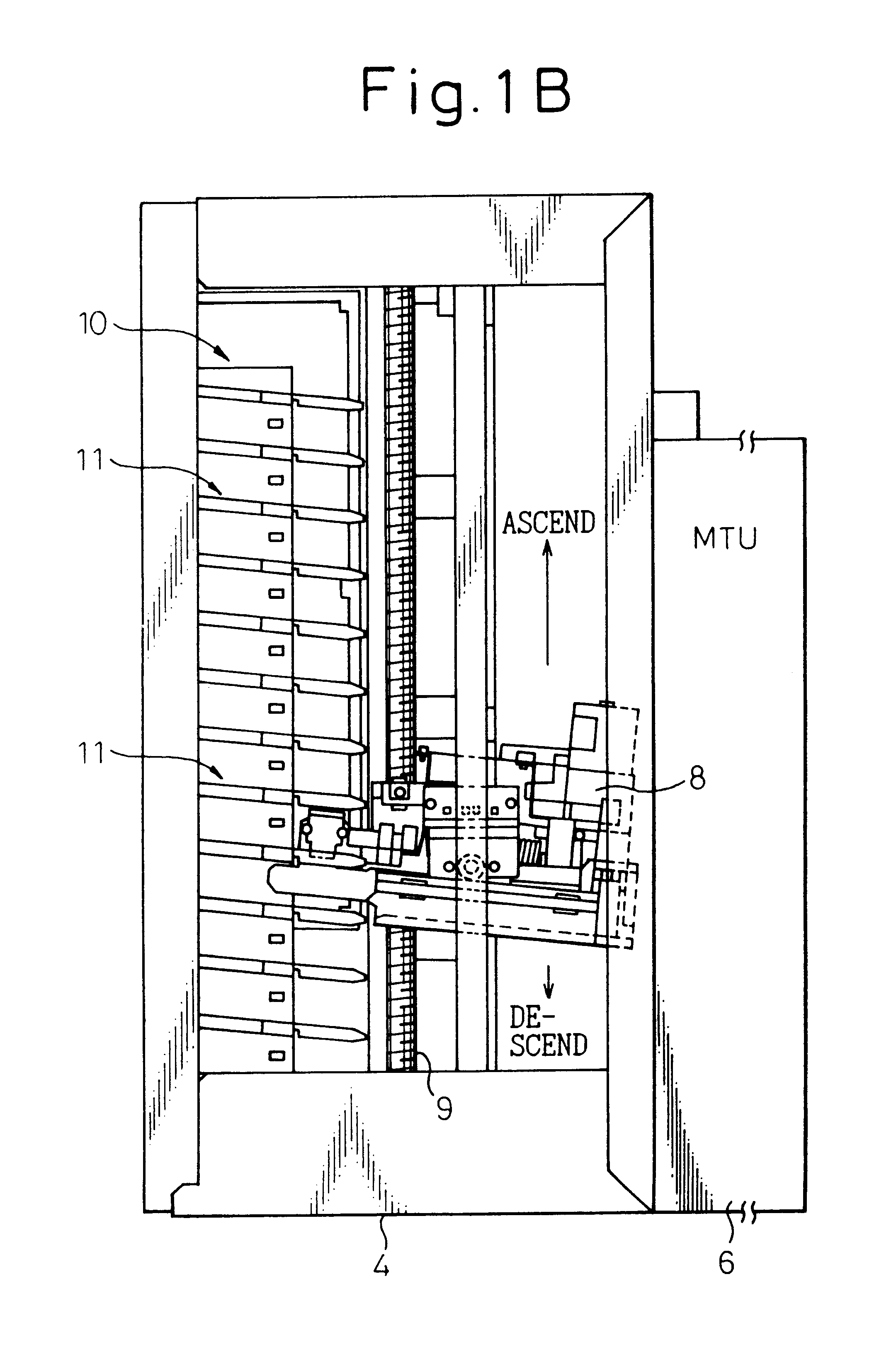
When the power source circuit is closed or an error has occurred, however, the accessor 8 is not initialized.
The conventional apparatus has not been equipped with a function for automatically discriminating a new ACL apparatus or an old ACL apparatus.
This makes it difficult to determine the number of the cartridges by the
software that manages the
library unit 12.
However, an extended
access time is required since the retrying is effected each time.
3 When the rack and the accessor 8 are deviated from each other, the cartridge is not taken out from the rack or the cartridge is not returned back to the rack, resulting in an error.
When such an event occurs in the batch job during the night, however, the
processing must be interrupted.
Therefore, the
processing is interrupted during this period often resulting in a tremendous amount of damage.
When the leader block has been pulled out, therefore, there arises a problem in that the cartridge cannot be loaded into the
library unit 12 when the cartridge is taken out from the exit
cell 14 in the ACL apparatus 5 for attachment to a library unit and is loaded into the MTU (MTU in the library unit 12) which is not prepared to cope with the cartridges into which the leader block has not been pushed.
Therefore, overrunning of a predetermined amount is not accomplished.
Therefore, the accessor 8 ascends or descends in a state where the cartridge has been missed or the cartridge has not been properly held in the accessor 8, causing the cartridge to be broken or the apparatus to be damaged.
Despite the feeder mechanism being retried, therefore, the cartridge is neither fed nor returned, and an error occurs.
In the conventional control operation, therefore, there is no guarantee that the cartridge has returned back to the rack, and there remains a possibility that the cartridge is erroneously recognized to have returned back to the rack though it has not really returned back to the rack due to some obstacle like damage to the motor.
There remains a problem in that if the LED of the operator panel breaks, it becomes difficult to determine whether the cartridge is the one that has not been processed or not.
When the data related to the types of the apparatuses are to be set, however, the operation involves mistakes, and the operator must set the data again requiring a cumbersome operation.
Furthermore, when the two firmwares are employed, i.e., when the respective firmwares are input to different apparatuses, it becomes impossible to operate the
system and mistakes are inevitably involved in the operation.
When a cartridge exists on the rack of the exit cell, it is not possible to
discharge the cartridge in the recording / reproducing apparatus (MTU 6).
However, if the presence-of-cartridge detector mechanism is not working properly, it may appear that the cartridge is present on the rack of the exit cell though it is really not present thereon.
When the cartridge was loaded onto the rack in an inclined manner, the cartridge, could not be detected and could not be processed.
Therefore, the feeder belts are not partly worn out but are entirely worn out.
When the cartridge that was being returned back to the rack was not detected by the detector mechanisms 1, 2 of the rack side, there was a probability that the cartridge may be missed even when it is not properly placed on the cell.


 Login to View More
  Login to View More