
Data processing system and method for dynamically setting bus clock frequency in response to a number of loads
a data processing system and bus clock frequency technology, applied in the field of data processing methods and systems, can solve the problem of the limit of the bus clock frequency on the number of loads connected to the bus
- Summary
- Abstract
- Description
- Claims
- Application Information
AI Technical Summary
Problems solved by technology
Method used
Image

Examples
Embodiment Construction
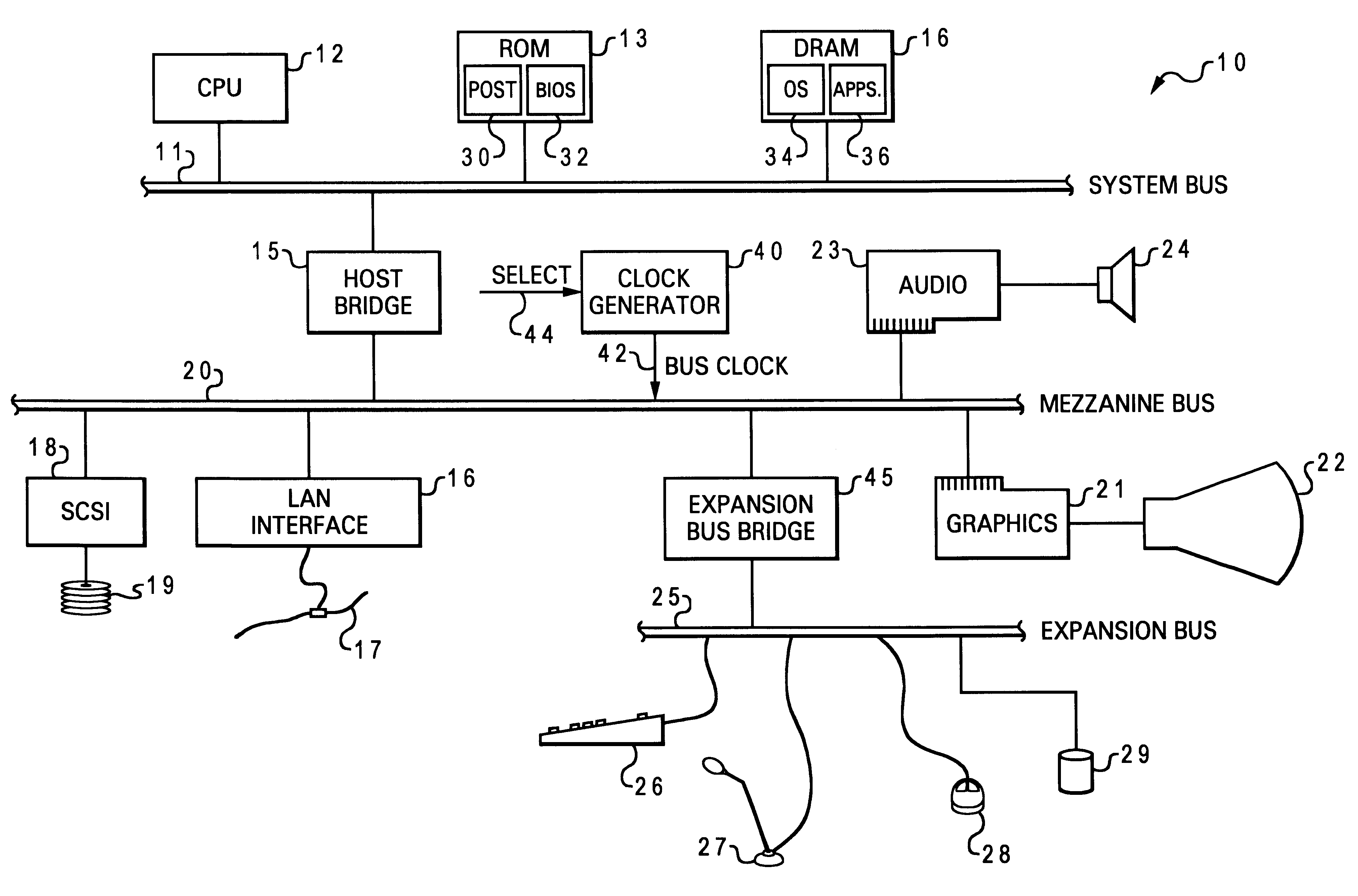
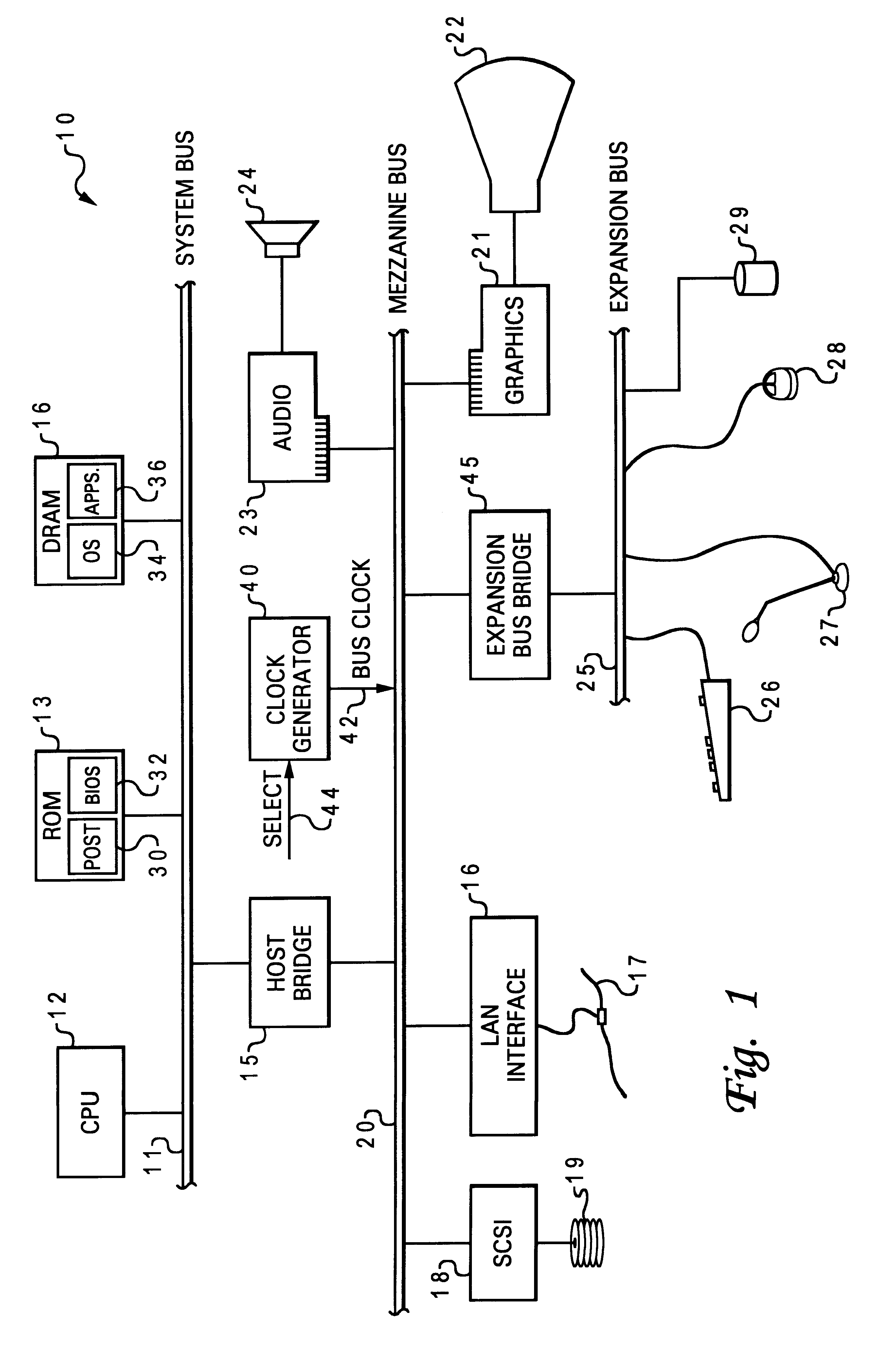
With reference now to the figures and in particular with reference to FIG. 1, there is depicted an illustrative embodiment of a data processing system with which the present invention may advantageously be utilized. As illustrated, data processing system 10, which may comprise a personal computer system, includes a central processing unit (CPU) 12, a read only memory (ROM) 13, and a dynamic random access memory (DRAM) 14, which are each connected to system bus 11. ROM 13 stores boot code, including Power-On Self Test (POST) 30 and Basic Input / Output System (BIOS) 32, which are executed by CPU 12 at power on. Following power on, CPU 12 typically executes operating system (OS) and application software (shown at reference numerals 34 and 36, respectively) stored within DRAM 14.
System bus 11 is coupled, via host bridge 15, to mezzanine bus 20, which can be implemented as a local bus or a pseudo-local bus such as a Peripheral Component Interconnect (PCI) bus. Host bridge 15 provides a lo...
PUM
 Login to View More
 Abstract
Description
Claims
Application Information
 Login to View More