
Beta sheet breaker peptide analogs that inhibit beta pleated sheet formation in amyloid beta-peptide
a technology of amyloid beta-peptide and peptide analogs, which is applied in the field of peptide analogs and peptide mimetics of beta-sheet breaker peptides, can solve the problems of neurodegenerative problems, loss of short-term memory, disorientation, and impairment of judgment and reasoning, and the development of peptide drugs is strongly limited
- Summary
- Abstract
- Description
- Claims
- Application Information
AI Technical Summary
Problems solved by technology
Method used
Image

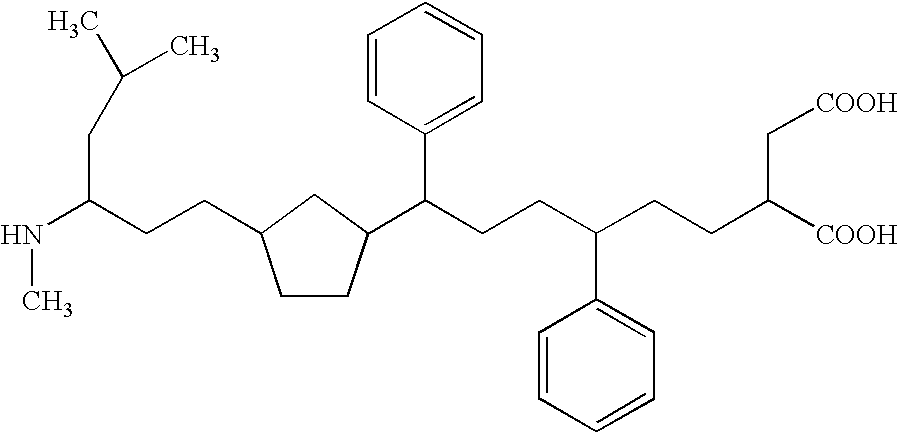

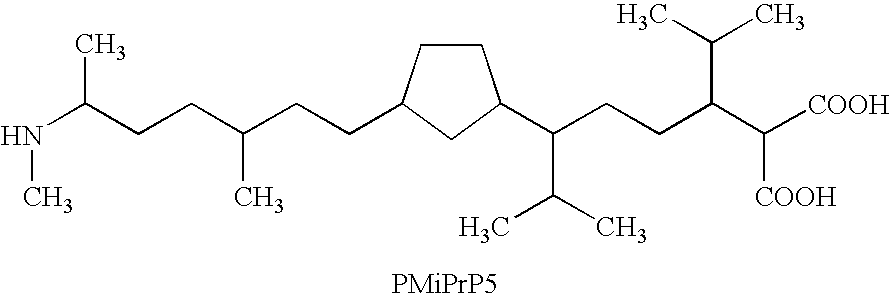
Examples
Embodiment Construction
One of the major drawbacks for the use of peptides as drugs is their rapid proteolytic degradation in biological fluids and tissues. In in vitro experiments, iA.beta.5, (Seq LPFFD- also depicted as Leu Pro Phe Phe Asp herein) degraded very quickly in vitro after incubation with fresh human plasma. As shown in FIG. 4a, fifty percent of the peptide iA.beta.5 disappeared in approximately 5 minutes in the presence of plasma. Since it was not possible to identify any metabolic fragments as a result of the proteolytic digestion, it seems likely that the degradation is mainly done by unspecific exopeptidases. This conclusion is supported by the finding that protection of amino- and carboxy-terminus of the peptide by acetylation and amidation, respectively, (to form Ac-iA.beta.5-Am--also depicted as Ac-Leu Pro Phe Phe Asp-Am herein) dramatically increases the stability of the peptide in vitro. As shown in FIG. 4b, the end-protected modified peptide of the present invention (Ac-iA.beta.5-Am)...
PUM
| Property | Measurement | Unit |
|---|---|---|
| Composition | aaaaa | aaaaa |
| Inhibition | aaaaa | aaaaa |
Abstract
Description
Claims
Application Information
 Login to View More