Sequential combined QPCH demodulation

a combined qpch and frequency technology, applied in the field of wireless communication systems, can solve the problems of reducing the battery life and associated standby time, reducing the phone battery life and reducing the power consumption of the phone, and drawing excess power

US6771616B2Inactive Publication Date: 2004-08-03QUALCOMM INC
11 Cites 10 Cited by

Patent Information

Authority / Receiving Office
US · United States
Patent Type
Patents(United States)
Current Assignee / Owner
Publication Date
2004-08-03
Estimated Expiration
Not applicable · inactive patent

Smart Images

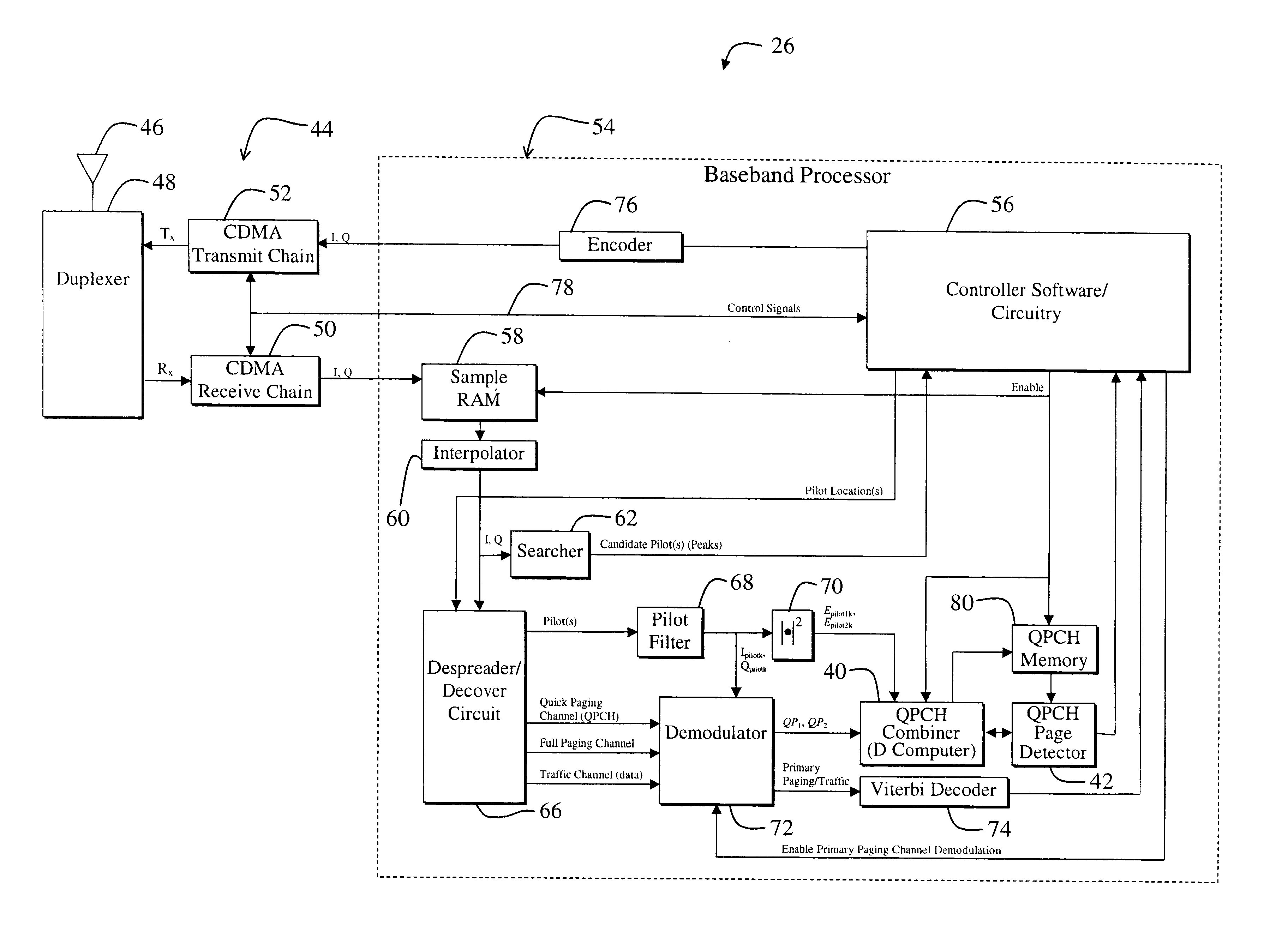
  • Figure 1
    Figure 1
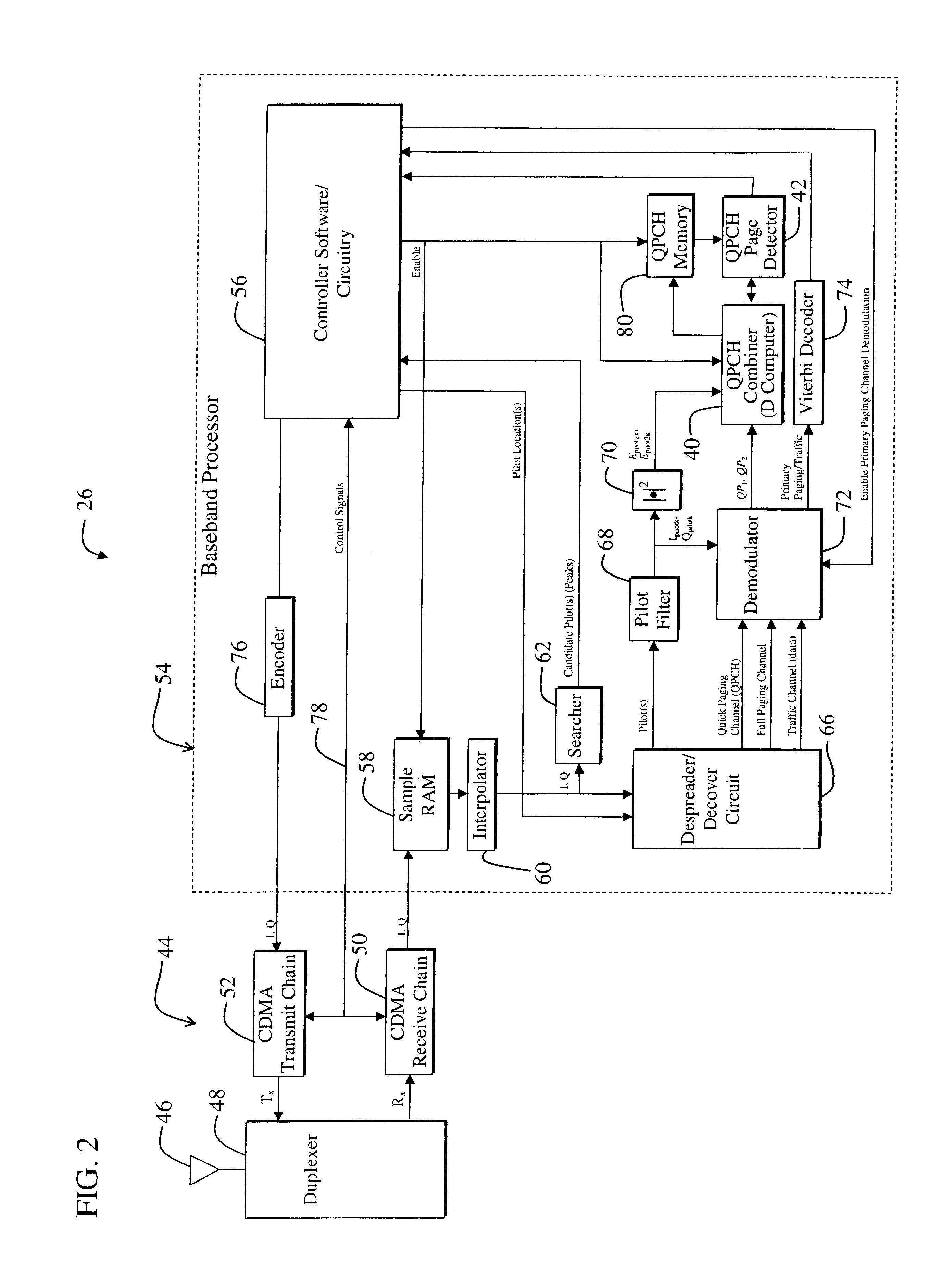
  • Figure 2
    Figure 2
  • Figure 3
    Figure 3
Patent Text Reader

Abstract

A system determines if a primary paging channel should be received based on an examination of a quick paging channel. A first QPCH symbol is examined (102) and the normalized pilot energy is determined (104). If the normalized pilot energy is above a first threshold (106), the symbol is demodulated and the QPCH-symbol-to-pilot-energy ratio is determined (110) and compared against another threshold (114). If the normalized pilot energy is below the first threshold, the system proceeds to the second QPCH symbol immediately. Based on the two comparisons, a second QPCH signal is examined (108) or the system sleeps (116). If the second signal is examined, and if its normalized pilot energy is high enough, it also is demodulated and the ratio of the sum-of-the-combined-QPCH-symbols to the sum-of-the-combined-pilot-energies is determined (122). If this ratio exceeds a threshold (124), the primary paging channel is processed (120); otherwise the system sleeps (116).
Need to check novelty before this filing date? Find Prior Art

Description

1. Field of InventionThis invention relates to wireless communications systems. Specifically, the present invention relates to receivers for demodulating quick paging channels in communications systems employing more than one paging channel to facilitate offline processing.2. Description of the Related ArtWireless communications systems are employed in a variety of demanding applications ranging from search and rescue to Internet applications. Such applications require reliable, cost-effective, and space-efficient communications systems with accompanying wireless phones having maximum battery life and associated standby time.Cellular telecommunications systems, such as Code Division Multiple access (CDMA) communications systems, are often characterized by a plurality of mobile stations (e.g. cellular telephones, mobile units, wireless telephones, or mobile phones) in communication with one or more Base Station Transceiver Subsystems (BTS's). Signals transmitted by the mobile station...

Examples

Embodiment Construction

While the present invention is described herein with reference to illustrative embodiments for particular applications, it should be understood that the invention is not limited thereto. Those having ordinary skill in the art and access to the teachings provided herein will recognize additional modifications, applications, and embodiments within the scope thereof and additional fields in which the present invention would be of significant utility.

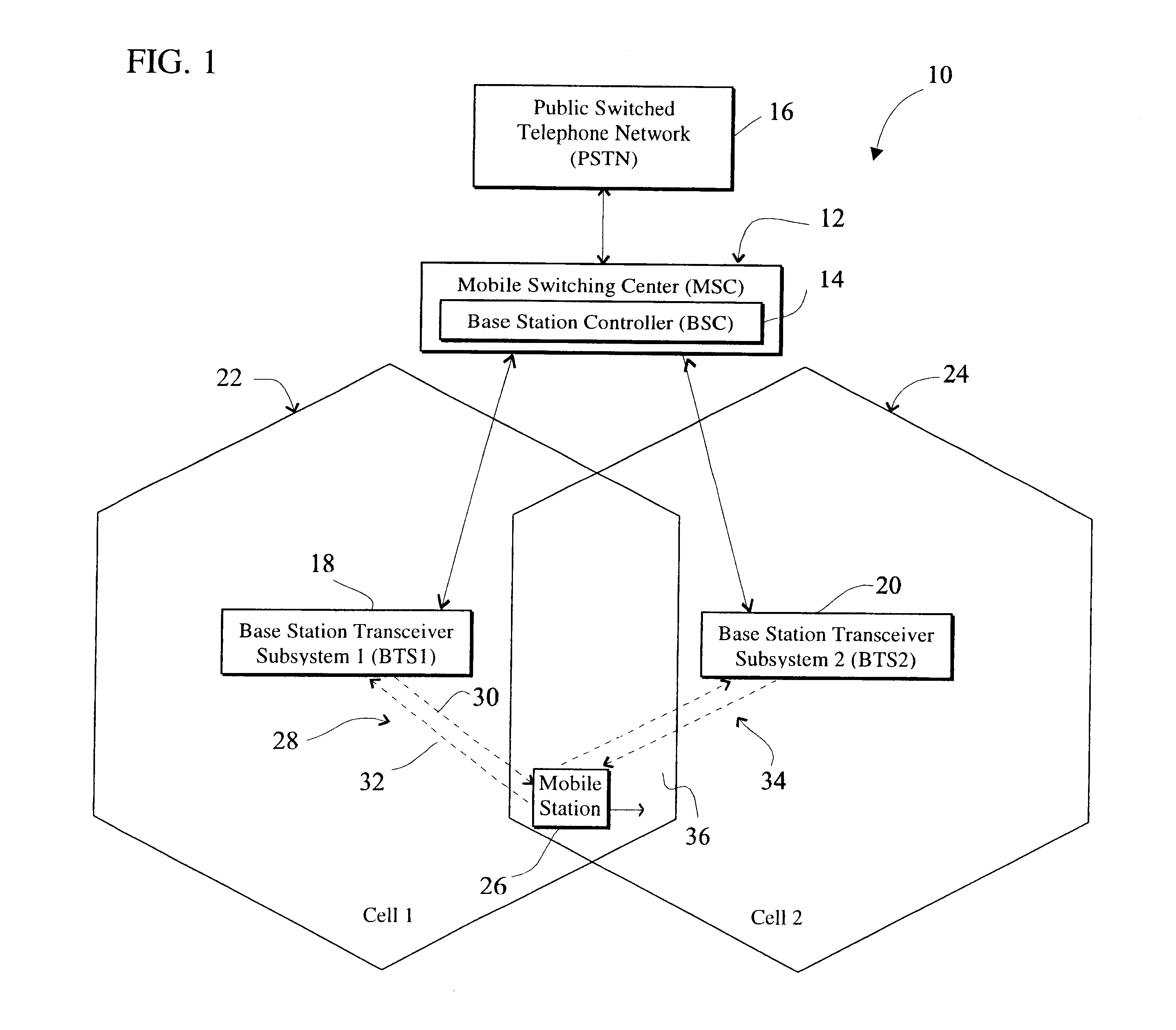
FIG. 1 is a block diagram of an exemplary wireless communications system 10 for which the present invention is adapted. The system 10 includes a Mobile Switching Center (MSC) 12 having a Base Station Controller (BSC) 14. A Public Switched Telephone Network (PSTN) 16 routes calls from telephone lines and other networks and communications devices (not shown) to and from the MSC 12. The MSC 12 routes calls from the PSTN 16 to and from a first BTS 18 and a second BTS 20 associated with a first cell 22 and a second cell 24, respectively. The BTS...