
Subscriber station, network control means and method for carrying out inter-frequency measurements in a mobile communication system
a mobile communication system and subscriber station technology, applied in the direction of electrical equipment, power management, wireless commuication services, etc., can solve the problems of long time needed for handover, system configuration may become complicated, and the quality of data transmission service is degraded
- Summary
- Abstract
- Description
- Claims
- Application Information
AI Technical Summary
Benefits of technology
Problems solved by technology
Method used
Image

Examples
first embodiment
of the Invention
[0090]In general, in a communication system one can distinguish different types of services, i.e. delay-sensitive or loss-sensitive services. If the service type is delay-sensitive, then it is most important, to some extent, that the transmitted information will be received in time rather than it is free of errors. E.g. voice is a delay-sensitive transmission.
[0091]On the other hand, if the service-type is loss-sensitive, then it is important that the information will be received with no more errors than the decoder in the subscriber station or the network control means can correct. If a packet contains unrecoverable errors then it is interpreted as lost.
[0092]For example, web-browsing is a loss-sensitive service, since it does not matter whether the information arrives earlier or later.
[0093]The first embodiment of the invention relates to a situation how a minimizing or a reduction of the quality of service QoS can be used for inter-frequency measurements for the c...
second embodiment
of the Invention
[0098]According to the second embodiment of the invention a minimization of the reduction of the quality of service QoS can be performed for inter-frequency measurements when a loss-sensitive data transmission is performed between the base transceiver station RBS and the subscriber station MS.
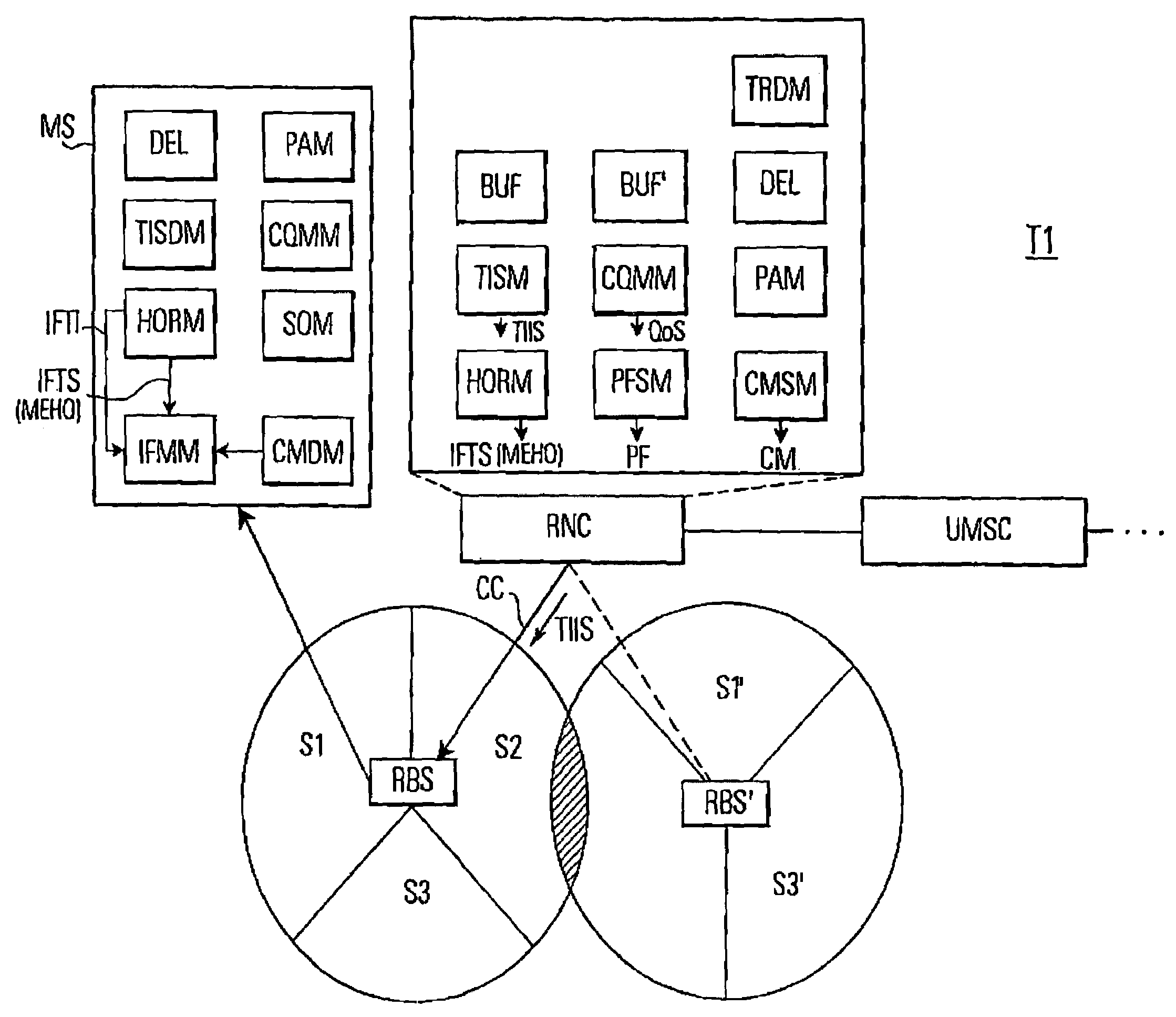
[0099]As shown in FIG. 7, in the network and / or in the network control means RNC a transmission buffer means BUF of a predetermined size is always used for an intermediate storage of the transmission data before it is sent on the down-link of said communication connection. If the connection service type is loss-sensitive, the information flow between the network control means RNC and the subscriber station MS is not dense and the transmission buffer means BUF used during that connection is normally below a specific threshold. Thus, the network control means RNC can request the subscriber station MS to perform measurements on other frequencies / systems in a predetermined time inte...
third embodiment
of the Invention
[0109]According to a third embodiment of the invention the network control means does not use an increase of the power or a reallocation or a rate varying mechanism in order to maintain the quality of service at an acceptable level.
[0110]According to the third embodiment of the invention the IF handover means HORM communicates with a transmission ratio determining means TRDM adapted to determine the ratio between transmitted and received data frames RF and the measurement time it took for this. When this ratio undergoes a specific level, the network has the ability to order the subscriber station MS to perform measurements on other frequencies / systems. However, this prerequisite may not be enough to give the order to perform measurements to the subscriber station MS.
[0111]For example, when the ratio undergoes a specific level, the network can safely assume that the data transmission rate is so low that the currently used buffer transmission means BUF will always be c...
PUM
 Login to View More
 Abstract
Description
Claims
Application Information
 Login to View More