
Medico-surgical devices
a technology of surgical devices and catheters, applied in the field of medical devices, can solve the problems of difficult placement of conventional catheters and relatively low differences, and achieve the effect of low ultrasound reflection and high ultrasound reflection
- Summary
- Abstract
- Description
- Claims
- Application Information
AI Technical Summary
Benefits of technology
Problems solved by technology
Method used
Image

Examples
Embodiment Construction
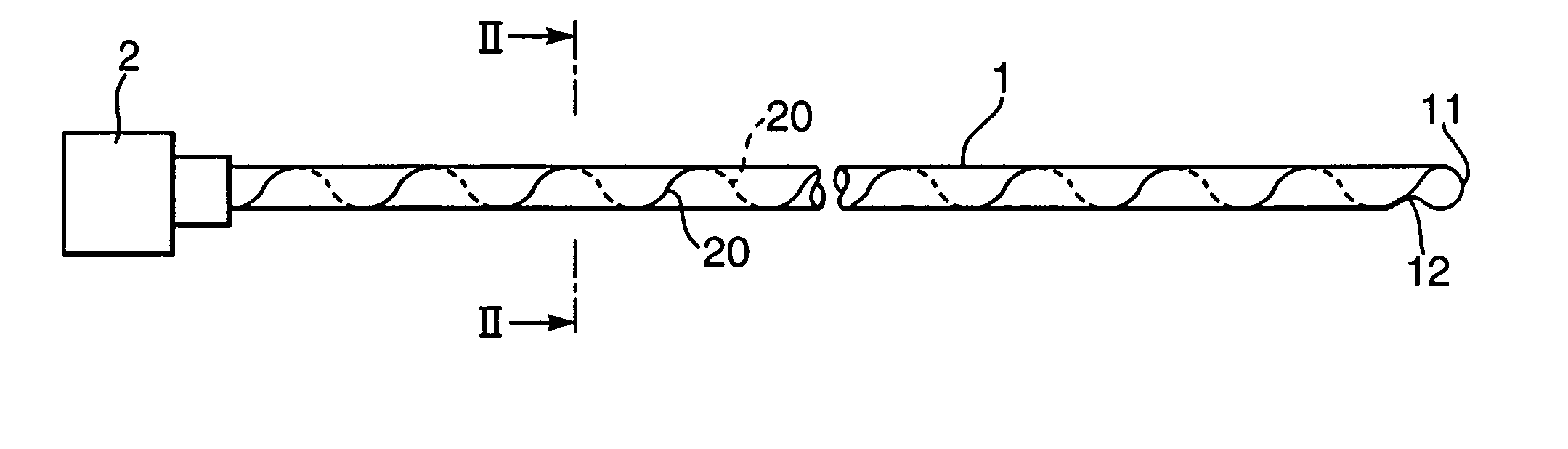
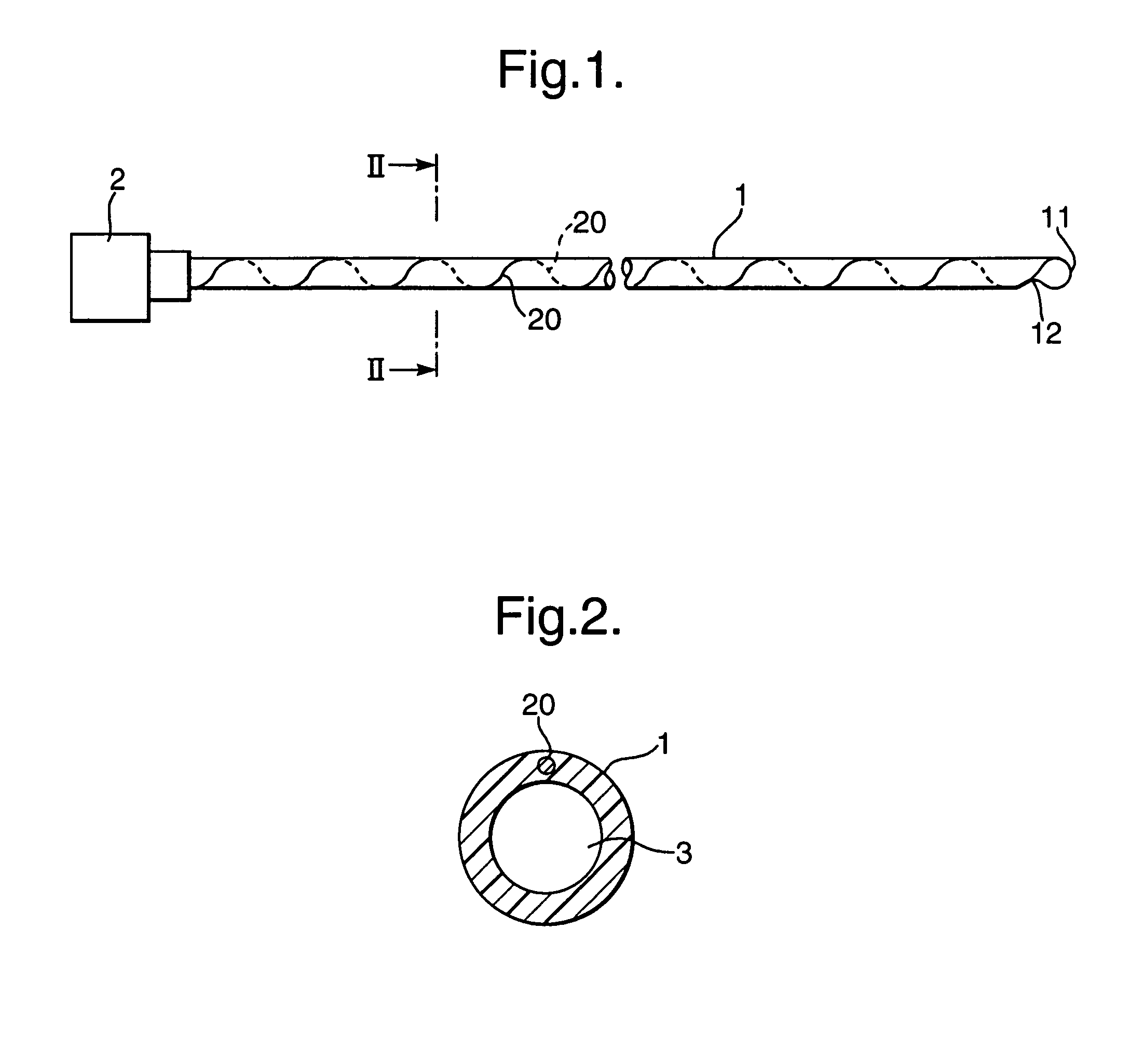
[0011]The catheter comprises an extruded flexible body or shaft 1 of a clear, transparent polyurethane and a hub 2 of polypropylene joined at the rear end of the shaft. The shaft 1 is between about 180 mm and 380 mm long with a circular section and an outer diameter of 1.6 mm. The shaft has a circular bore 3 with a diameter of 1.1 mm. The forward, right-hand, patient end 11 of the catheter is atraumatically rounded and there is a side opening 12 close to the patient end.
[0012]The shaft 1 also has an ultrasound line or marker 20 extruded within its wall. The marker 20 is of an elongate, helical form, extending along the length of the shaft 1 and around its circumference. The path along which the marker extends need not be helical but could be of some other shape that extends along and around the catheter. The marker 20 is selected to reflect a relatively large amount of the ultrasound energy incident on it. This reflectivity may be achieved in various different ways, such as by makin...
PUM
 Login to View More
 Abstract
Description
Claims
Application Information
 Login to View More