
Tactile sensor module with a flexible substrate adapted for use on a curved surface and method of a mounting tactile sensor
a flexible substrate and tactile sensor technology, applied in the field of tactile sensors, can solve the problems of increasing complexity and increasing manufacturing costs, and achieve the effect of reducing costs, increasing costs, and easy construction of tactile sensors
- Summary
- Abstract
- Description
- Claims
- Application Information
AI Technical Summary
Benefits of technology
Problems solved by technology
Method used
Image

Examples
first embodiment
[F] H-Shaped Strip Section
[F-1] Overall Configuration of Tactile Sensor Module
[0078]A description is now given based mainly on FIG. 9 to FIG. 14 of a first embodiment. In the first embodiment, the pressure sensors 3 are provided at strip-shaped body configured from a strip-shaped base section and a plurality of branched strips formed integrally at a distal end of the strip-shaped base section. Specifically, the distal end of the second strip-shaped body 7 is configured from an H-shaped section 9 comprised of a plurality of branched strips. Namely, the second strip-shaped body 7 is comprised of the strip 7A as the strip-shaped base section and the H-shaped section integrally provided at the distal end of the strip 7A. The proximal end of the strip 7A is connected to the strip 6A of the first strip-shaped body 6. The H-shaped section 9 is comprised of two strip-shaped sensing element mounting portions 90, 91 and a strip-shaped connecting portion connecting intermediate portions of two...
example
[F-7] Example
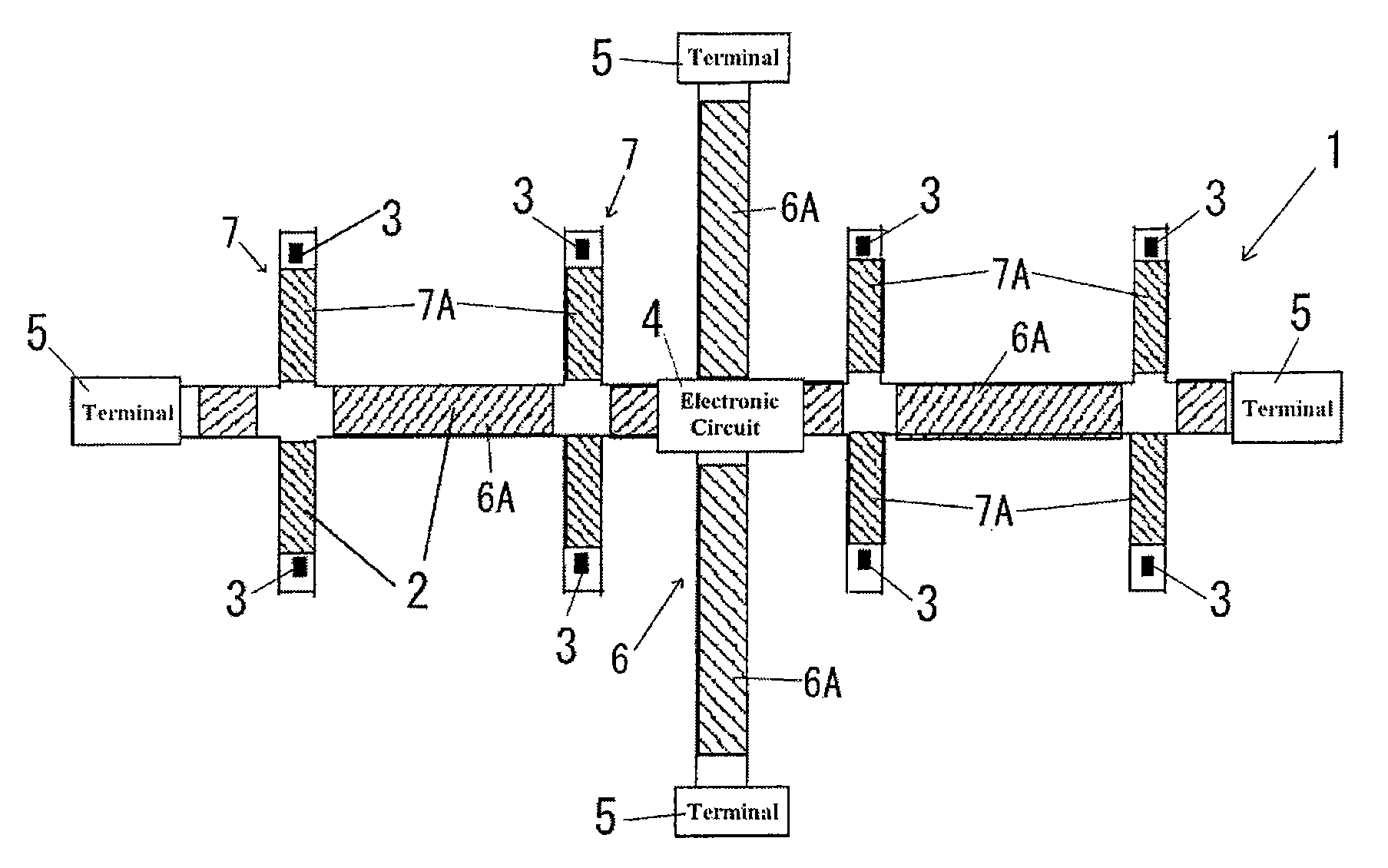
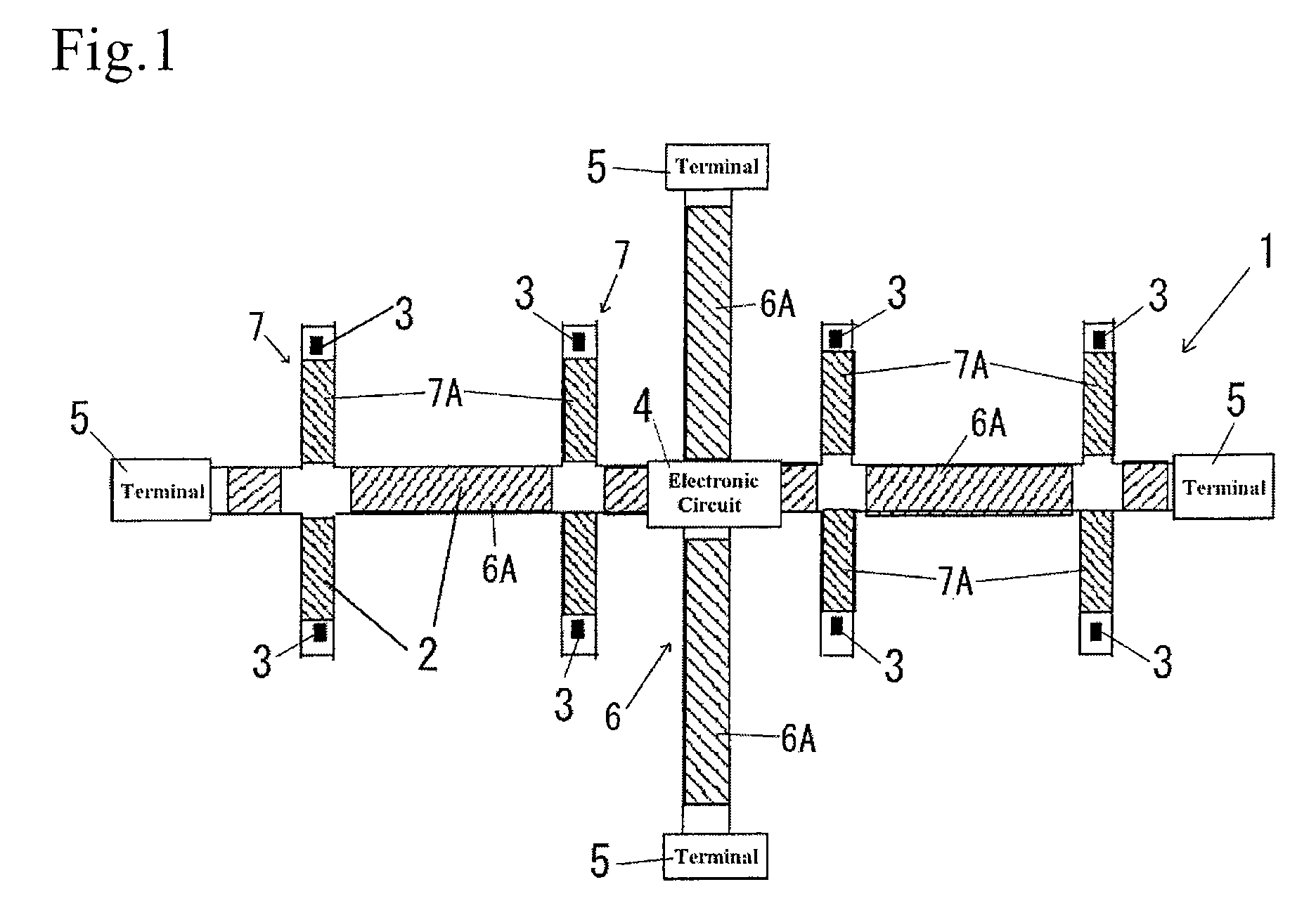
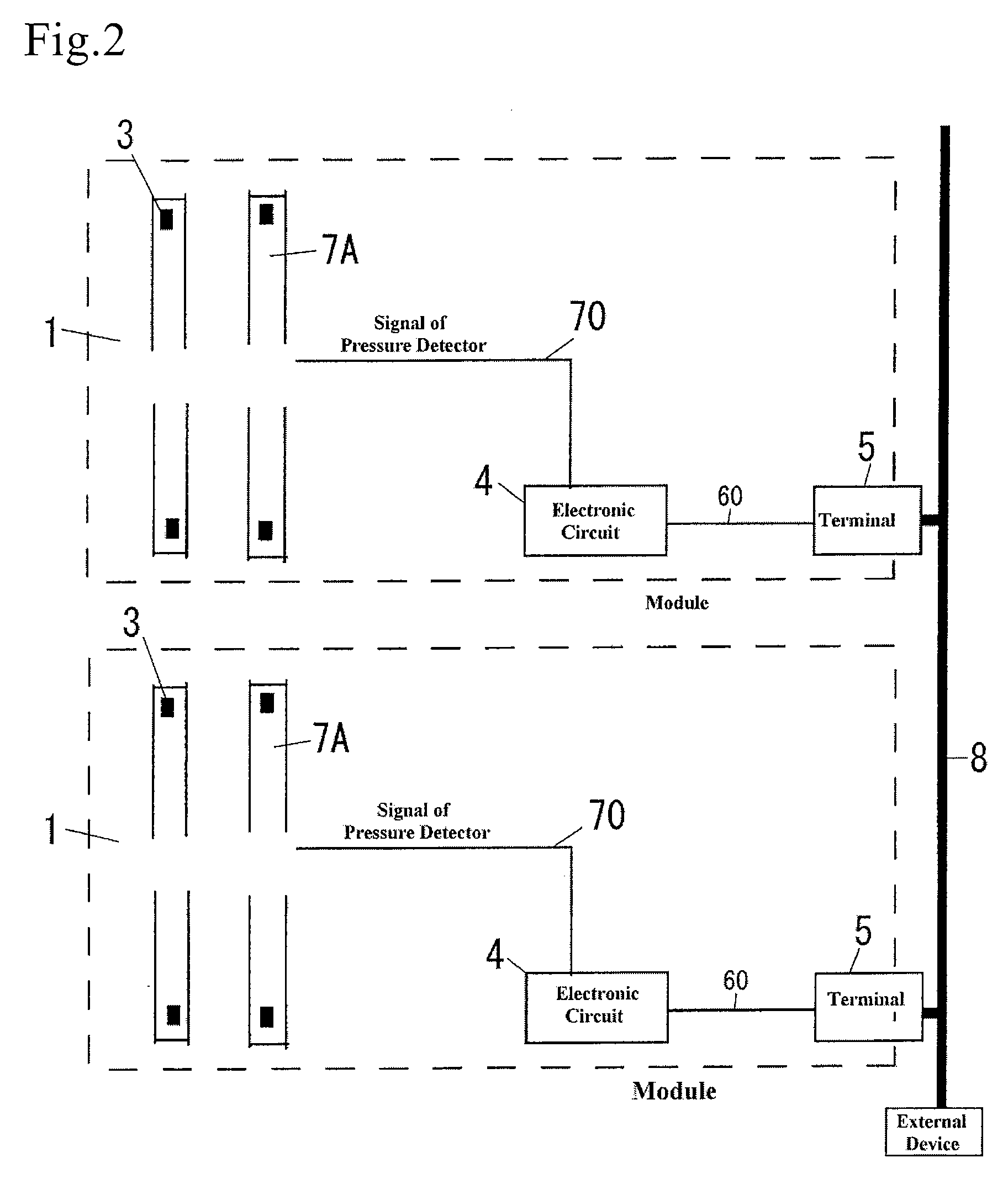
[0095]A description is now given of experimental examples of small-size tactile sensors employing the reflective photointerrupters and urethane shown in the first embodiment. A tactile sensor module is designed, and experiments are carried out regarding sensor functions, communication functions, and functions for connecting between modules. The tactile sensor module comprises thirty-two tactile sensing elements, an electronic circuit section of an 8051 microcomputer (Silicon Laboratories), and a communication terminal capable of connecting the modules. These elements are provided on single flexible substrate such that the module can function by itself as well as function when a plurality of modules are connected together. Four AD converters are prepared for the thirty-two tactile sensing elements and are shared by each eight channels of tactile sensing elements. The four AD converters and the eight channels of LED switches are implemented within a microcontroller. Excel...
second embodiment
[G] Flexible Substrate with a High Degree of Freedom of Arrangement for the Sensing Elements
[0100]An example of changing the substrate shape of the first embodiment is shown. The flexible substrate of the second embodiment is configured from a star structure where a number of strips are coupled together at the base end side. As shown in FIG. 15A, a rectangular flexible substrate is cut vertically in eight places so as to give ten strips, at the center of which the electronic circuit section 4 is located. A communication terminal 5 is provided at a strip 10A at the lower side of the center, with photointerrupters then being arranged at the end portions of the other nine strips 10. By then just folding each strip once in the middle portion, it is possible to arrange the reflective photointerrupters 30 at substantially arbitrary positions within a region on the inside of a circle of a radius of a dimension between the base end sections (bases of the cuts) of the strips 10 and the dista...
PUM
 Login to View More
 Abstract
Description
Claims
Application Information
 Login to View More