
Use of des-aspartate-angiotensin I
a technology of aspartate and angiotensin, which is applied in the field of desaspartate angiotensin i, can solve the problems of unstoppable aid virus spreading far, ever present threat of pandemic flu outbreak, and many adverse effects, so as to reduce hyperglycemia and improve the survival rate of patients. , the effect of treating and/or prophylaxis of viral infections
- Summary
- Abstract
- Description
- Claims
- Application Information
AI Technical Summary
Benefits of technology
Problems solved by technology
Method used
Image

Examples
example 1
Source of Materials
[0062]Des-aspartate-angiotensin was purchased from Bachem (Dubendorf, Switzerland). Des-aspartate-angiotensin I can be prepared by techniques well known in the art. Influenza A / Aichi / 2 / 68 virus and Madin-Darby Canine Kidney cells were purchased from ATCC. The virus has a titer of 106.75 CEID50 / 0.2 ml in 2 days on II day old SPF CE. Six to 7 weeks old female BALB / c mice were obtained from the Animal Center, National University of Singapore. Six to 7 weeks old diabetic KKAy mice were purchased from CLEA, Japan.
example 2
Development of a Mouse Model for Influenza A Virus
[0063]Two BALB / c mice were intranasally infected with 50 μL of influenza A virus. Two days later, the infected mice were sacrificed by cervical dislocation and their lungs were removed. 0.3 g of lung tissue was homogenized in 1 mL of PBS containing 1000 units / L penicillin and 10 μg / L streptomycin. The lung homogenate was cleared of connective tissue by centrifuging at 5,000 rpm for 5 minutes on a bench-top centrifuge. This homogenate was labeled as passage-1 lung homogenate. A second batch of 2 BALB / c mice was infected with 50 μL of passage-1 lung homogenate. The process of passaging was repeated and the virus virulence and titer in each passage of lung homogenate was monitored by assaying its infectivity in Madin-Darby Canine Kidney (MDCK) cells, which is a host cell for influenza A virus. The virulence and titer of the influenza A virus increased progressively with each passage. Fifty μL of passage-6 lung homogenate, equivalent to ...
example 3
Monitoring and Treatment (with Orally-Administered Des-aspartate-angiotensin I) of Influenza A Virus-Infected BALB / c Mice
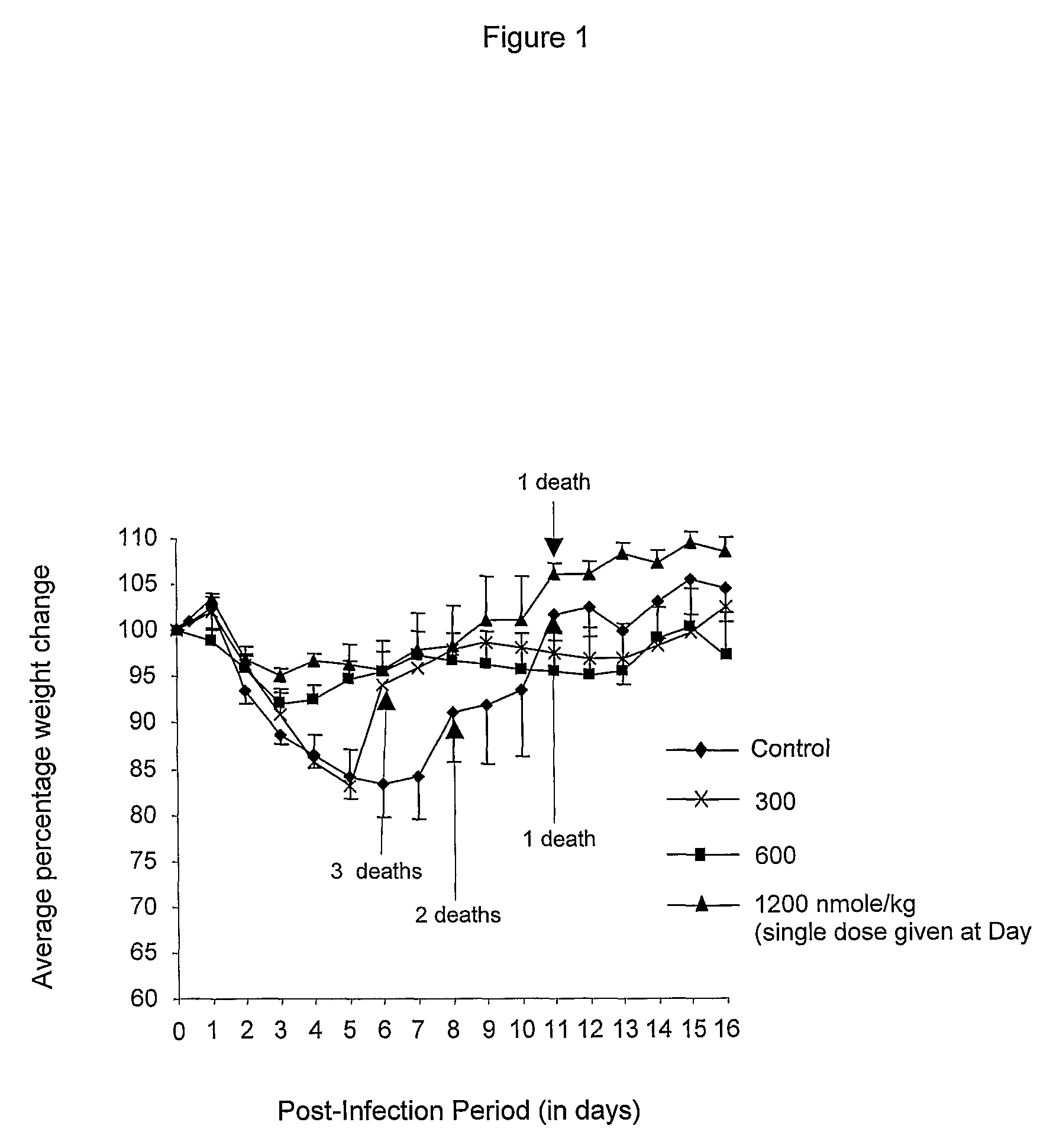
[0064]BALB / c mice when infected with passage-6 lung homogenate lost weight and suffered fatality. The following protocol described by Johasson et al was used to study the effect of des-aspartate-angiotensin on these parameters. Six to 7 weeks old female BALB / c mice were intranasally infected with 50 μL passage-6 lung homogenate. Groups of 5-9 mice were orally administered with one of the following dose of des-aspartate-angiotensin I:—300 nmole / kg daily for 8 days, 600 nmole / kg daily for 8 days, and 1200 nmole / kg on day 2 post virus infection (i.e. only one dose was administered). A group of 8 mice were similarly administered water for 8 days and served as the control group. The weight and survival of the mice were recorded daily for 16 days.
PUM
| Property | Measurement | Unit |
|---|---|---|
| volume | aaaaa | aaaaa |
| weight loss | aaaaa | aaaaa |
| weight | aaaaa | aaaaa |
Abstract
Description
Claims
Application Information
 Login to View More