
System and method for providing question and answers with deferred type evaluation
a question and answer system and deferred type technology, applied in the field of information retrieval systems, can solve the problems of limited effectiveness of methods, inability to answer factual questions based on information included in a collection of documents, and difficulty in determining the type of question and answer, so as to increase the level of confiden
- Summary
- Abstract
- Description
- Claims
- Application Information
AI Technical Summary
Benefits of technology
Problems solved by technology
Method used
Image

Examples
first embodiment
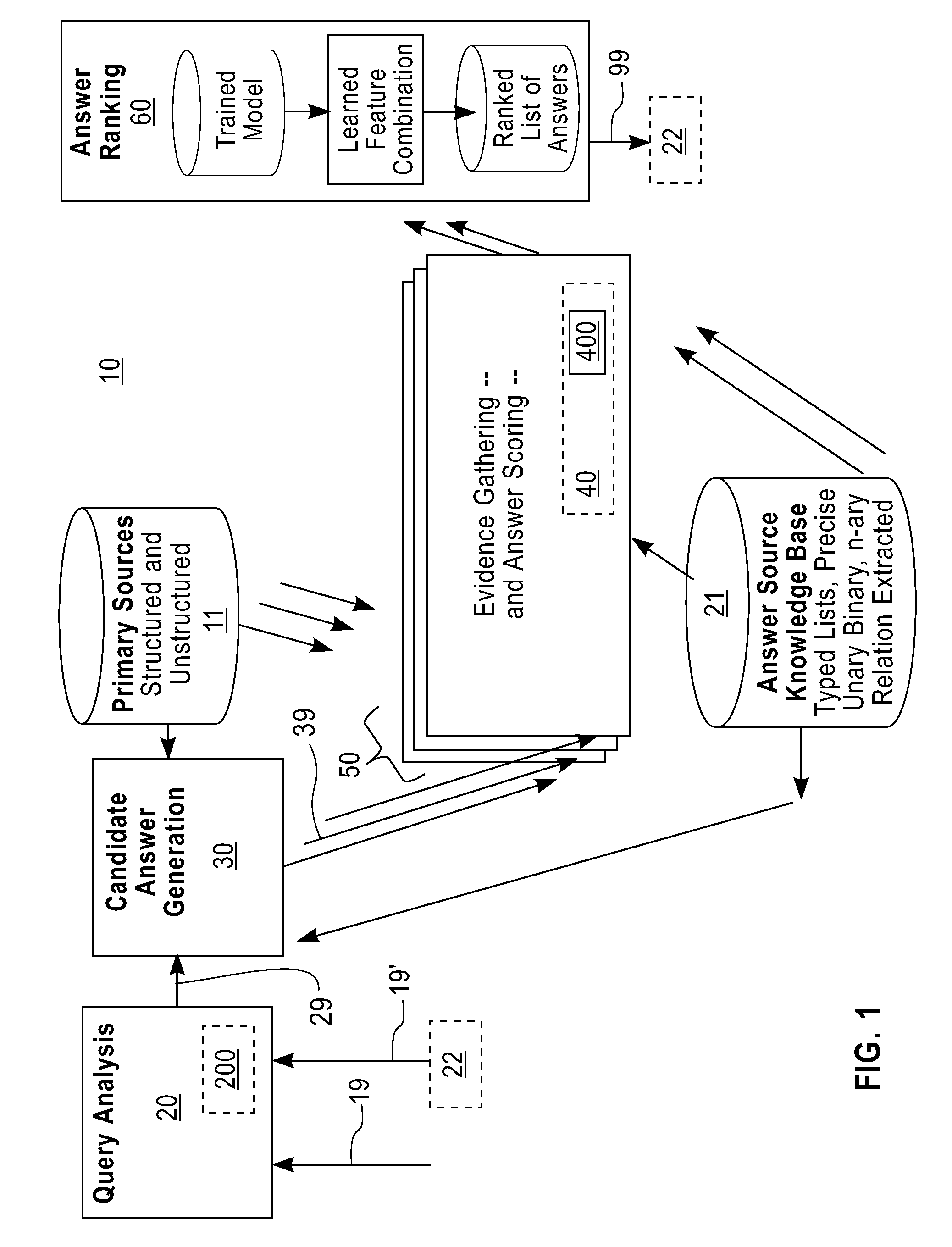
[0043]FIG. 1 shows a system, diagram depicting a high-level logical architecture 10 and methodology of the present invention. As shown in FIG. 1, the high level logical architecture 10 includes the provision of a Query Analysis module 20 implementing functions for receiving and analyzing a user query or question. According to the invention, in one embodiment, a “user” refers to a person or persons interacting with the system, and the term “user query” refers to a query (and its context) 19 posed by the user. However, it is understood other embodiments can be constructed, where the term “user” refers to a computer system 22 generating a query by mechanical means, and where the term “user query” refers to such a mechanically generated query and context 19′. A candidate answer generation module 30 is provided to implement search for candidate answers by traversing structured, semi structured and unstructured sources contained in a Primary Sources module 11 and in an Answer Source Knowl...
second embodiment
[0105]Aspects of the UIMA are further shown in FIG. 4, where there is illustrated a Analysis Engine (AE) 600 that can be a component part of the Text Analysis Engine (TAE). Included in the AE 600 is a Common Analysis System (CAS) 610, an annotator 620 and a controller 630. a TAE (not shown) includes an aggregate Analysis Engine composed of two or more component analysis engines as well as the CAS, and implements the same external interface as the AE 600.
Common Analysis System 210
[0106]The Common Analysis System (CAS) 610 is provided as the common facility that all Annotators 620 use for accessing and modifying analysis structures. Thus, the CAS 610 enables coordination between annotators 620 and facilitates annotator 620 reuse within different applications and different types of architectures (e.g. loosely vs. tightly coupled). The CAS 210 can be considered to constrain operation of the various annotators.
[0107]The CAS 210 principally provides for data modeling, data creation and da...
PUM
 Login to View More
 Abstract
Description
Claims
Application Information
 Login to View More