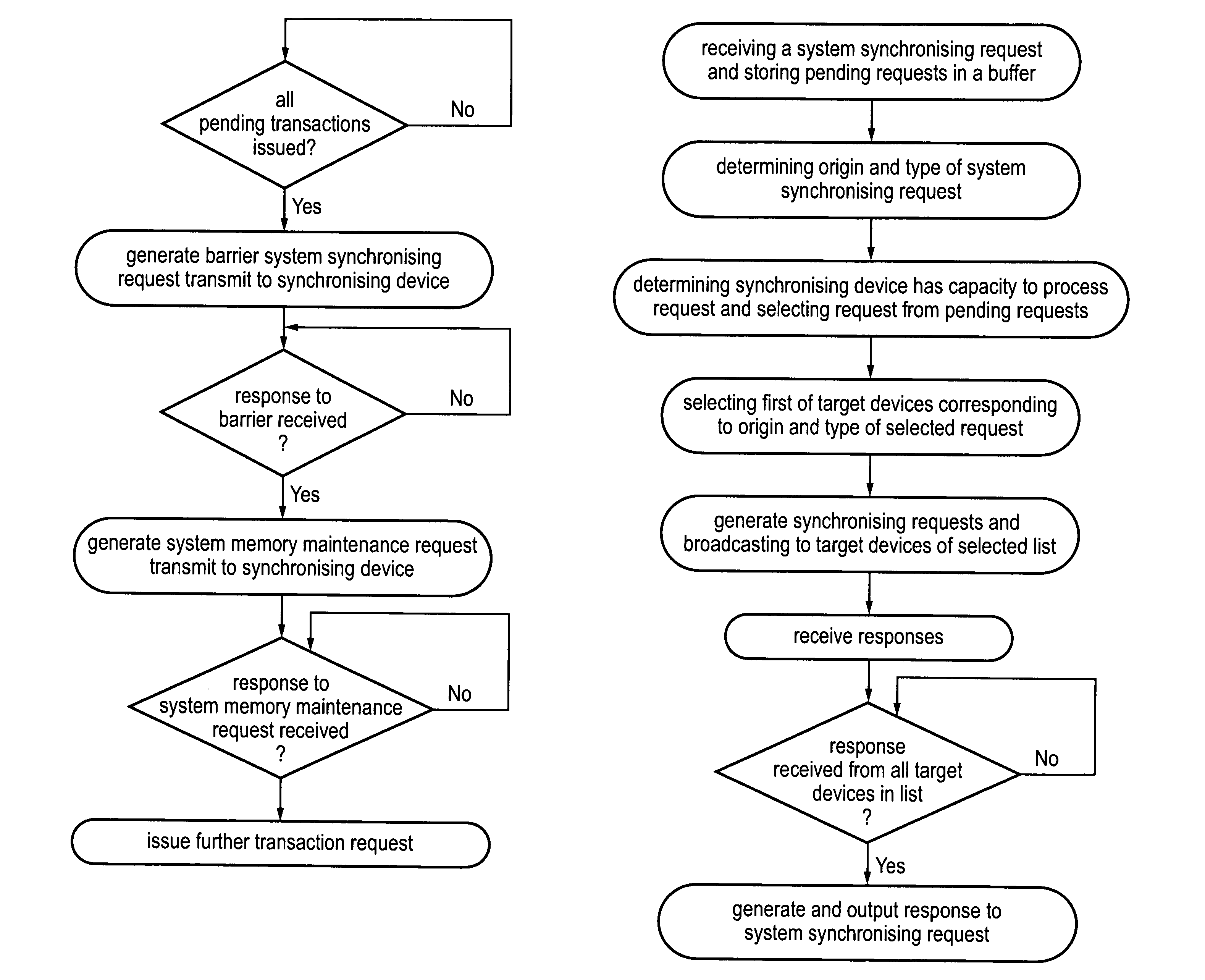
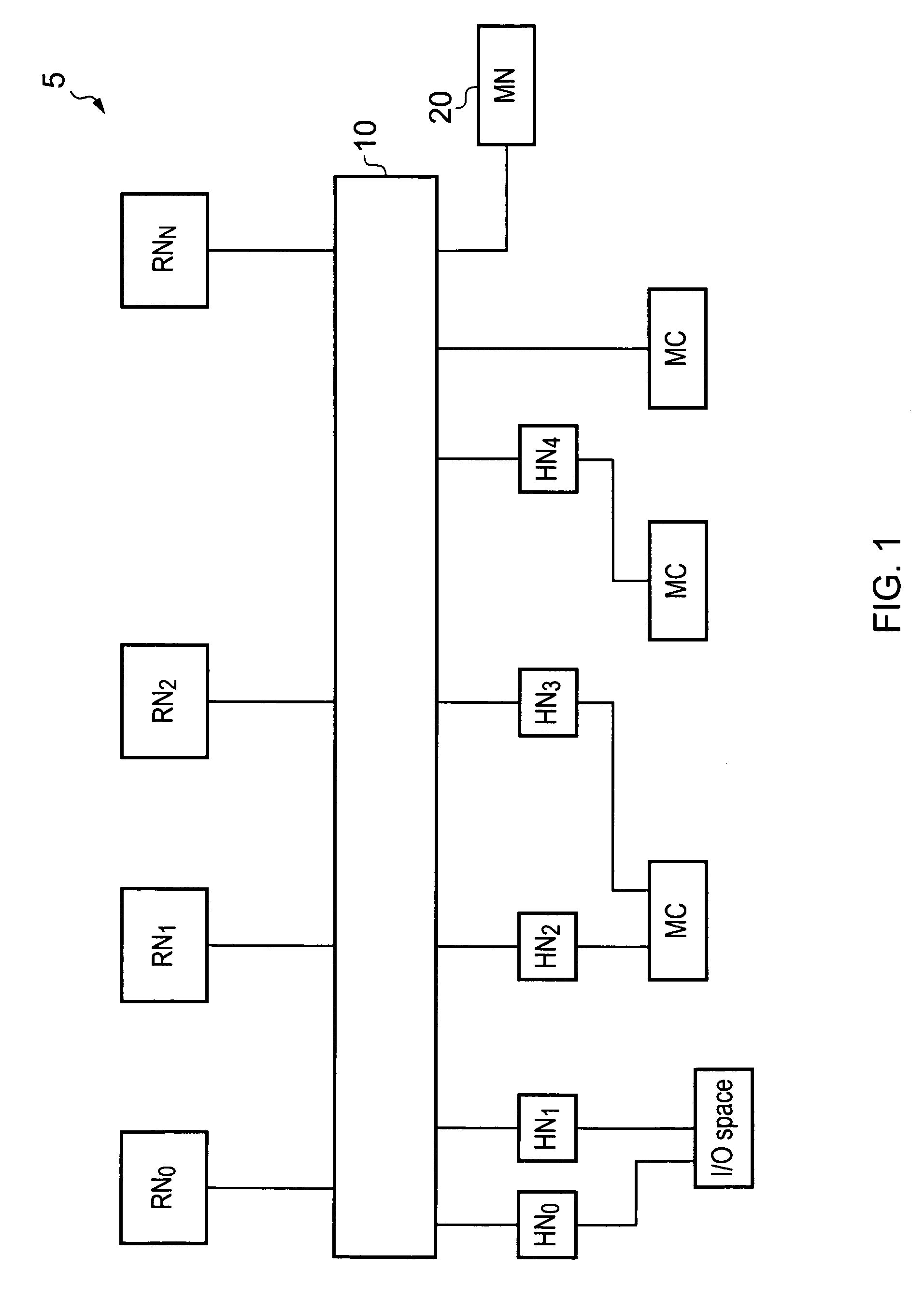
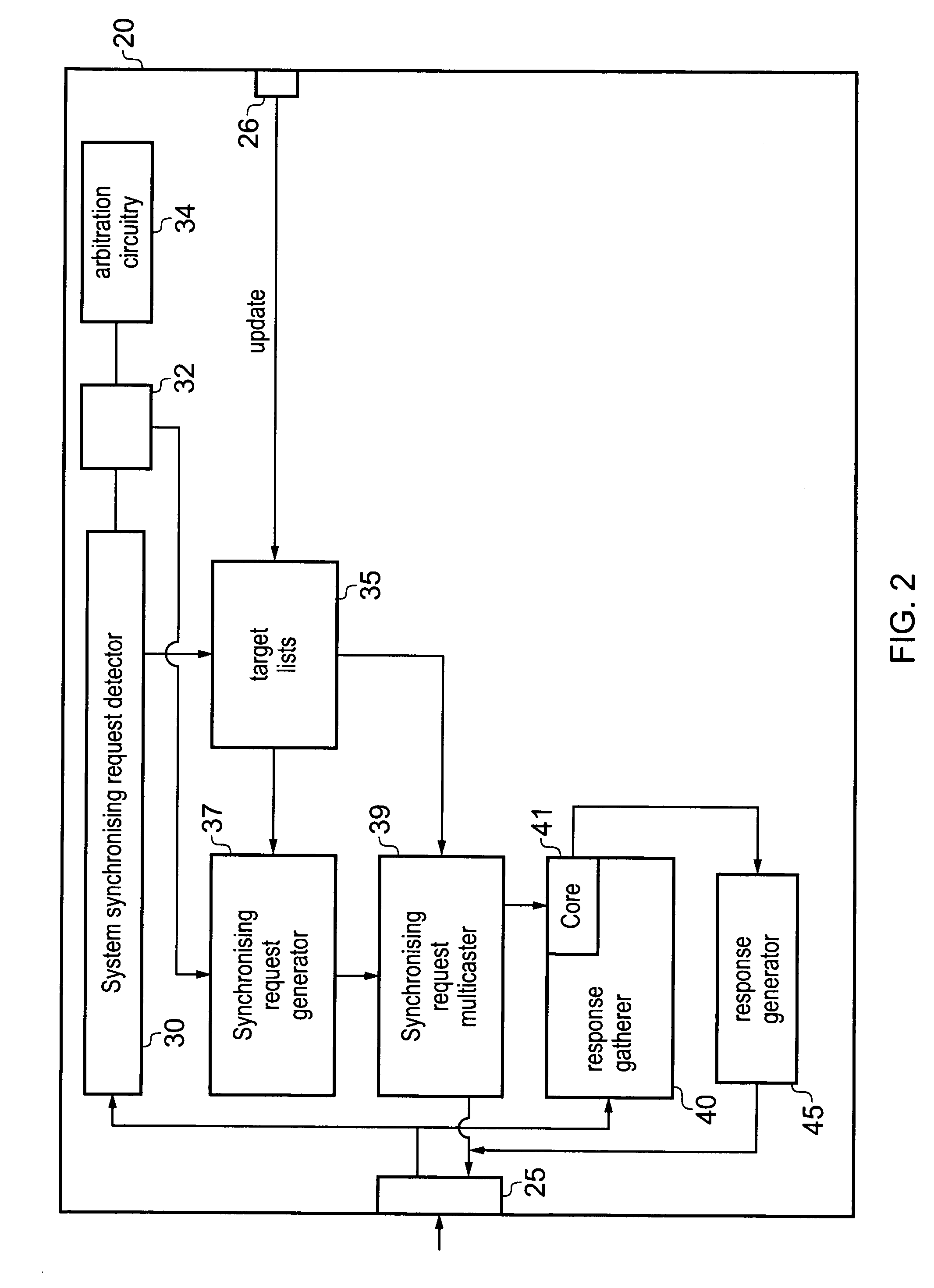
[0011]By centralising the synchronisation, individual transaction generators do not need their own synchronisation circuitry, they simply need to generate a system synchronisation request and transmit it to this particular device and await a response. Thus, the request generating and multicasting circuitry and the response gathering circuitry can be located in this one device which can be used by the many transaction generators. Furthermore, the devices responding to the multicast synchronising requests do not need to identify the source of the system synchronising request and transmit a response to that device, they simply send responses to synchronising requests to the synchronisation device, thereby facilitating the routing of these responses.
[0012]Furthermore, by providing arbitration circuitry within the synchronising device, the ordering of the different synchronising requests can be controlled and potential conflicts can be addressed and priorities given in this central device. This avoids the need for the individual transaction generators and recipient devices to control the flow with complicated handshaking mechanisms as occurs in devices of the prior art.
[0017]In addition to controlling synchronising requests centrally, in some embodiments the synchronising device may also receive and process other system maintenance requests. These are generally requests that do not target memory, and include memory maintenance requests, configuration requests and error handling requests. These requests require handling by similar circuitry to the synchronisation requests in that they are multicast and responses are gathered. Furthermore, some of them may be related to the synchronising requests and thus, it is advantageous if the same device executes these requests as it simplifies the flow control of such requests.
[0024]The devices that the synchronising requests are multicast to in response to the system synchronising request can be stored as a list within the synchronising device. This may be a convenient way of centrally storing the information and allowing the multicast of the synchronising requests to appropriate devices. Knowing where the previous transactions to be tracked have been sent and where to therefore multicast the generated synchronising requests can be a complex problem, the storing of lists within the synchronising device that are based on the connections and routing of the system is a convenient way of providing this information to the synchronising device. It also allows for flow control, perhaps only allowing a certain number of system synchronisation requests to be processed at any one time which avoids flooding the targets with synchronisation messages which may have contradictory requirements.
[0026]It may be advantageous if the target list of devices is stored securely as in this case, the list may be updated from the secure system as required but cannot be updated in the non-secure domain. This avoids a user accidentally updating these lists which could cause the system to malfunction.
[0030]It may be advantageous if the target list can be updated. Devices that transaction generating devices communicate with may change over time. For example, the routing algorithms of the device may be reprogrammed so that individual devices may be located in different domains and communicate with different devices and / or devices that they communicate with may be powered down. Storing the list centrally makes it convenient and efficient to perform updates when required. In some embodiments, said synchronising device is configured to handle a plurality of different types of system synchronising requests, said data store being configured to store a plurality of target lists, at least one of said target lists corresponding to at least one of said types of said system synchronising requests and to at least one of said of said plurality of transaction generating devices, such that in response to receipt of said system synchronising request of said at least one of said type from said at least one of said plurality of transaction generating devices said generated synchronising requests are transmitted to said at least some devices in said corresponding target list.


 Login to View More
  Login to View More