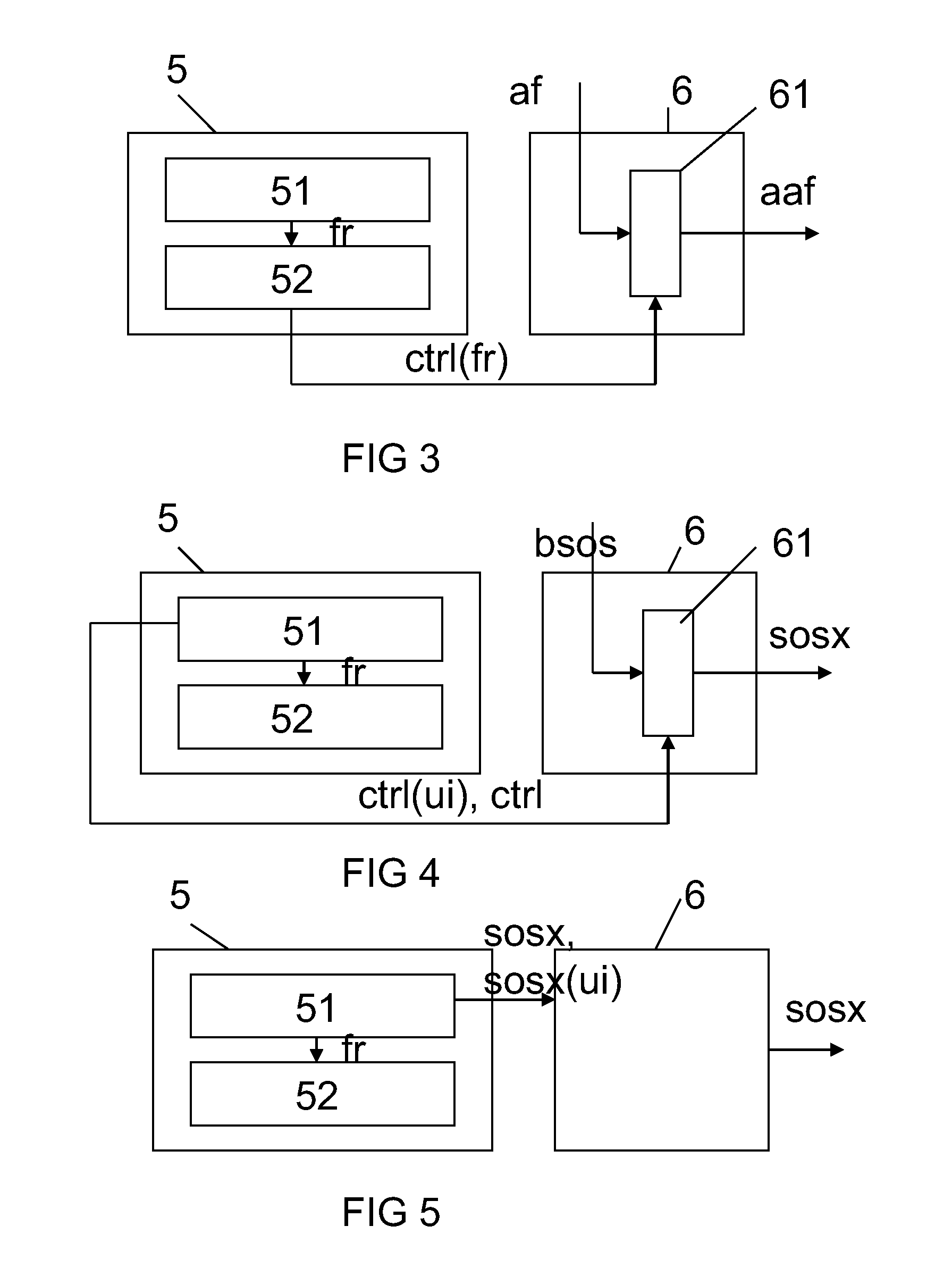
[0017]When having identified the relevant frequency range, one or more audio files may be adapted subject to the identified frequency range. In a first scenario, and based on the “Listening to tailor-made notched music reduces tinnitus loudness and tinnitus-related auditory cortex activity”-paper, the identified frequency range may be suppressed in the frequency band of the audio file. In this sense, the frequency spectrum of the audio file will be adapted by filtering out the identified frequency range. In such sense, the adaptation unit may represent a band elimination filter characteristic acting on the audio file for generating the adapted audio file.
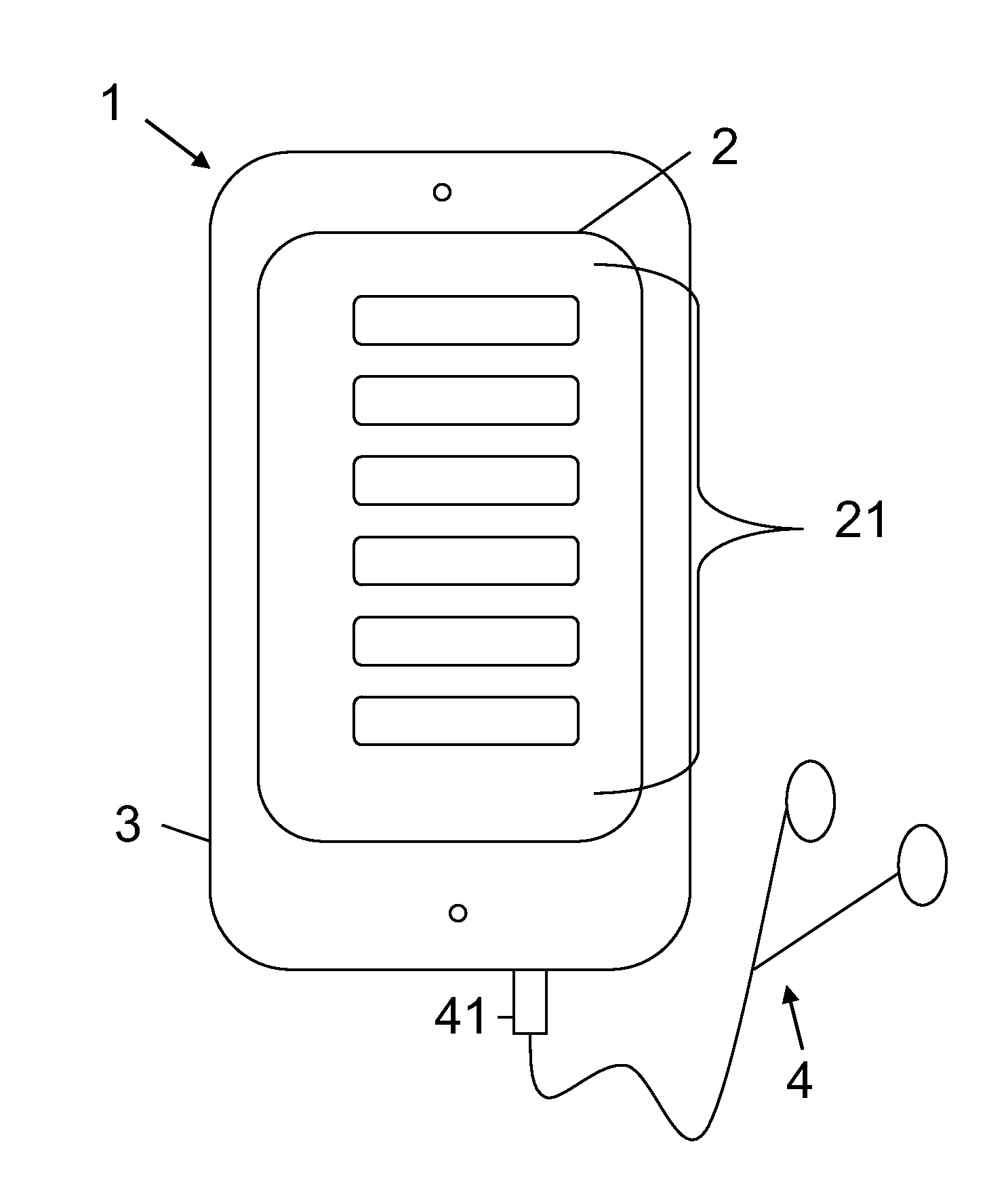
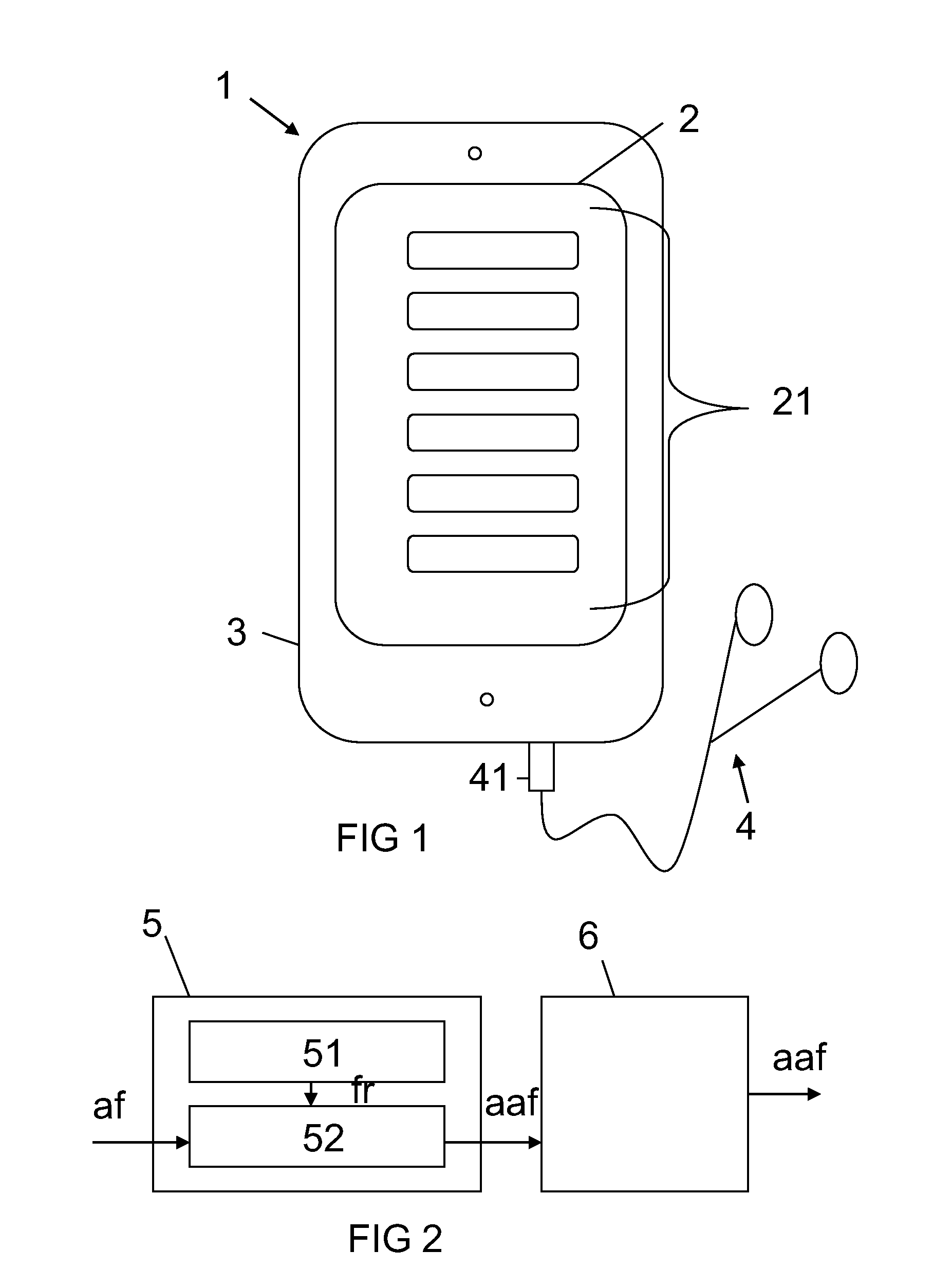
[0023]Preferably, the apparatus is a stand alone mobile electronic device containing the identification unit, the frequency modifier and the audio player in a common housing of the mobile electronic device. Such mobile electronic device may, for example, be a mobile phone, and specifically a smartphone, a portable audio player, or a portable computing device. Today's smartphones may be an ideal choice for implementing all the functions of the apparatus for the reason that sufficient computational power is provided for implementing the identification unit and the adaptation unit, that an enhanced user interface is provided in form of a touchscreen which facilitates interaction with the user in identifying the tinnitus characteristics. In addition, most of today's smartphones include an audio player function as such. Portable audio players, such as MP3™ players or Apples™ iPod™ offer computational power as well as user interfaces to be adapted / modified for implementing the present idea. So do portable computational devices, such as notebooks, netbooks, handhelds or tablet computers.
[0031]The above embodiments may support the treatment of auditory disorders such as tinnitus, but not limited to, in that the user may be free in applying a frequency characteristic to any music track preferred. The choice of preferred music may support the treatment in that a comfortable atmosphere may improve cure. In addition, such adapted music may permanently be available to the user for listening to. And the user may immediately react to changed hearing characteristics, such as to a shifted frequency or a reduced loudness in the case of tinnitus, by measuring the frequency range from new supported by the present apparatus, and may immediately apply the results of such measurement to the preferred music tracks by having applied a new frequency characteristic determined to the music tracks. In this sense, the apparatus encompasses a compact device for improving auditory disorders. Such stand alone device not only is capable of playing music adapted to the hearing disorder, but also is capable of supporting the identification of a frequency range associated with the auditory disorder, to monitor the frequency range over time, and to adapt the preferred music tracks in accordance with the identified frequency range. Especially, the measuring of the auditory disorder may be executed multiple times at the users discretion and as such may provide better measurements results caused by the user not being exposed to potentially stressful situations at the doctors and as a result the user possibly being more sensitive to the measuring. In addition, auditory disorders may show periods in which they disappear or are reduced in appearance. Such periods may be excluded from measurement since the measuring device permanently is available.
[0034]In another embodiment, the identification unit may additionally ask the user for his / her general condition / mood / mental state, e.g. by means of requesting for input on a scale. Such information may be linked to the identified frequency range, and may allow a better monitoring of the overall state of the user and / or provide additional information in how to improve treatment. Such information may additionally be included in a set of data referred to above.


 Login to View More
  Login to View More