
Application of silver halide composite materials in preparing carbon dioxide into hydrocarbon under visible-light catalysis
A technology for hydrocarbons and composite materials, which is applied in the preparation of organic compounds, the preparation of hydrocarbons from carbon oxides, the preparation of hydroxyl compounds, etc., can solve problems such as low efficiency and low quantum yield, and achieve improved efficiency and enhanced response. degree, overcome the effect of easy decomposition
Patent Information
- Authority / Receiving Office
- CN · China
- Patent Type
- Patents(China)
- Current Assignee / Owner
- Publication Date
- 2012-11-07
- Estimated Expiration
- Not applicable · inactive patent
Smart Images
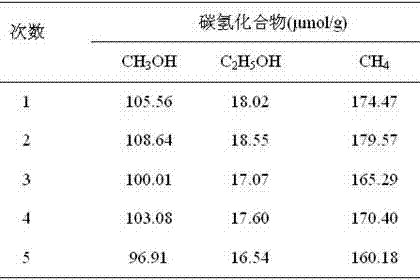
Figure 1 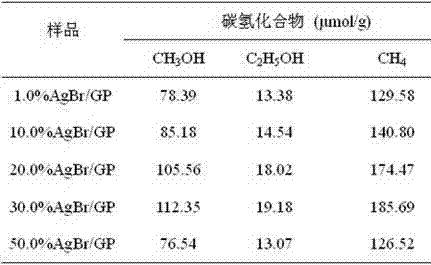
Figure 2 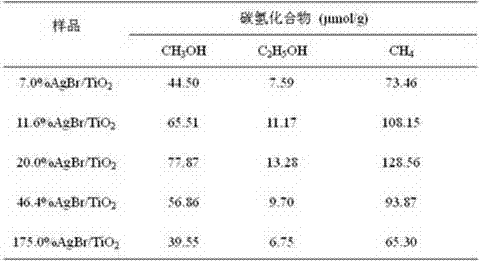
Figure 3
Abstract
Description
technical field
[0001] The invention relates to the application of silver halide composite materials to catalyze carbon dioxide to prepare hydrocarbons under the condition of visible light. Background technique
[0002] carbon dioxide (CO 2 ) gases are considered to be the main cause of global warming. An estimated 66% of global warming is attributable to CO 2 . Humans emit 24 billion tons of CO every year 2 to the atmosphere, of which 22 billion tons are due to the burning of fossil fuels, thus reducing CO 2 The emission of emissions has become a focus of attention of countries all over the world. From the perspective of sustainable development, purely relying on the reduction of CO 2 The emission of greenhouse gases is bound to affect the normal development of social economy, so the comprehensive utilization of greenhouse gases is inevitable for economic and social development. Make full use of industrial by-product CO 2 Transformation and fixation are not only ben...
Examples
Embodiment 1
[0032] Reality Embodiment 1: Preparation of AgBr composite material
[0033] 1 g of GP, EGP, GO, CNT, GAC, Zeolite, TiO 2 The solid powder was added to 100 ml of 0.01 mol / L cetylmethylammonium bromide (CTAB) aqueous solution, ultrasonically dispersed for 30 min, and then stirred with a magnetic stirrer for 30 min to obtain a uniformly distributed suspension A. Take 0.0012 mol of AgNO 3 Add to 2.3 ml NH 4 OH (25 wt. % NH 3 ) to obtain mixed solution B. Then the B mixed solution was quickly added to the suspension A, and after magnetic stirring at room temperature for 12 h, the resulting precipitate was separated by a high-speed centrifuge and washed with ethanol for 5 times, and then dried at 75 °C. Then calcined at different temperatures of 200°C, 400°C, 500°C and 700°C for 3 hours to obtain 20.0% AgBr / GP, AgBr / EGP, AgBr / GO, AgBr / CNT, AgBr / GAC, AgBr / Zeolite, AgBr / TiO 2 composite material. Prepare 1.0%, 10.0%, 30.0% and 50.0% AgBr / GP, AgBr / EGP, AgBr by controlling the ...
Embodiment 2
[0034] Example 2: AgX / GP Visible Light Catalytic CO 2 preparation of hydrocarbons
[0035] Visible light catalyzed CO 2 The reaction device for preparing hydrocarbons adopts a closed cylindrical stainless steel reactor. The stainless steel reactor has its own valve to facilitate the control of gas input and discharge. In order to facilitate the illumination, there is a sealable circular glass window with optical filter above the stainless steel reactor. A 500 W medium-pressure xenon light source was used as the visible light source to provide visible light of λ≥420 nm. Take 0.5 g of synthesized 1.0%, 10.0%, 20.0%, 30.0% and 50.0% (wt.AgBr / GP) AgBr / GP composite samples and disperse them in 100 ml of 0.2 mol / L KHCO 3 A suspension was formed in the solution, and the pH of the solution was adjusted to 8.5 with NaOH. Pure CO was continuously fed into the suspension through the control valve in the stainless steel reactor before the illumination started. 2 gas (purity 9...
Embodiment 3
[0038] Example 3: AgX / TiO 2 Visible light catalyzed CO 2 preparation of hydrocarbons
[0039] The stainless steel reactor described in Example 2 was used as the reaction device, and a 500 W medium-pressure xenon lamp light source was used to provide the visible light source with λ≥420 nm of visible light. 7.0%, 11.6%, 20.0%, 46.4% and 175.0% (wt.AgBr / wt.TiO 2 ) a series of AgBr / TiO 2 Nanocatalyst sample, dispersed in 100ml of 0.2 mol / L KHCO 3 A suspension was formed in the solution, and the pH of the solution was adjusted to 8.5 with NaOH. Pure CO was continuously fed into the suspension through the control valve in the stainless steel reactor before the illumination started. 2 gas (99.99% purity) for 30 min to remove oxygen from the solution. Then close the control valve and continue to introduce CO 2 The gas maintains the pressure in the reactor at about 7.5 MPa. Turn on the xenon lamp light source under magnetic stirring, and continue to irradiate for 5h....