
Efficient adsorbent based on michelia chapensis leaves and preparation method thereof
An adsorbent, leaf technology, applied in chemical instruments and methods, adsorption water/sewage treatment, other chemical processes, etc. The effect of low energy consumption, simple preparation process and easy operation
Patent Information
- Authority / Receiving Office
- CN · China
- Current Assignee / Owner
- Publication Date
- 2016-10-12
- Estimated Expiration
- Not applicable · inactive patent
Smart Images
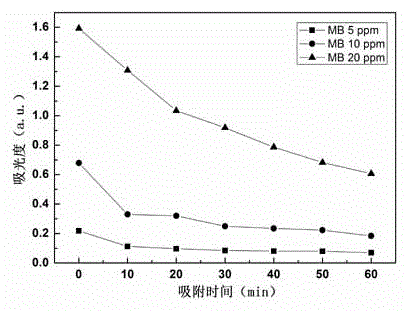
Figure 1 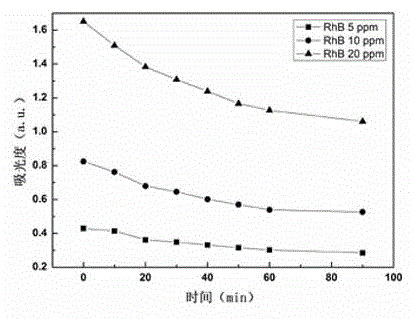
Figure 2
Abstract
Description
technical field
[0001] The invention relates to the technical field of dye sewage treatment, in particular to preparing an efficient dye adsorbent by using agricultural and forestry waste. Background technique
[0002] Adsorbents are solid substances that are effective in absorbing certain components from a gas or liquid. At present, commonly used adsorbents are alumina, activated carbon, silica gel, etc. These adsorbents have problems such as high manufacturing cost and high energy consumption. How to prepare adsorbents with excellent performance at low cost is one of the hotspots in the field of pollutant treatment. On the other hand, due to the action of metabolism, plants will produce dead leaves and fallen leaves every year. At present, the method of incineration or landfill is mainly used to deal with dead leaves and fallen leaves. However, in the process of burning dead leaves, a large amount of harmful gases (such as CO, NO x etc.), while generating dust, causing...
Examples
Embodiment 1
[0018] (1) Lechang Michelia leaves are crushed into powder, sieved, and the leaf powder with a size below 300 microns is taken for subsequent use;
[0019] (2) Utilize the sodium hydroxide solution that mass concentration is 5% to soak leaf powder, and at 60 ℃, keep warm for 1 hour;
[0020] (3) After washing the powder soaked in step (2) repeatedly with water until it is colorless, dry the powder at 80°C;
[0021] (4) After weighing 5g of leaf powder and 5g of sodium hydroxide powder and mixing, add 250mL of water to soak the solid matter, stir well and let stand for 1 hour;
[0022] (5) After repeatedly washing the solid substance in step (4) with water until it is colorless, dry it at 80° C. until the solid no longer loses weight, and then the adsorbent product can be obtained.
[0023] Adsorption performance evaluation was performed at room temperature: 0.05 g of adsorbent was added to 20 mL of methylene blue solutions with initial concentrations of 5 ppm, 10 ppm, and 20 ...
Embodiment 2
[0024] (1) Lechang Michelia leaves are crushed into powder, sieved, and the leaf powder with a size below 800 microns is taken for subsequent use;
[0025] (2) Soak the leaf powder in a sodium hydroxide solution with a mass concentration of 15%, and keep it warm for 1 hour at 40°C;
[0026] (3) After washing the powder soaked in step (2) repeatedly with water until it is colorless, dry the powder at 90°C;
[0027] (4) After weighing 5g of leaf powder and 10g of sodium hydroxide powder and mixing, add 350mL of water to soak the solid matter, stir well and let stand for 1.5 hours;
[0028] (5) After repeatedly washing the solid substance in step (4) with water until it is colorless, dry it at 90° C. until the solid no longer loses weight, and then the adsorbent product can be obtained.
[0029] Adsorption performance evaluation was carried out at room temperature: 0.05 g of adsorbent was added to 20 mL of rhodamine B solutions with initial concentrations of 5 ppm, 10 ppm and 20...
Embodiment 3
[0030] (1) Lechang Michelia leaves are crushed into powder, sieved, and the leaf powder with a size below 50 microns is taken for subsequent use;
[0031] (2) Soak the leaf powder with a sodium carbonate solution with a mass concentration of 3%, and keep it warm for 0.5 hours at 80°C;
[0032] (3) After washing the powder soaked in step (2) repeatedly with water until it is colorless, dry the powder at 70°C;
[0033] (4) After weighing 5g of leaf powder and 15g of sodium carbonate powder and mixing, add 400mL of water to soak the solid matter, stir well and let stand for 1 hour;
[0034] (5) After repeatedly washing the solid substance in step (4) with water until it is colorless, dry it at 70° C. until the solid no longer loses weight, and then the adsorbent product can be obtained.
[0035] Adsorption performance evaluation was performed at room temperature: 0.05 g of adsorbent was added to 20 mL of methylene blue solutions with initial concentrations of 5 ppm, 10 ppm, and ...