
Production method for formaldehyde-free bamboo chip plate
A production method and technology of bamboo chips, which are applied in the field of plate manufacturing, can solve problems such as low bonding strength and poor water resistance, and achieve good bonding effect, improved waterproof performance, and good curing effect
Patent Information
- Authority / Receiving Office
- CN · China
- Current Assignee / Owner
- Publication Date
- 2018-08-24
Smart Images
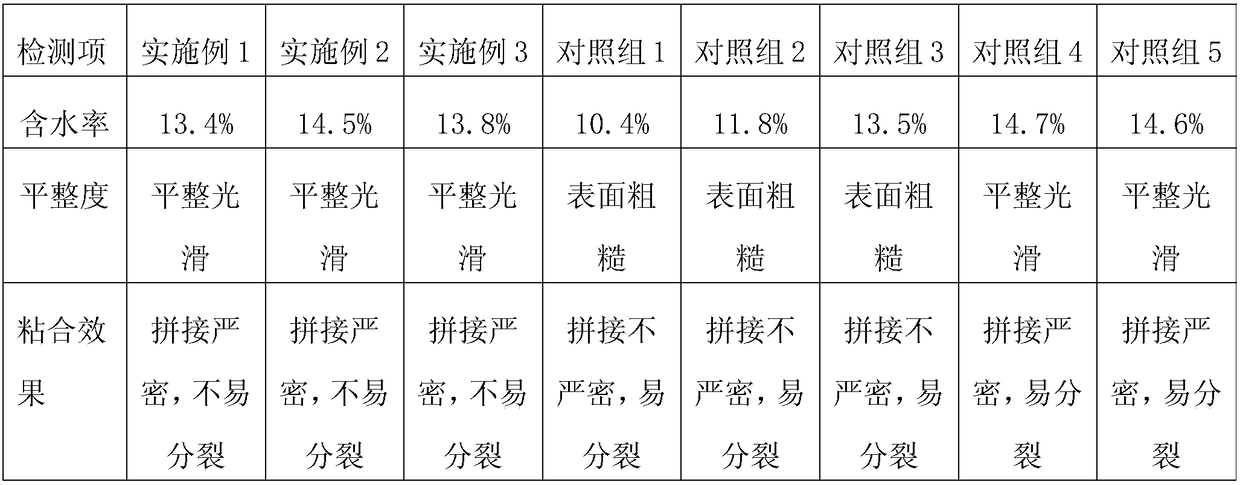
Figure 1
Abstract
Description
technical field
[0001] The invention relates to the technical field of board manufacture, in particular to a method for making formaldehyde-free bamboo boards. Background technique
[0002] Adhesives containing formaldehyde are used in the board manufacturing process, so using adhesives containing formaldehyde to make furniture will release formaldehyde. In addition to causing respiratory and nervous system diseases, such as cough, sore throat, chest tightness, dizziness, nausea, limb weakness, dyspnea, lethargy and other symptoms, formaldehyde can also induce the development of cancers such as nose cancer, throat cancer, skin cancer and leukemia. occur.
[0003] Most of the adhesives used in the prior art contain formaldehyde, and the adhesives without formaldehyde can be natural polymers, mainly soybean protein adhesives, etc., but this adhesive has low bonding strength and poor water resistance. shortcoming. Therefore, the preparation of a formaldehyde-free adhesive wi...
Examples
Embodiment 1
[0028] A method for making a formaldehyde-free bamboo chip board comprises the steps:
[0029] (1) heat treatment: bamboo is placed in hot steam and kept warm for 5h;
[0030] (2) making bamboo chips;
[0031] (3) Drying: the wood is placed in a drier with a relative air humidity of 10%, and the temperature is 50°C, and the wind speed is 10m / s to dry the wood to a moisture content of 23%;
[0032] (4) Repair: Repair and arrange the badly shaped planks;
[0033] (5) One-time gluing: apply the A adhesive to the surface of the wood to form a glue layer, and the coating amount of the A adhesive is 100g / m 2 ; The A adhesive is made up of the following raw materials in parts by mass: 30 parts of chitosan, 10 parts of konjac chitosan, 4 parts of lysozyme, 40 parts of fish gelatin, 10 parts of montmorillonite, 1 part of salicylic acid 6 parts, 6 parts of potassium dichromate;
[0034] (6) Tissue culture: the fiber angle of two bamboo planks is 90 degrees, and the number of layers ...
Embodiment 2
[0042] A method for making a formaldehyde-free bamboo chip board comprises the steps:
[0043] (1) heat treatment: place bamboo in hot steam for 3 hours;
[0044] (2) making bamboo chips;
[0045] (3) drying: the wood is placed in a drier with a relative air humidity of 20%, and the temperature is 40°C, and the wind speed is 20m / s, and the moisture percentage of the wood is dried to 15%;
[0046] (4) Repair: Repair and arrange the badly shaped planks;
[0047] (5) One-time gluing: apply the A adhesive to the surface of the wood to form a glue layer, and the coating amount of the A adhesive is 200g / m 2 ; The A adhesive is made up of the following raw materials in parts by mass: 20 parts of chitosan, 30 parts of konjac chitosan, 1 part of lysozyme, 50 parts of fish gelatin, 5 parts of montmorillonite, 5 parts of salicylic acid 1 part, 1 part of potassium dichromate;
[0048] (6) Tissue culture: the angle between the fibers of the two bamboo planks is 90 degrees, and the number...
Embodiment 3
[0056] A method for making a formaldehyde-free bamboo chip board comprises the steps:
[0057] (1) heat treatment: place bamboo in hot steam for 4 hours;
[0058] (2) making bamboo chips;
[0059] (3) drying: the wood is placed in a drier with a relative air humidity of 15%, and the temperature is 45°C, and the wind speed is 15m / s to dry the wood until the moisture percentage of the wood is 20%;
[0060] (4) Repair: Repair and arrange the badly shaped planks;
[0061] (5) One-time gluing: A glue is coated on the wood surface to form a glue layer, and the coating amount of the A glue is 150g / m2; the A glue is composed of the following raw materials in parts by mass : 25 parts of chitosan, 20 parts of konjac chitosan, 3 parts of lysozyme, 45 parts of fish gelatin, 8 parts of montmorillonite, 3 parts of salicylic acid, 5 parts of potassium dichromate;
[0062] (6) Tissue culture: the angle between the fibers of the two bamboo planks is 90 degrees, and the number of layers is 7...