
Silane-terminated polyether and preparation method thereof
A technology of silane-terminated polyether and hydroxyl-terminated polyether, which is applied in the direction of polyether adhesives, adhesive types, adhesives, etc., to achieve the effects of wide sources, low prices, and mature technology
Patent Information
- Authority / Receiving Office
- CN · China
- Patent Type
- Applications(China)
- Current Assignee / Owner
- Publication Date
- 2019-07-19
Smart Images
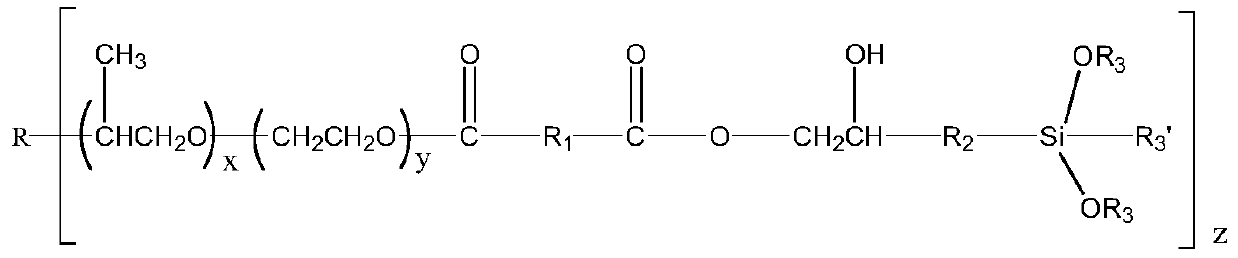
Figure 1 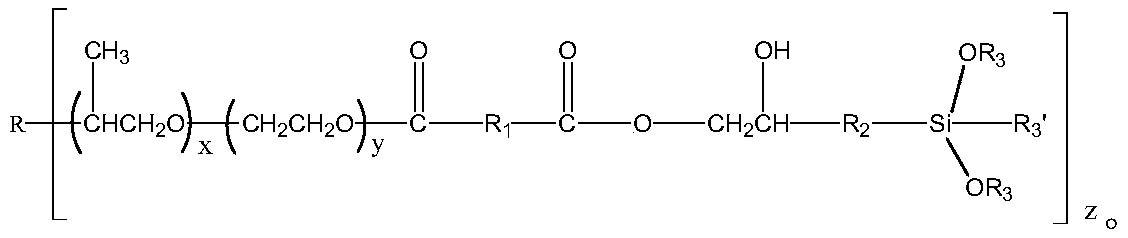
Figure 2 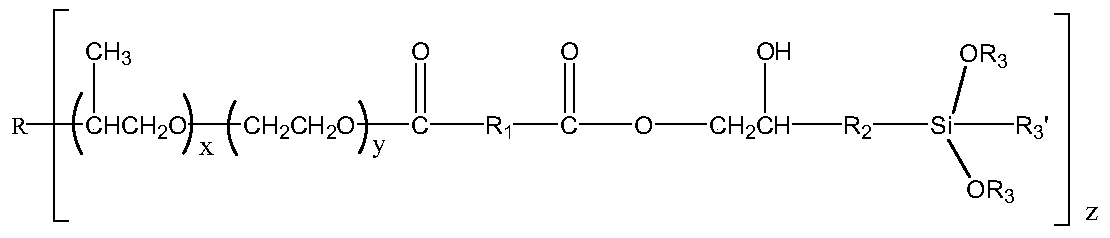
Figure 3
Abstract
Description
technical field
[0001] The invention belongs to the field of chemical industry and relates to a polyether, specifically a silane-terminated polyether and a preparation method thereof. Background technique
[0002] Polyurethane sealants contain free isocyanate groups that are harmful to the human body, and are prone to bubbles during curing. Silicone sealant has low tear strength, poor finish and easy to pollute building materials. The silane-modified sealant does not contain isocyanate and organic solvents, and has good paintability, stain resistance and mechanical strength, which is the main development direction of sealants at home and abroad.
[0003] The silane-modified sealant is made of silane-terminated polyether as the basic polymer and supplemented with other additives. When curing, the siloxy groups at the end of the molecular chain are hydrolyzed under the action of moisture to form a cross-linked network. The competitiveness of such products is closely related ...
Examples
Embodiment 1
[0042] Add 100 g of polypropylene glycol monomethyl ether (x=17, y=0, z=1) with a molecular weight of 1000 g / mol into a three-necked flask equipped with a stirrer and a thermometer, heat up to 80°C and vacuumize for 3 hours, and continue to heat up to 90°C. ℃, and add 10g of maleic anhydride, react for 4h to obtain carboxyl-terminated polyether.
[0043] Raise the temperature of the above-mentioned reactants to 100°C, add 23.6g of γ-glycidyl etheroxypropyl trimethoxysilane and 0.13g (0.1% of total weight) triphenylphosphine catalyst to continue the reaction for 2h, cool down to 50°C and discharge , to obtain silane-terminated polyether.
Embodiment 2
[0045] Add 100 g of polyethylene glycol ether glycol (x=0, y=45, z=2) with a molecular weight of 2000 g / mol to a three-necked flask equipped with a stirrer and a thermometer, heat up to 100° C. for 2 hours, and continue The temperature was raised to 120°C, and 16.8 g of methyl hexahydrophthalic anhydride was added, and reacted for 3 hours to obtain a carboxyl-terminated polyether.
[0046] Raise the temperature of the above-mentioned reactant to 110°C, add 27.8g of γ-glycidyl etheroxypropyltriethoxysilane and 1.44g (1% of total weight) of quaternary ammonium salt catalyst to continue the reaction for 2h, cool down to 50°C and exit material to obtain silane-terminated polyether.
Embodiment 3
[0048] Add 300g of polypropylene glycol ether trihydric alcohol (x=100, y=1, z=3) with a molecular weight of 6000g / mol to a three-necked flask equipped with a stirrer and a thermometer, heat up to 120°C and vacuumize for 1h, continue to heat up to 150°C, and added 22.2g of phthalic anhydride, and reacted for 2h to obtain carboxyl-terminated polyether.
[0049] The temperature of the above-mentioned reactants was raised to 120° C., and 20.9 g of γ-glycidyl etheroxypropyl triethoxysilane, 17.7 g of γ-glycidyl etheroxypropyl trimethoxysilane and 1.80 g (total weight 0.5% ) secondary amine catalyst to continue the reaction for 2 hours, cool down to 50° C. and discharge to obtain silane-terminated polyether.