
Acrylate-based polydiacetylene thermochromic material, and preparation method and application thereof
A thermochromic material, acrylate-based technology, applied in the direction of additive processing, etc., can solve the problems of secondary pollution, adverse effects on material performance, etc., achieve the effect of convenient storage, elimination of adverse effects, and expansion of application potential
Patent Information
- Authority / Receiving Office
- CN · China
- Current Assignee / Owner
- Publication Date
- 2019-12-17
Smart Images
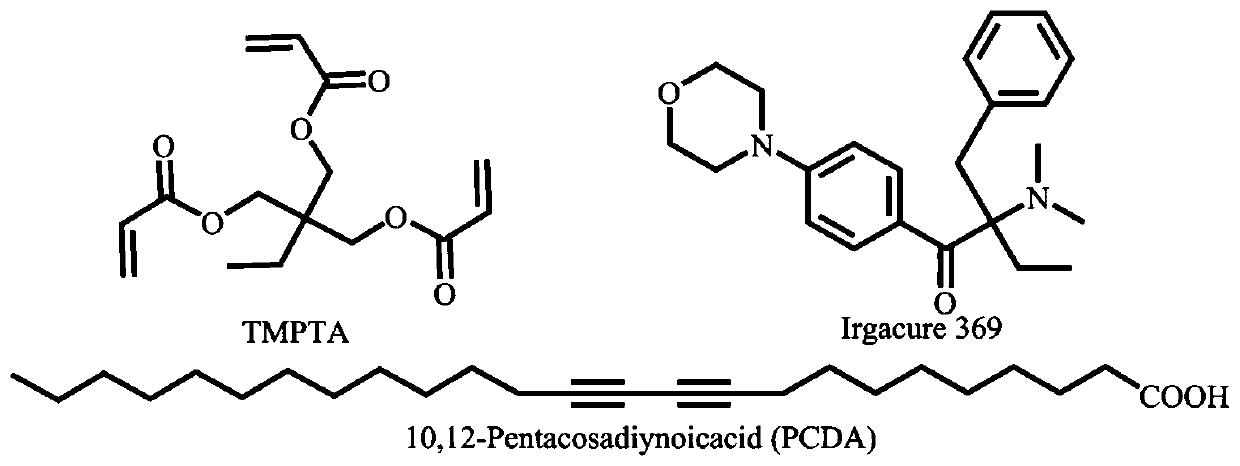
Figure 1 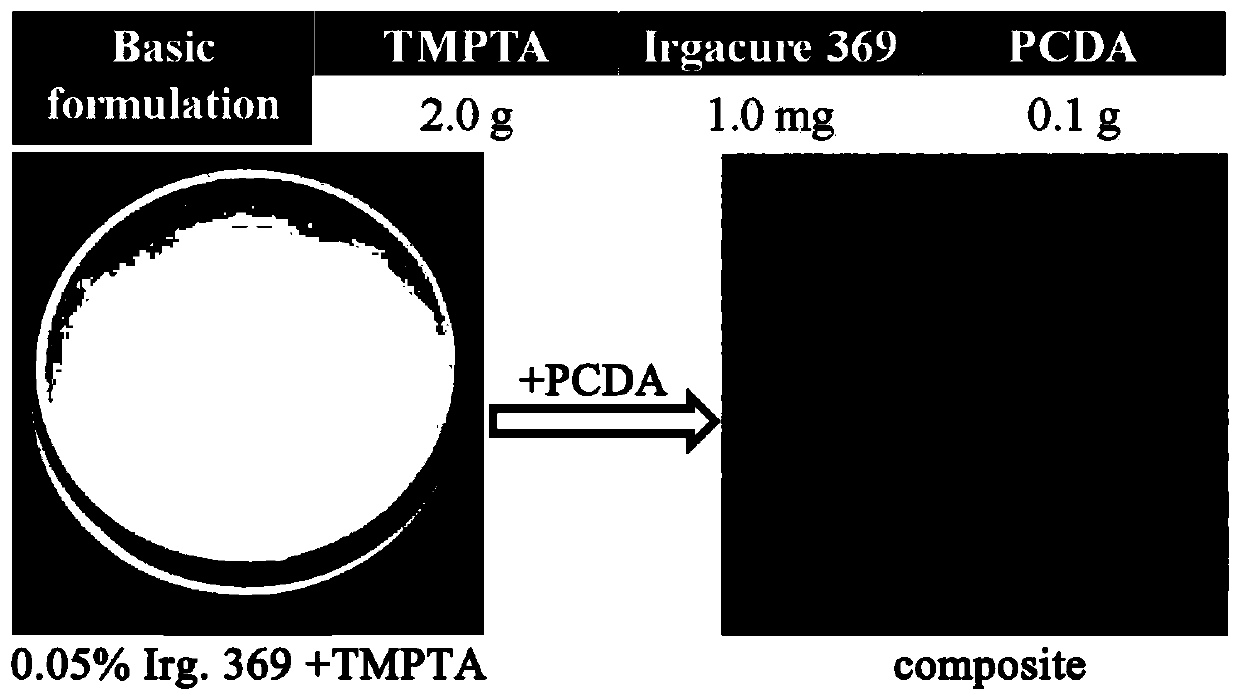
Figure 2 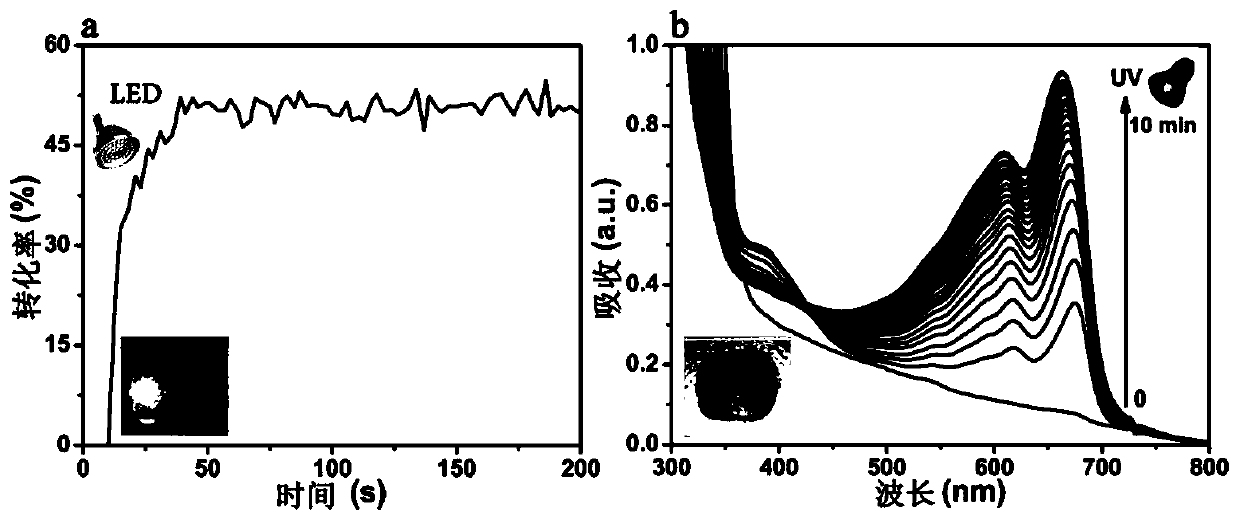
Figure 3
Abstract
Description
technical field
[0001] The invention relates to the field of heat-responsive composite materials, in particular to an acrylate-based polydiacetylene thermochromic material and its preparation method and application. Background technique
[0002] As an important class of conjugated polymer materials, polydiacetylene responds to color change (usually from blue to red) and fluorescence enhancement (from no fluorescence to red) due to significant environmental stimuli (pH, heat, organic solvents, stress, etc.) It has aroused extensive research interest and has been prepared into a variety of different forms, including vesicles, films, liquid crystals, electrospun fibers, etc. However, in most cases, volatile organic solvents are required in the preparation process, which does not conform to the development concept of green chemistry, thus limiting its further in-depth research. 3D printing technology constructs a three-dimensional structure by layer-by-layer printing, and has a...
Examples
preparation example Construction
[0019] The invention provides a method for preparing an acrylate-based polydiacetylene thermochromic material, the preparation method comprising:
[0020] (1) In a light-proof environment, the photoinitiator Irgacure 369, trimethylolpropane triacrylate and 10,12-pentacosadiynoic acid are mixed to obtain an emulsion;
[0021] (2) sequentially irradiating the emulsion with LED light and ultraviolet light to obtain an acrylate-based polydiacetylene thermochromic material.
[0022] In a preferred embodiment of the present invention, in order to improve material performance and response sensitivity, photoinitiator Irgacure 369 and trimethylolpropane triacrylate are mixed for the first time to obtain a colorless liquid. In the light environment, 10,12-pentacosadiynoic acid was added, and an emulsion was obtained after the second mixing.
[0023] In a preferred embodiment of the present invention, in order to improve material performance and response sensitivity, relative to 2g of t...
Embodiment 1
[0036] First mix the photoinitiator Irgacure 369 and trimethylolpropane triacrylate (using mechanical stirring, the stirring time is 3min) to obtain a colorless liquid, then add 10,12- Pentacosadiynoic acid, mixed for the second time (including ultrasonic dispersion for 5 minutes, followed by mechanical stirring for 5 minutes.) to obtain emulsion; sequentially use 405nm LED light (irradiation 2min, light intensity is 110mW / cm 2 ) and 254nm ultraviolet light irradiation (irradiation 5min, light intensity is 15W / cm 2 ) above-mentioned emulsion, obtains acrylate-based polydiacetylene thermochromic material; Relative to the trimethylolpropane trimethacrylate of 2g, the consumption of photoinitiator Irgacure 369 is 1mg, 10,12-pentacoke The dosage of diynoic acid is 0.1 g. The structure diagram of raw material photoinitiator Irgacure 369, trimethylolpropane triacrylate (TMPTA) and 10,12-pentacosadiynoic acid (PCDA) is as follows figure 1 As shown, the three arms of TMPTA contain a...
Embodiment 2
[0038] First mix the photoinitiator Irgacure 369 and trimethylolpropane triacrylate (using mechanical stirring, the stirring time is 2min) to obtain a colorless liquid, then add 10,12- Pentacosadiynoic acid, mixed for the second time (including ultrasonic dispersion for 4min, followed by mechanical stirring for 4min.) to obtain emulsion; sequentially use 405nmLED light (irradiation 1.5min, light intensity is 105mW / cm 2 ) and 254nm ultraviolet light irradiation (irradiation 4min, light intensity is 10W / cm 2 ) above-mentioned emulsion, obtains acrylate-based polydiacetylene thermochromic material; Relative to the trimethylolpropane trimethacrylate of 2g, the consumption of photoinitiator Irgacure 369 is 2mg, 10,12-pentacactyl The dosage of diynoic acid is 0.2 g.