

Sweet corn breeding method
A technology of sweet corn and golden jade, applied in the field of corn breeding, can solve the problems of lack of cold resistance, heat resistance, drought resistance, lodging resistance, poor disease resistance, poor adaptability, etc., and achieve good survival, strong palatability, and good quality.
Patent Information
- Authority / Receiving Office
- CN · China
- Patent Type
- Applications(China)
- Current Assignee / Owner
- Publication Date
- 2020-09-18
Smart Images
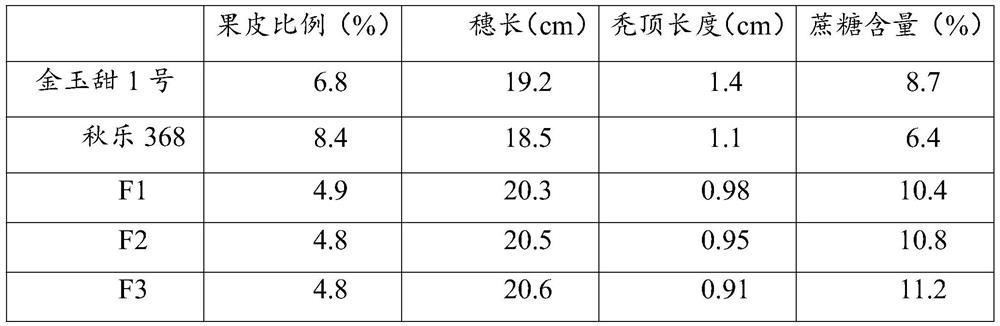
Figure 1 
Figure 2
Abstract
Description
technical field
[0001] The invention relates to the technical field of corn breeding, in particular to a sweet corn breeding method. Background technique
[0002] Sweet corn originated from the American continent and carries a mutation gene related to carbohydrate metabolism. According to the genetic type and endosperm characteristics, sweet corn is divided into ordinary sweet corn, super sweet sweet corn (also known as fruit sweet corn) and enhanced sweet corn. corn. Sweet corn is mainly used for fresh ear consumption and fresh-keeping processing. Sweet corn is rich in nutrition and unique in flavor. It is a new four-element economic crop integrating grain, feed, fruit and vegetables. The development of planting scale has surpassed that of any kind of vegetables. value and industrial production.
[0003] The breeding work of sweet corn is generally combined with conventional breeding, the sweet quality gene of sweet corn is introduced into the material with good genetic ...
Examples
Embodiment 1
[0028] Breeding process
[0029] (1) Jinyutian 1 with a plant height of 180-210cm, ear length > 19cm, and total soluble sugar > 8% was used as the female parent, and Qiule 368 with a plant height of 290-300cm and ear length > 18cm was used as the male parent, and the planting density For 3000 plants / mu, F1 generation seeds were obtained through artificial pollination;
[0030] (2) Plant F1 generation seeds, the planting density is 4000 plants / mu, select fruit peel ratio20cm, bald length10%, to Fusarium stem rot, Fusarium ear rot disease, large leaf spot, small spot, and head smut are all resistant to selfing to obtain F2 generation seeds;
[0031] (3) Step (2) was repeated continuously for 4 generations to obtain inbred lines with stable properties.
[0032] During the breeding process, fertilization treatment is required, 40kg per mu, and the applied fertilizer includes the following components in mass parts: 25 parts of coconut soil, 45 parts of vermicompost, 12 parts of c...
Embodiment 2
[0039] The seed selected and bred at last of embodiment 1 is carried out trial planting, and each index characteristic is as follows:
[0040] 1. Output performance
[0041] The seeds finally bred in Example 1 were tested. The control group was Jinyutian No. 1. The average yield per mu in 2015-2016 was 824.8% kg. 4.99%.
[0042] 2. Characteristics
[0043] (1) Morphological characteristics:
[0044] At the seedling stage, it grows strong, with a strong growth potential. The plant height is 232.5cm, the total number of leaves is 20, the ear length is 20.8cm, the bald head length is 0.89cm, the 100-grain weight is 34.8g, and the ear is cylindrical.
[0045] (2) Cultivation characteristics:
[0046] According to the farmers who planted it, the seeds have a high germination rate, strong germination potential, resistance to overturning, and strong environmental adaptability.
[0047] (3) Quality
[0048] Peel ratio 4.6%, sucrose content 11.7%
[0049] (4) Resistance
[0050...