
Bacillus pumilus expression system
A technology of Bacillus pumilus and expression vectors, applied in the fields of molecular biology, environmental microbiology and genetic engineering
Patent Information
- Authority / Receiving Office
- CN · China
- Current Assignee / Owner
- Publication Date
- 2006-06-07
- Estimated Expiration
- Not applicable · inactive patent
Smart Images

Figure 1 
Figure 2 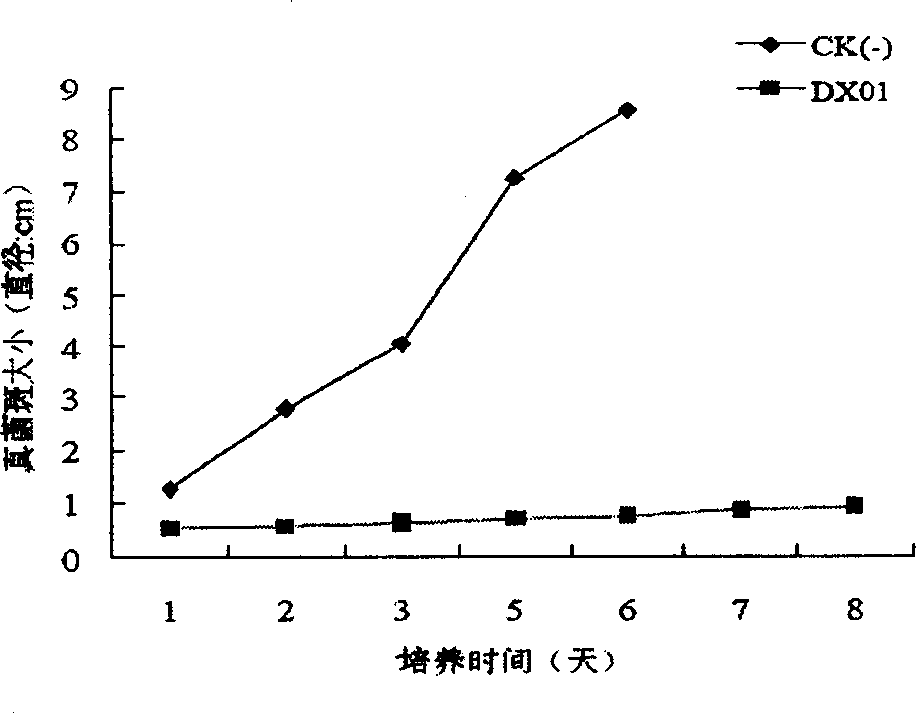
Figure 3
Abstract
Description
technical field
[0001] The invention belongs to the technical fields of molecular biology, environmental microbiology and genetic engineering, and specifically relates to a Bacillus pumilus expression system, which specifically includes a promoter active fragment F1, a fusion gene construct, and a new compositional expression vector carrying the construct . The invention also relates to a random insertion point mutation method and antibacterial research on engineering bacteria. Background technique
[0002] Fungal diseases are one of the important reasons for the loss of crop yield. The use of natural or genetically modified microorganisms to control plant fungal diseases is one of the more active research fields in the world. The inventor has isolated an epiphytic bacterium DX01 from the leaves of rice. It has been proved by experiments that this bacterium has the characteristics of natural antagonism against certain fungi. The effective components of biological pesticide...
Examples
Embodiment 1
[0051] Example 1, Subcloning of Bacillus pumilus constitutive promoter active fragment F1
[0052] PCR primers were designed according to the promoter pCP01 sequence (GenBank accession number: AF294434) of the Bacillus pumilus DX01 strain published by Cao Qingyu et al.
Embodiment 2
[0053] Example 2, Construction of Bacillus pumilus gfp gene constitutive expression vector pHY300-F1gfp
[0054] Digest the pGEM-T transformant plasmid with double restriction enzymes, cut out the promoter fragment F1, connect it with the cloning vector pUC118 that has been cut with the same double restriction enzymes, transform Escherichia coli DH5a, and screen positive clones. Plasmid pSG1164 was digested with double enzymes, and the 720bp gfp gene was excised. The gene had the initiation codon ATG, but lacked the xylose-inducible promoter Pxyl, so it could not be expressed in Escherichia coli. The gfp gene was ligated with pUC118, transformed into DH5a, and after dephosphorylation, the ligated product was transformed into Escherichia coli DH5a, and positive clones were screened.
[0055] Double digest pUC118-F1gfp, cut out a fragment of about 1.2kb, recover it and connect it with the shuttle vector pHY300PLK that has been cut with the same double restriction enzymes, transf...
Embodiment 3
[0056] Embodiment 3, fluorescence detection
[0057] Pick a single colony containing the expression plasmid DX01, shake overnight at 37°C at 250r / min, then inoculate in 50mL LB liquid medium containing the corresponding antibiotic, shake the bacteria, place in a refrigerator at 4°C for several hours to overnight, and centrifuge at 4000r / min After 15 minutes, the bacterial pellet was collected, washed twice with PBS buffer, and resuspended in 30 mL of PBS. Take 5-10μL bacterial liquid smears, observe under OLYMPUS fluorescence microscope, and take pictures with excitation light at 485nm.