
Acrylic block copolymer and thermoplastic resin composition
a technology of acrylic block and composition, applied in the direction of adhesives, etc., can solve the problems of complicated molding process, difficult moldability, and cycle time of molding, and achieve the effects of good mechanical strength, excellent mechanical strength, and excellent moldability
Patent Information
- Authority / Receiving Office
- US · United States
- Patent Type
- Applications(United States)
- Current Assignee / Owner
- Publication Date
- 2005-10-20
- Estimated Expiration
- Not applicable · inactive patent
Smart Images
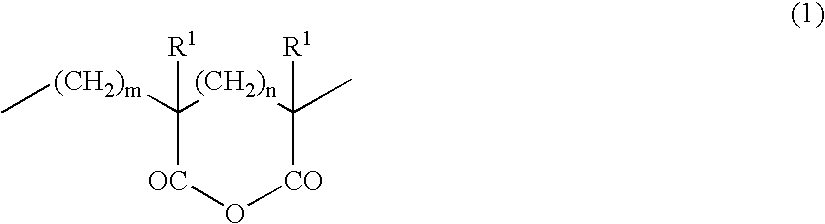
Figure 1 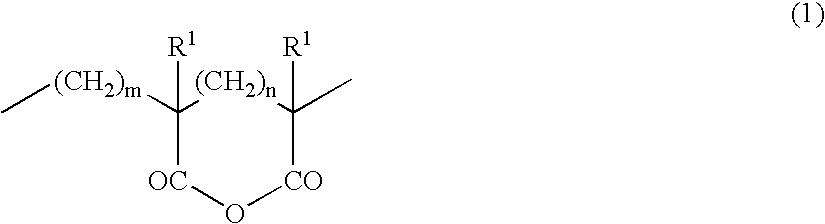
Figure 2 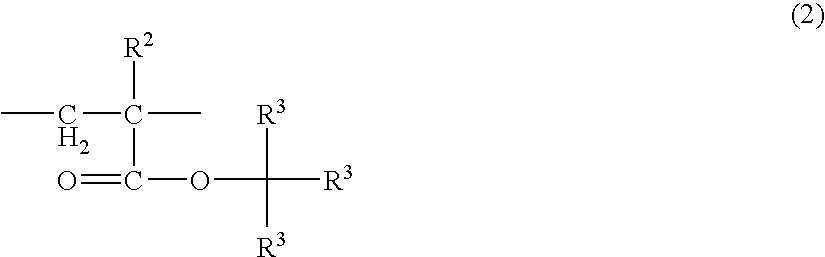
Figure 3
Abstract
Description
TECHNICAL FIELD
[0001] The present invention relates to nonconventional acrylic block copolymers and compositions which are rich in flexibility and excellent in mechanical strength, moldability, oil resistance, heat resistance, thermal decomposition resistance, weather resistance, and compression set, and is further rich in reactivity.
[0002] The present invention also relates to seal products for automobiles, home electric appliances, or office electric appliances, and automobile, electric, and electronic parts all of which are produced using the acrylic block copolymers or compositions comprising the acrylic block copolymers.
[0003] The present invention further relates to a process for producing the acrylic block copolymers. BACKGROUND ART
[0004] Although vulcanized rubber has excellent flexibility and excellent rubber elasticity, rubber must be mixed with an additive and vulcanized in molding to increase the molding cycle time and complicate the molding process, thereby causing ...
Examples
production example 1
Synthesis of (MMA-co-TBMA)-b-BA-b-(MMA-co-TBMA) (MMA / TBMA=50 / 50 Mol %, BA / (MMA-co-TBMA)=70 / 30% by Weight) Acrylic Block Copolymer (Referred to as “50TBA7” Hereinafter)
[0244] The procedures below were preformed for producing 50TBA7. The air in a 5-L separable flask used as a polymerization vessel was replaced by nitrogen, and 11.3 g (78.5 mmol) of copper bromide and 180 mL of acetonitrile (bubbled with nitrogen) were added to the flask. After stirring under heating at 70° C. for 30 minutes, 5.65 g (15.7 mmol) of diethyl 2,5-dibromoadipate serving as an initiator and 900 ml (6.28 mol) of BA were added to the flask. The resultant mixture was stirred under heating at 85° C., and 1.64 ml (7.85 mmol) of diethylenetriamine was added as a ligand to initiate polymerization.
[0245] After the initiation of polymerization, 0.2 mL of a solution was sampled from the polymerization solution with predetermined time intervals, and the BA conversion rate was determined by gas chromatographic analysi...
production example 2
Synthesis of (MMA-co-TBMA)-b-BA-b-(MMA-co-TBMA) (MMA / TBMA=95 / 5 Mol %, BA / (MMA-co-TBMA)=70 / 30% by Weight) Acrylic Block Copolymer (Referred to as “5TBA7” Hereinafter)
[0248] The target acrylic block copolymer 5TBA7 was produced by the same method as in Production Example 1 except the following procedures: In a 5-L separable flask, 5.80 g (16.1 mmol) of diethyl 2,5-dibromoadipate and 900 ml (6.28 mol) of BA were charged and subjected to polymerization. At a BA conversion rate of 95%, 40.9 ml (0.25 mol) of TBMA and 512.6 ml (4.82 mol) of MMA were added to the reaction solution. At a TBMA conversion rate of 60% and an MMA conversion rate of 57%, the reaction was terminated.
[0249] GPC analysis of the resultant acrylic block copolymer 5TBA7 showed a number-average molecular weight Mn of 107,312 and a molecular weight distribution Mw / Mn of 1.58.
production example 3
Synthesis of (MMA-co-TBMA)-b-BA-b-(MMA-co-TBMA) (MMA / TBMA=80 / 20 Mol %, BA / (MMA-co-TBMA)=70 / 30% by Weight) Acrylic Block Copolymer (Referred to as “20TBA7” Hereinafter)
[0250] The target acrylic block copolymer 20TBA7 was produced by the same method as in Production Example 1 except the following procedures: In a 5-L separable flask, 5.65 g (15.7 mmol) of diethyl 2,5-dibromoadipate and 900 ml (6.28 mol) of BA were charged and subjected to polymerization. At a BA conversion rate of 95%, 151.9 ml (0.94 mol) of TBMA and 400.9 ml (3.77 mol) of MMA were added to the reaction solution. At a TBMA conversion rate of 70% and an MMA conversion rate of 64%, the reaction was terminated.
[0251] GPC analysis of the resultant acrylic block copolymer 20TBA7 showed a number-average molecular weight Mn of 122,858 and a molecular weight distribution Mw / Mn of 1.46.