
DOWNREGULATION OF miR-7 FOR PROMOTION OF BETA CELL DIFFERENTIATION AND INSULIN PRODUCTION
a technology of mir-7 and beta cell differentiation, applied in the field of mir-7 downregulation, can solve the problems of glucose intolerance, abnormal eye appearance, and abnormal embryonic development, and achieve the effect of increasing the insulin content of beta cells
Patent Information
- Authority / Receiving Office
- US · United States
- Patent Type
- Applications(United States)
- Current Assignee / Owner
- Publication Date
- 2014-07-31
- Estimated Expiration
- Not applicable · inactive patent
Smart Images
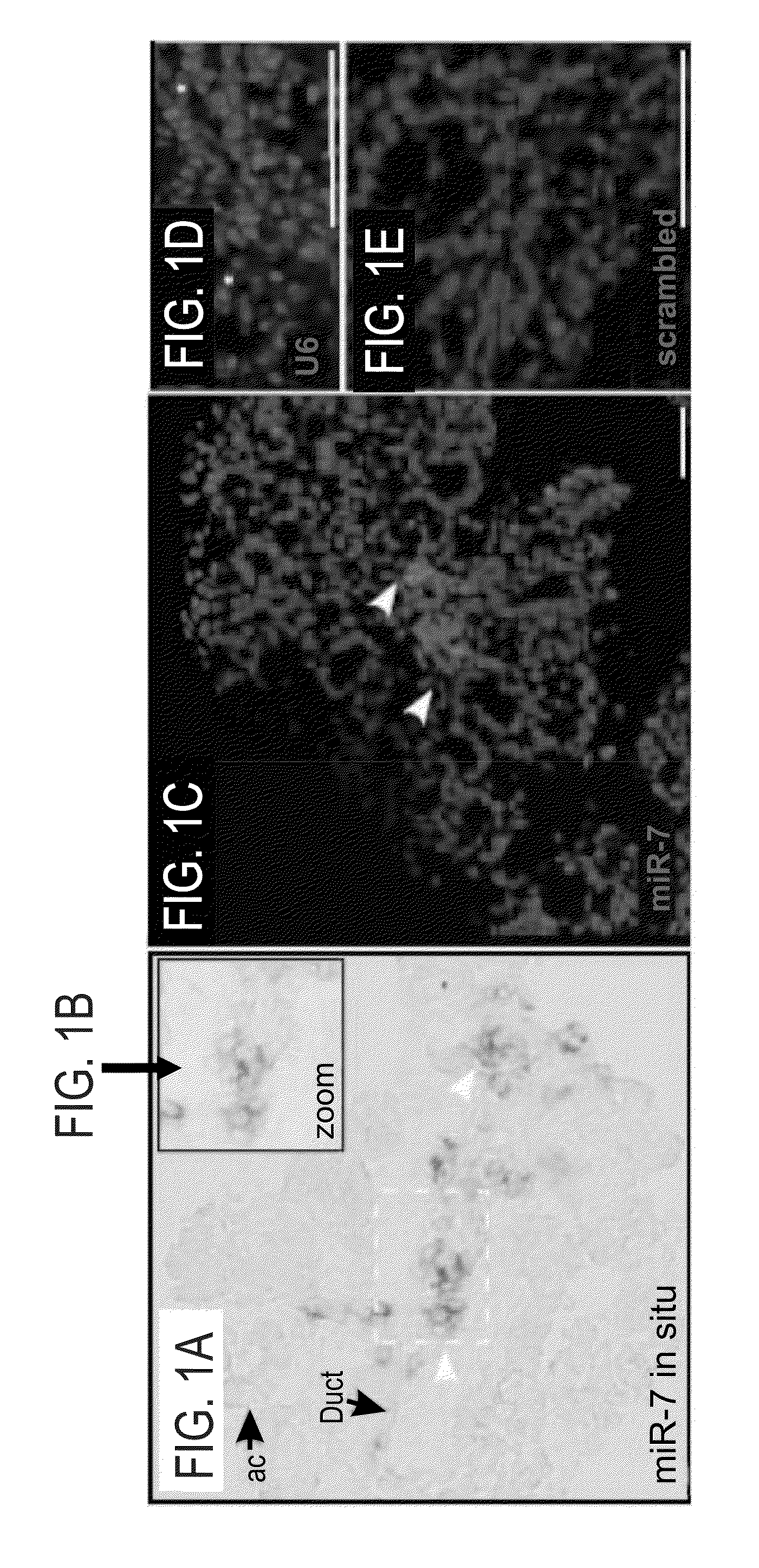
Figure 1 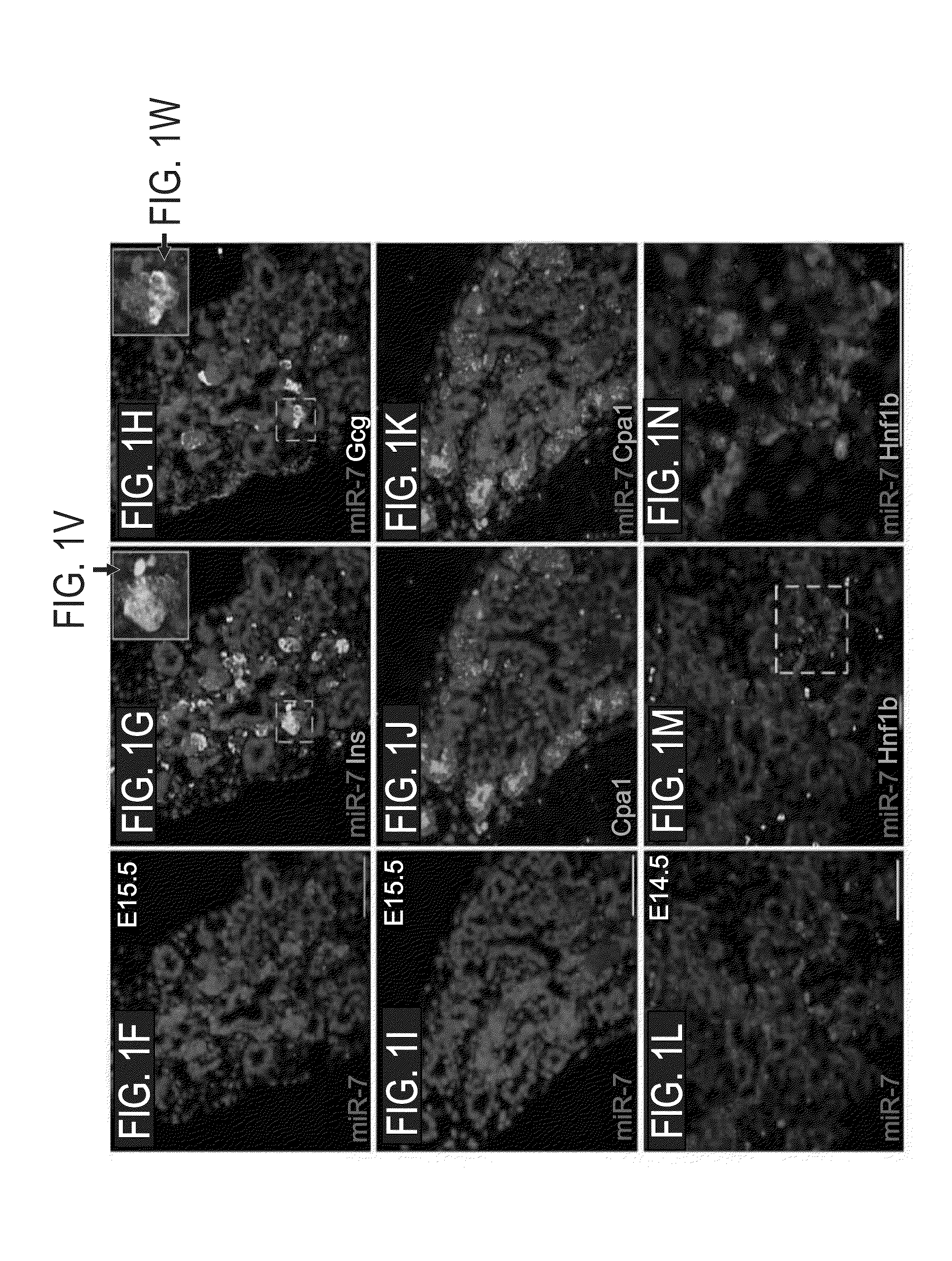
Figure 2 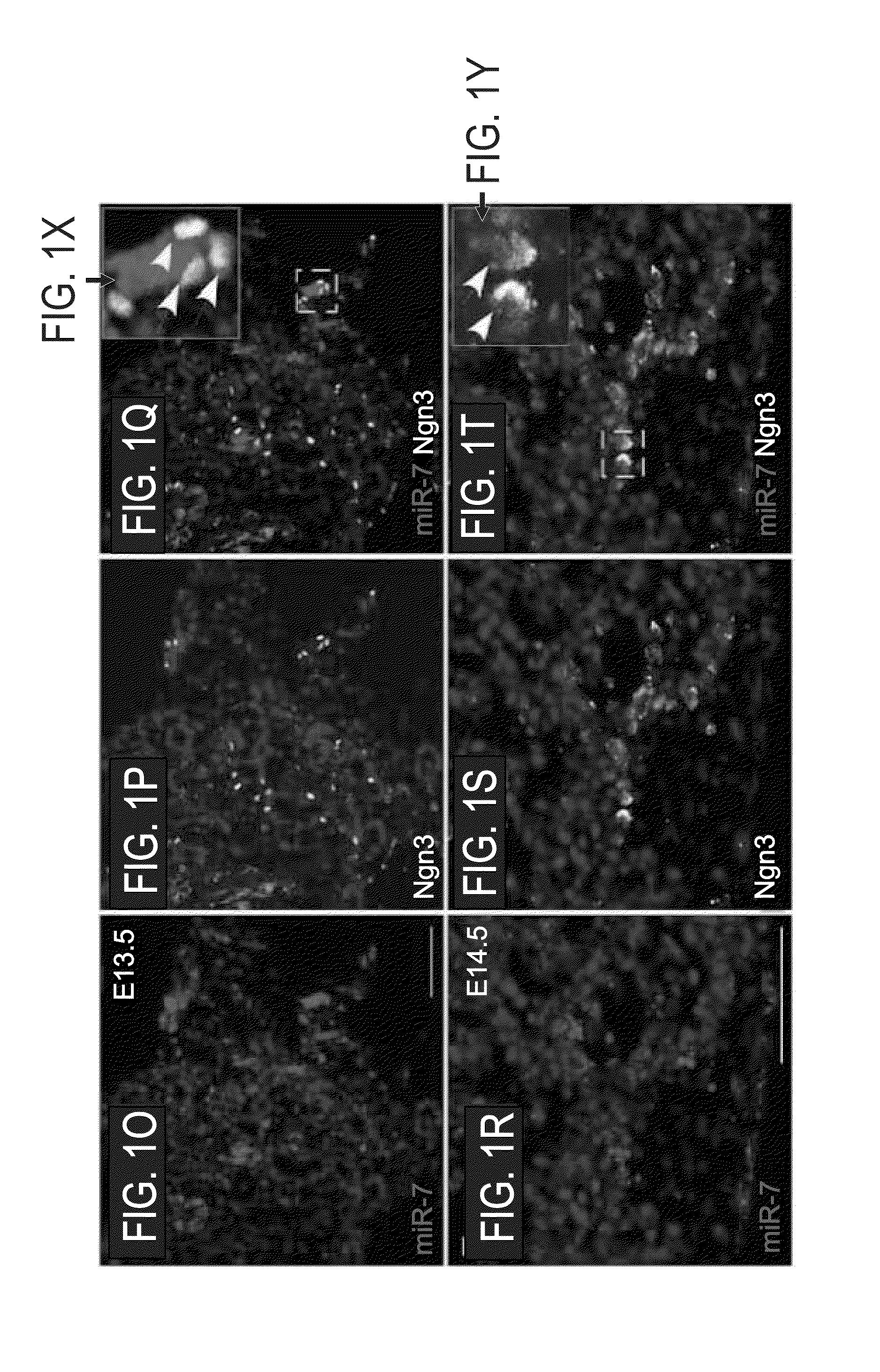
Figure 3
Abstract
Description
FIELD AND BACKGROUND OF THE INVENTION
[0001] The present invention, in some embodiments thereof, relates to downregulation of microRNA-7 and, more particularly, but not exclusively, to the use of same for promoting insulin production from pancreatic beta cells.
[0002] The development of the endocrine pancreas is governed by a network of transcription factors that specify the different endocrine cell types, including insulin-producing beta cells, glucagon-producing alpha cells, delta cells (somatostatin producing cells), PP cells (pancreatic peptide producing cells) and epsilon cells (ghrelin producing cells). The transcription factor Neurogenin3 (Ngn3) initiates the endocrine differentiation program and then a complex network of transcription factors is activated to differentially specify the endocrine lineages.
[0003] Pax6 is one such transcription factor acting downstream of Ngn3. Pax6 is pivotal in the differentiation of pancreatic beta-cells and alpha-cells, as islet morphogenesis has...
Examples
example 1
miR-7 is Expressed in the Endocrine Cells of the Pancreas
[0289]To determine the spatial expression pattern of miR-7, the present inventors carried out in situ hybridization combined with immunefluorescent protein detection on E12.5-E15.5 pancreatic sections, using a digoxigenin (DIG)-labeled LNA probe. At this time point, called ‘secondary transition’, many endocrine cells are generated within the pancreatic epithelium. Bright field analysis revealed that miR-7 expression was restricted to a subset of clustered epithelial cells at the “trunk” compartment of the branching pancreatic epithelium (FIGS. 1A-B). To identify in higher resolution what cell types expressed miR-7, the present inventors carried out fluorescence in situ hybridization. This experiment revealed clusters of miR-7 expressing cells (FIG. 1C). The hybridization pattern was specific to miR-7 and could not be detected with a probe against the ubiquitously-expressed small RNA U6 or a scrambled miRNA sequence (FIGS. 1D-E...
example 2
Pax6 is a miR-7 Target
[0290]To identify potential miR-7 targets that play a role in pancreas development, two unbiased bioinformatic approaches were employed. First, ‘gene ontology’ (GO) was analyzed in terms related to miR-7 targets [DAVID, as previously described in Dennis G. et al., Genome Biol. (2003)4, P3]. Among the 237 predicted miR-7 targets [TargetScan as described in Lewis et al. (2005) Cell, 120, 15-20], the GO term ‘Regulation of transcription’ was found to be the most significantly enriched (52 genes, P−7). Intriguingly, within this list, Pax6 was the only established pancreatic transcription factor (see Tables 2-4, below, and FIG. 2A). Furthermore, the binding site for miR-7 at the Pax6 mRNA 3′ untranslated region (3′ UTR) is predicted to be strong and conserved (FIG. 2B),
[0291]Independently, an interaction map was built of miRNAs with the 3′ UTRs of transcription factors that are known to control pancreas development, including Pdx1, Ngn3, Nkx2.2, Nkx6.1, MafB, Pax4, ...
example 3
miR-7 Controls Endocrine Differentiation in Explants Culture
[0294]To determine the functional role of miR-7 in the endocrine lineage, inventors carried out gain- and loss-of function experiments in a primary pancreatic explant system (see schematic illustration in FIG. 3A). E12.5 pancreatic buds were cultured for 48 hrs under defined ex-vivo conditions, providing a reliable model for normal development [as previously described by Kredo-Russo, S. and Hornstein, E. (2011), supra]. Inventors detected typical Ngn3, insulin and miR-7 expression that recapitulated in-vivo differentiation, including the expected differentiation of alpha and beta cells (FIG. 4A-E).
[0295]To manipulate miR-7 expression in organ cultures, inventors used cholesterol-conjugated 2′-O-methyl (2′OMe) ‘antagomirs’ against miR-7 or miR-7 ‘mimic’ oligos (termed ‘miR-7 KD’ and ‘miR-7 OE’, respectively). As ‘non-targeting’ negative controls, inventors used antagomirs against the liver specific miR-122, which is not expr...