
Compound having affinity substance to antibody, cleavable portion, and reactive group, or salt thereof
a technology of antibody and reaction substance, which is applied in the field of compound having affinity substance to antibody, cleavable portion, and reactive group, or salt thereof, can solve the problems of long time for constructing an antibody expression system, reducing the expression efficiency of antibodies themselves, and reducing the total yield
Patent Information
- Authority / Receiving Office
- US · United States
- Patent Type
- Applications(United States)
- Current Assignee / Owner
- Publication Date
- 2021-05-13
Smart Images
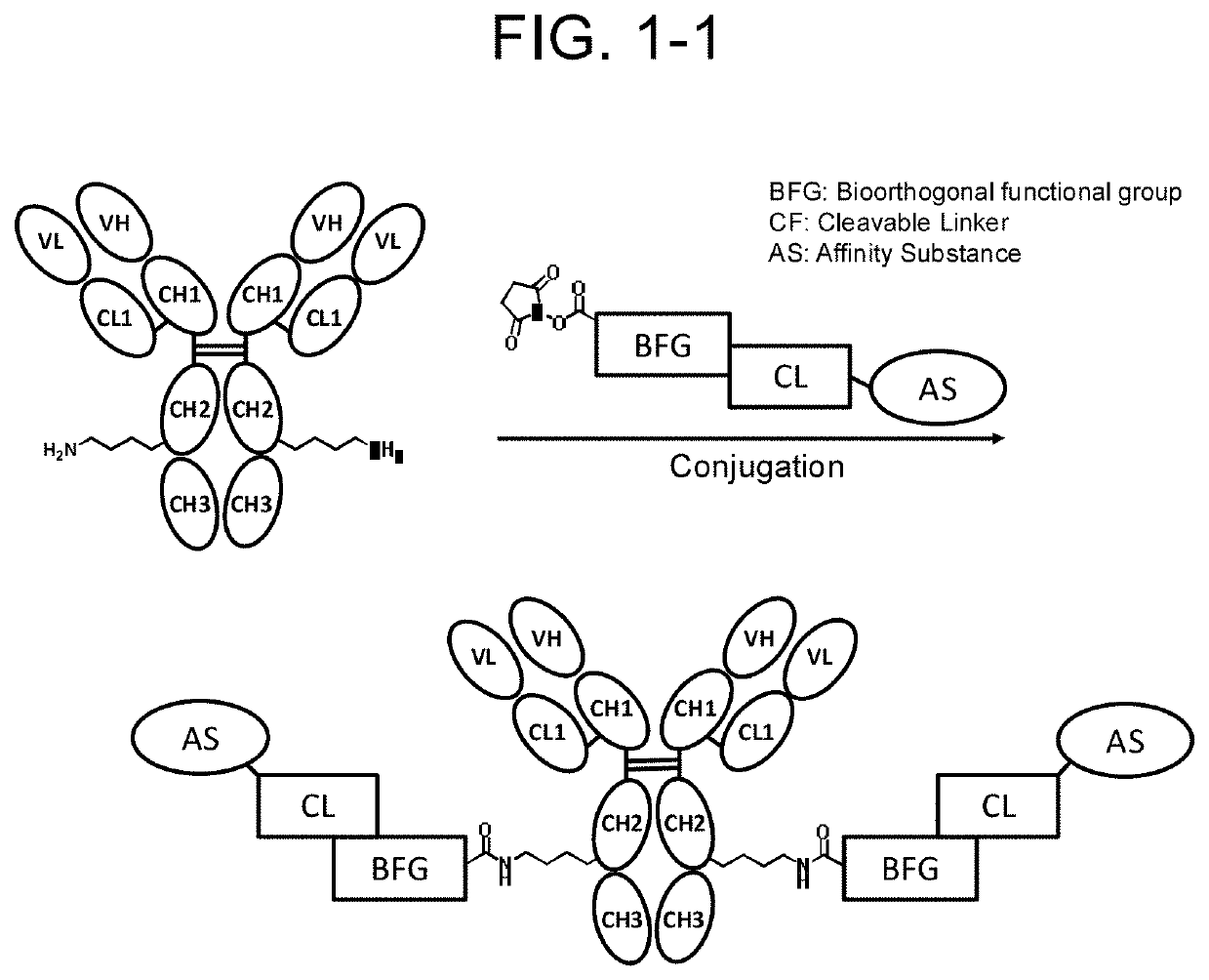
Figure 1 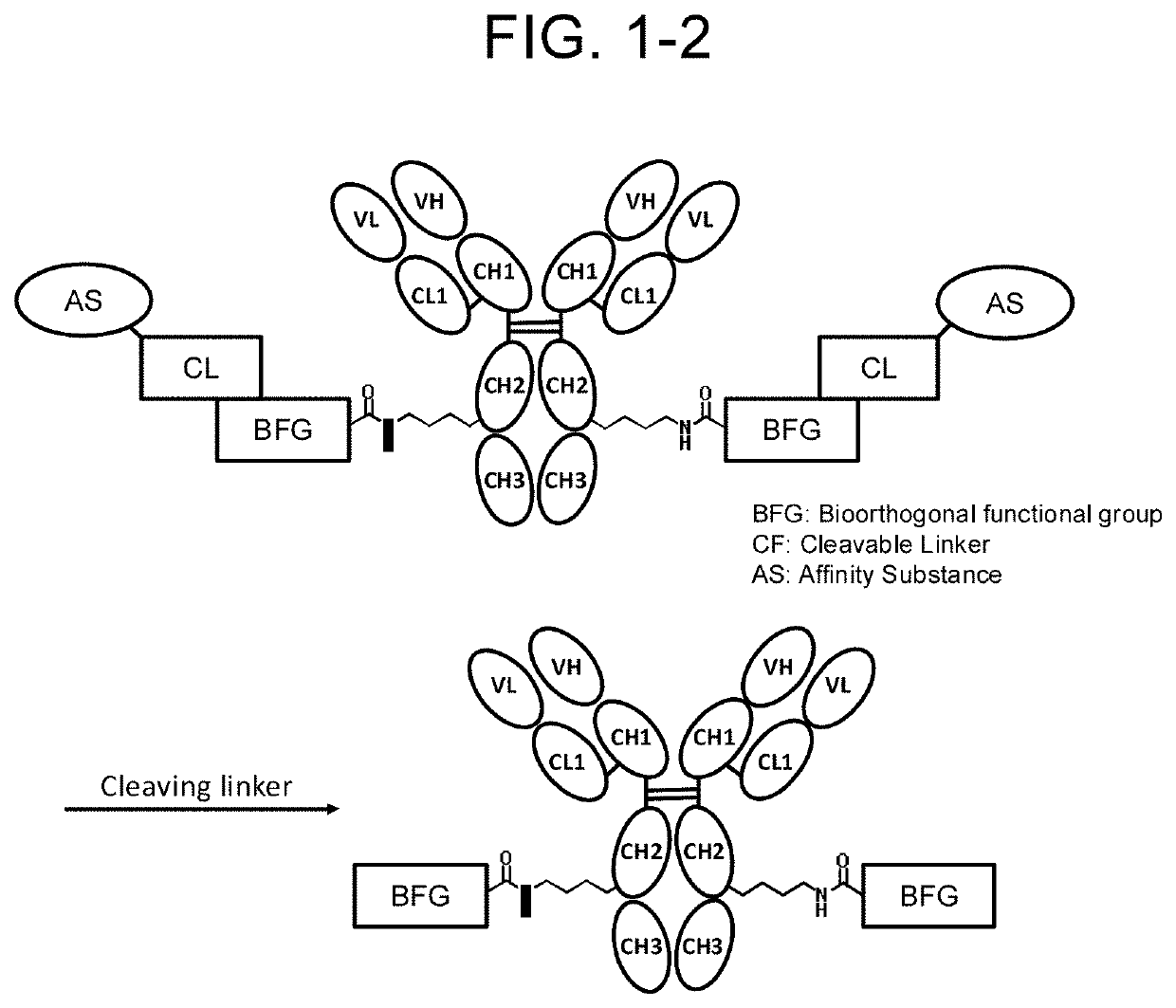
Figure 2 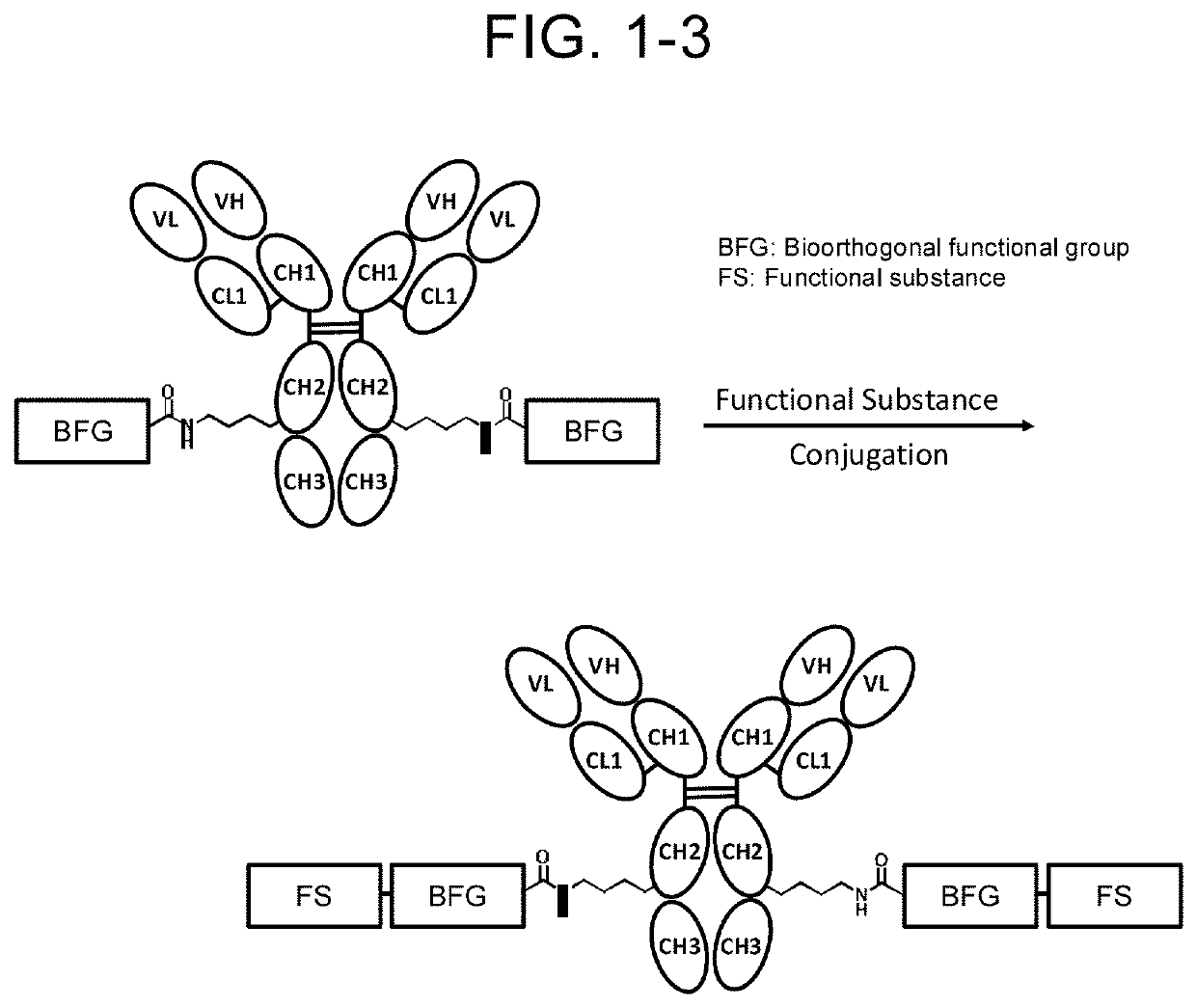
Figure 3
Abstract
Description
CROSS REFERENCES TO RELATED APPLICATIONS
[0001] This application is a continuation of International Patent Application No. PCT / JP2019 / 023778, filed on Jun. 14, 2019, and claims priority to Japanese Patent Application No. 2018-113953, filed on Jun. 14, 2018, both of which are incorporated herein by reference in their entireties.BACKGROUND OF THE INVENTIONField of the Invention
[0002] The present invention relates to compounds having an affinity substance to an antibody, a cleavable portion, and a reactive group, or a salt thereof, and the like.Discussion of the Background
[0003] In recent years, research and development of an antibody-drug conjugate (ADC) have been actively conducted. An ADC, as implied by the name, is a medicine in which a drug (e.g., an anti-cancer agent) is conjugated with an antibody and has a direct cytotoxic activity on cancer cells and the like. A typical ADC is T-DM1 (trade name: Kadcyla (registered trademark)) (see Reichert J M et al., Nat Biotechnol 2005; 23: 107...
Examples
example 1
of Compound Having Affinity Substance to Antibody, Cleavable Portion, and Reactive Group (Peptide- and Disulfide Linker-Coupled NHS-Activation Compound), Modification of Anti-HER2 IgG Antibody Trastuzumab Using the Compound, and Analysis Thereof
[1226](1-1) Synthesis of IgG1 Fc-Binding Peptide
[1227]The peptide of Ac-RGNCAYHKGQIIWCTYH-NH2 (SEQ ID NO: 5) was synthesized by Fmoc solid phase synthesis method. For a peptide synthesizing apparatus, Liberty Blue manufactured by CEM was used. For all reagents, those manufactured by Watanabe Chemical Industries, Ltd. were used. Resin was Fmoc-NH-SAL-PEG Resin HL. Arginine (R), cysteine (C), and histidine (H) were subjected to double coupling. Cutting out from Resin was performed under a condition with three-hour stirring in a solution of trifluoroacetic acid:water:triisopropylsilane:ethanediol=94:2.5:1.0:2.5. After cutting out, Resin was removed by filtration, and trifluoroacetic acid was removed. Diethyl ether was added to the formed crystal...
example 2
apping of Thiol-Introduced Trastuzumab
[1248](2-1) Treatment of Thiol-introduced Trastuzumab with Digestive Enzyme
[1249]The antibody-peptide conjugate obtained in (1-3) of Example 1 was glycosylated with PNGaseF (manufactured by New England BioLabs), and then subjected to peptide mapping. To a 1.5 mL low-adsorptive micro test tube, 10 μL of a sample solution, a 50 mM ammonium hydrogencarbonate buffer, and 10 μL of a 20 mM aqueous dithiothreitol solution dissolved in 40% trifluoroethanol were added, and the resulting solution was heated at 65° C. for one hour. Thereafter, 10 μL of a 50 mM aqueous iodoacetamide solution was added thereto, and the resulting solution was reacted in a dark place at room temperature while being shaken at 300 rpm for 30 minutes. After the reaction, 40 μL of a 50 mM ammonium hydrogencarbonate buffer was added thereto, the resulting mixture was stirred, 10 μL of a 20 ng / μL aqueous trypsin solution or 12.5 μL of a 200 ng / μL aqueous Glu-C protease solution was ...
example 3
Linker Cleavage, Reoxidation, and Fluorescent Labeling of Trastuzumab-Peptide Conjugate, and Analysis of Product Thereof
[1275](3-1) Linker Cleavage and Reoxidation of Trastuzumab-Peptide Conjugate and Analysis of Product Thereof by ESI-TOFMS
[1276]First, 1.9 mg of the trastuzumab-peptide conjugate synthesized in (1-4) of Example 1 was dissolved in a 60 mM phosphate buffer (pH 7.0) to be 18 μM, then 51.4 μL of 10 mM tris(2-carboxyethyl) phosphine (40 equivalents with respect to the trastuzumab-peptide conjugate) was added thereto, and the solution was stirred at room temperature for one hour to cleave the disulfide bond in the linker.
[1277]Next, to again form the disulfide bond in the antibody cleaved together with the disulfide bond in the linker, a process of reoxidation was performed (Jagath R Junutula et al., NATURE BIOTECHNOLOGY, 26(8), 925-932 (2008), which is incorporated herein by reference in its entirety). Specifically, the reaction solution was subjected to solvent substitu...