
Lithium secondary battery
a secondary battery and lithium battery technology, applied in the field of lithium secondary batteries, can solve the problems of insufficient charge/discharge cycle characteristics, difficult practicability, and complicated battery configuration, and achieve suppress capacity deterioration, and excellent charge/discharge cycle characteristics.
Patent Information
- Authority / Receiving Office
- US · United States
- Patent Type
- Patents(United States)
- Current Assignee / Owner
- Publication Date
- 2015-06-16
- Estimated Expiration
- Not applicable · inactive patent
Smart Images
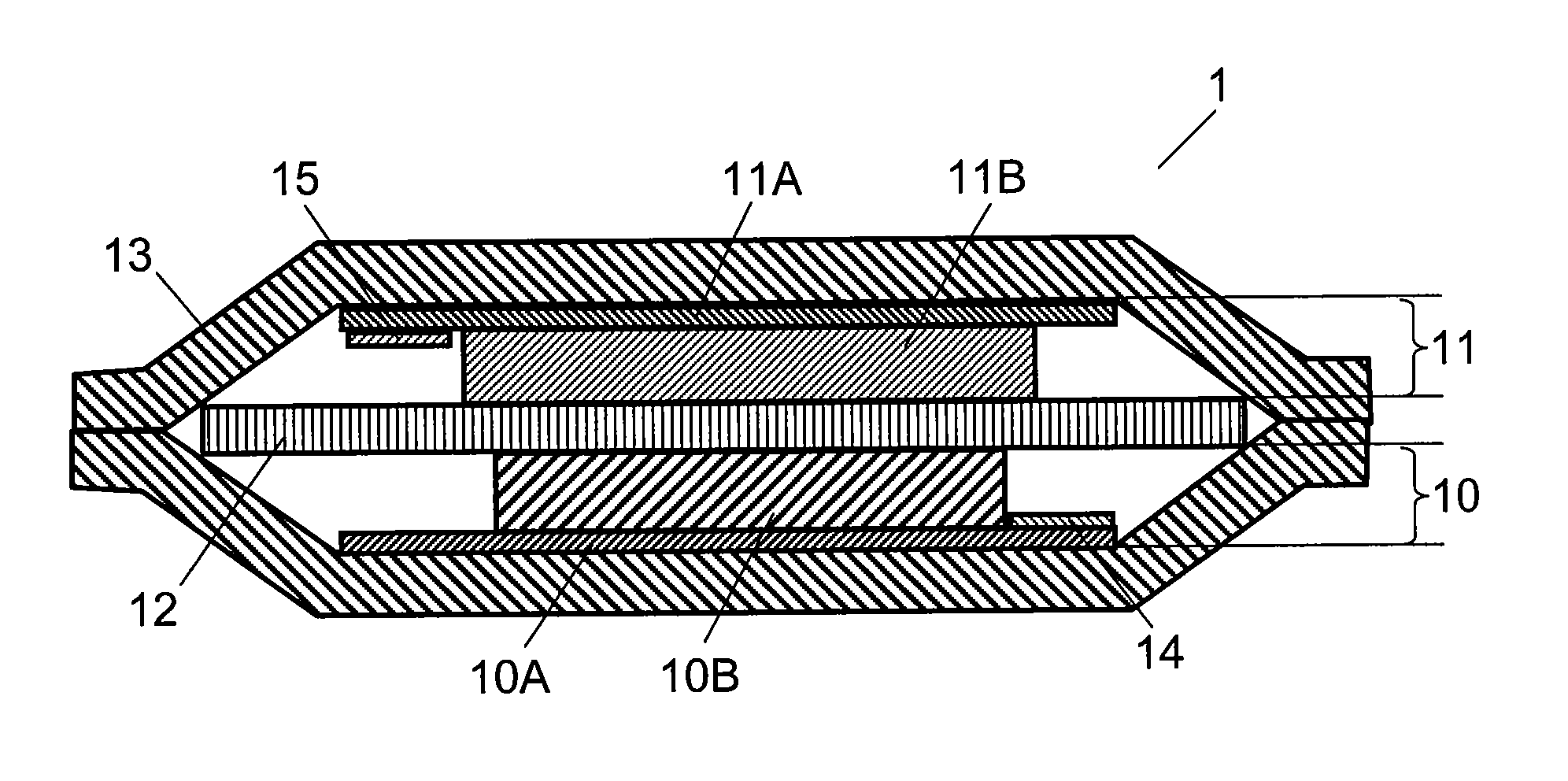
Figure 1 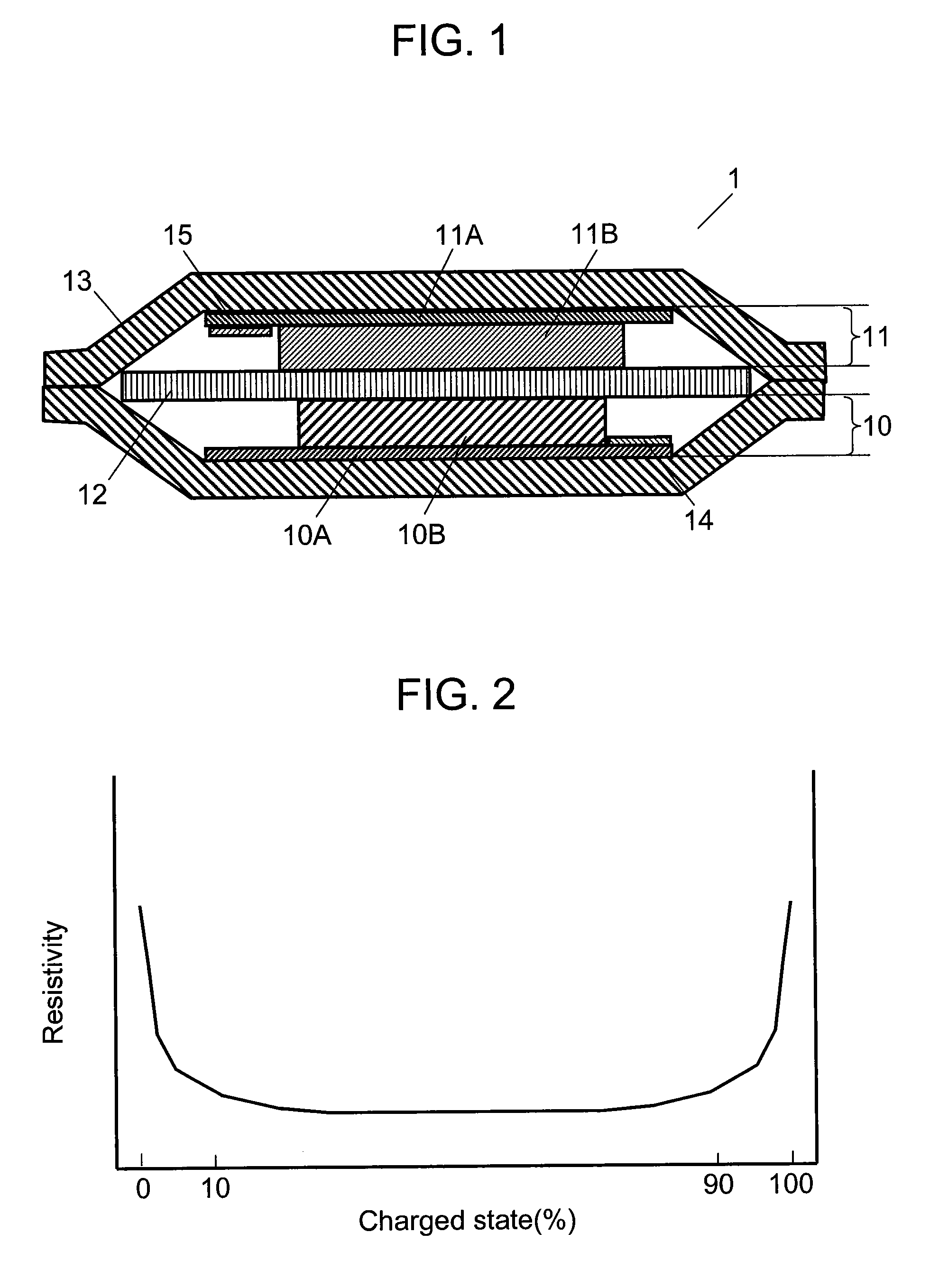
Figure 2 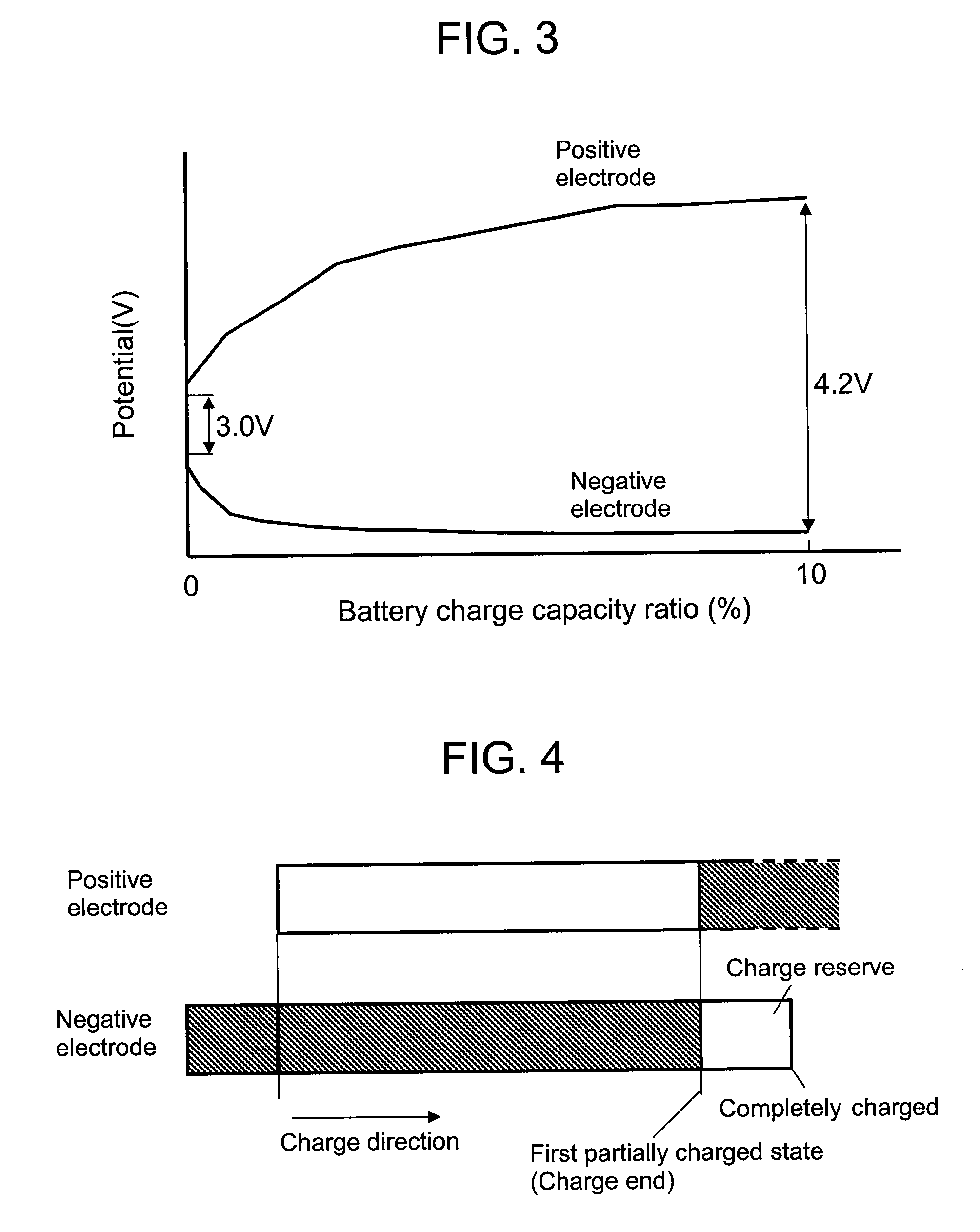
Figure 3
Abstract
Description
TECHNICAL FIELD
[0001] The present invention relates to a lithium secondary battery having an active material including at least one element of silicon and tin in a negative electrode and being excellent in the charge / discharge cycle characteristics.BACKGROUND ART
[0002] Recently, with the development of portable devices such as personal computers and portable telephones, batteries as a power source for such devices have been increasingly demanded. The batteries used for the above-mentioned applications are required to be used at ordinary temperatures as well as to have a large energy density and excellent cycle characteristics.
[0003] In order to respond to these requirements, for both positive electrode and negative electrode, active materials having a large capacity density have been newly developed. Above all, elemental substances, alloys, or oxides of silicon (Si) or tin (Sn) that can provide an extremely large capacity density are promising materials as negative active materials.[00...
Examples
first exemplary embodiment
[0027]FIG. 1 is a schematic sectional view showing a configuration of a laminated battery as an example of a lithium secondary battery in accordance with one exemplary embodiment of the present invention. In lithium secondary battery 1, positive electrode 10, negative electrode 11 and separator 12 intervened therebetween are laminated to each other so as to form an electrode group. This electrode group and a non-aqueous electrolyte (not shown) having lithium ion conductivity are accommodated inside outer case 13. The non-aqueous electrolyte is impregnated into separator 12 and interposed between positive electrode 10 and negative electrode 11.
[0028]Positive electrode 10 includes positive electrode current collector 10A and positive electrode active material layer 10B supported by positive electrode current collector 10A. Negative electrode 11 includes negative electrode current collector 11A and negative electrode active material layer 11B supported by negative electrode current col...
second exemplary embodiment
[0055]In this exemplary embodiment, an additive for improving the viscosity of a coating film of a negative electrode active material is added to lithium secondary battery 1. Except the additive, the configuration of the battery and idea of designing the capacity in this exemplary embodiment are substantially similar to those of the first exemplary embodiment.
[0056]As the additive, vinylene carbonate, vinyl ethylene carbonate, fluoroethylene carbonate and the like may be used singly or in combination thereof. These additives may be added to an electrolytic solution as a non-aqueous electrolyte or applied to negative electrode 11 prior to the infusion of the electrolytic solution. Since the use of such additives improves the viscosity of the coating film of the negative electrode active material, the destruction of the coating film when discharge proceeds and the charged state of the negative electrode active material is lowered is suppressed. Due to this, when the second partially c...
example
[0059]Hereinafter, specific examples and the effects thereof are described. Firstly, a production procedure of negative electrode 11 is described. FIG. 10 is a schematic configuration view showing a manufacturing device of a negative electrode for a non-aqueous electrolyte secondary battery in the Example of the present invention. FIG. 11 is a schematic sectional view showing a negative electrode produced by using the device of FIG. 10.
[0060]Manufacturing device 80 includes: vapor deposition unit 85 for forming a columnar body by depositing, on the surface of current collector 11A, material to be vacuum-deposited; gas introducing pipe 82 for introducing oxygen into vacuum chamber 81; and fixing stand 83 for fixing current collector 11A. At the tip of gas introducing pipe 82, nozzle 84 for supplying oxygen into vacuum chamber 81 is provided. These are disposed in vacuum chamber 81. Vacuum pump 86 reduces the pressure inside vacuum chamber 81. Fixing stand 83 is disposed above nozzle ...