
Fountain solution composition for lithographic printing and heat-set offset rotary printing process
A technology of lithographic printing and dampening solution, applied in printing, preparation of printing surface, printing device, etc., can solve the problem of blanket ink accumulation not specifically raised, achieve good printing performance, easy adjustment, and suppress ink accumulation Effect
- Summary
- Abstract
- Description
- Claims
- Application Information
AI Technical Summary
Problems solved by technology
Method used
Image

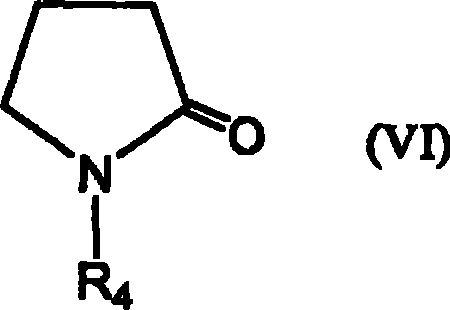
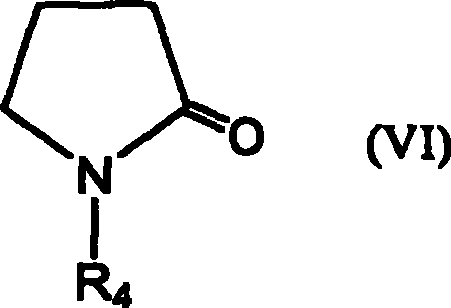
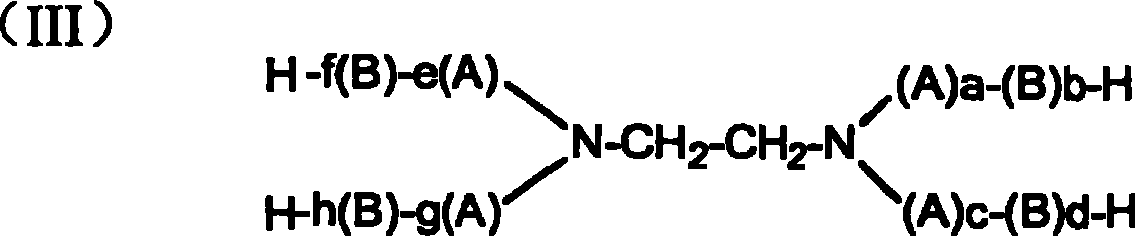
Examples
Embodiment 1 and 2 and comparative example 1~11
[0141]Except for changing the diol compound according to the following Table 1, use equal mass and exactly the same operation to prepare various fountain solution compositions according to the following formulas. In this formula, the unit is gram, and it is the addition amount in the case of adding water to adjust to 100 g at the end, and has the same meaning as mass %.
[0142] Formulation of fountain solution composition (use solution) when used
[0143] Ingredients Amount
[0144] Propylene glycol mono-n-butyl ether 0.5g
[0145] Propylene glycol 0.3g
[0146] Glycol compound 0.3g of table 1
[0148] Citric acid 0.01g
[0149] Isothiazolin-3-one 0.002g
[0150] Benzotriazole 0.001g
[0151] Add water to reach 100g
[0152] For each fountain solution composition, a Lithron 26 printing machine manufactured by KOMORI Co., Ltd. was used, ink Super Leo Ecoo Black L of Toyo Ink Co., Ltd., micro-coated paper OK coat of Oji Paper Co., Ltd., a...
Embodiment 3~12
[0170] Except that the propylene glycol mono-n-butyl ether and propylene glycol in Example 2 were replaced with the compounds in Table 2 below, all experiments were performed in the same manner. In Example 12, isopropanol was used and its added amount was increased to 15 times (ie, 7.5%) that of the compound used in other examples (0.5%). In Example 12, unless the amount of isopropanol was increased in this way, even if the amount of water was increased, the ink tended to adhere to the non-image portion of the printed matter, and staining tended to occur. The results are shown in Table 2.
[0171] Table 2
[0172] Example
Compound 1
Compound 2
dot area
Reduction rate (%) Feed roller contamination
2 Propylene glycol mono-n-butyl ether Propylene Glycol 49 6 ○ 3 Ethylene glycol mono-n-butyl ether Propylene Glycol 52 8 ○ 4 Ethylene glycol mono-tert-butyl ether Propylene Glycol 52 8 ○ 5 Eth...
experiment example 1
[0176] The same printing experiment was carried out by only changing the addition amount of the diol compound in Example 2. As a result, it was found that the added amount is preferably 0.05% or more, more preferably 0.1% or more, particularly preferably 0.2% or more. In addition, when the added amount exceeds 1%, contamination of the water feed roller tends to worsen.
[0177] Furthermore, when the amount of 1,2-octanediol added was 70% and 1,2-hexanediol was added 30% in Example 2, the same effect was seen.
[0178] The results are shown in Table 3 below.
[0179] table 3
[0180] 1,2-octanediol content
[0181] * ○△=The intermediate level between ○ and △
PUM
 Login to View More
 Abstract
Description
Claims
Application Information
 Login to View More