Audio fine scalable coding method and system based on perception self-adaption bit allocation

A hierarchical coding and bit allocation technology, applied in the field of audio coding, can solve problems such as quantization efficiency and grading granularity cannot have a good unified process, lack of sub-band bits, uneven bit allocation, etc., to achieve high-efficiency, fine-scale and scalable audio coding , achieve quantization accuracy and quantization efficiency, and improve the effect of coding efficiency

CN101800050BInactive Publication Date: 2012-10-10WUHAN UNIV
0 Cites 1 Cited by

Patent Information

Authority / Receiving Office
CN · China
Patent Type
Patents(China)
Current Assignee / Owner
Publication Date
2012-10-10
Estimated Expiration
Not applicable · inactive patent

Smart Images

  • Figure 1
    Figure 1
  • Figure 2
    Figure 2
  • Figure 3
    Figure 3
Patent Text Reader

Abstract

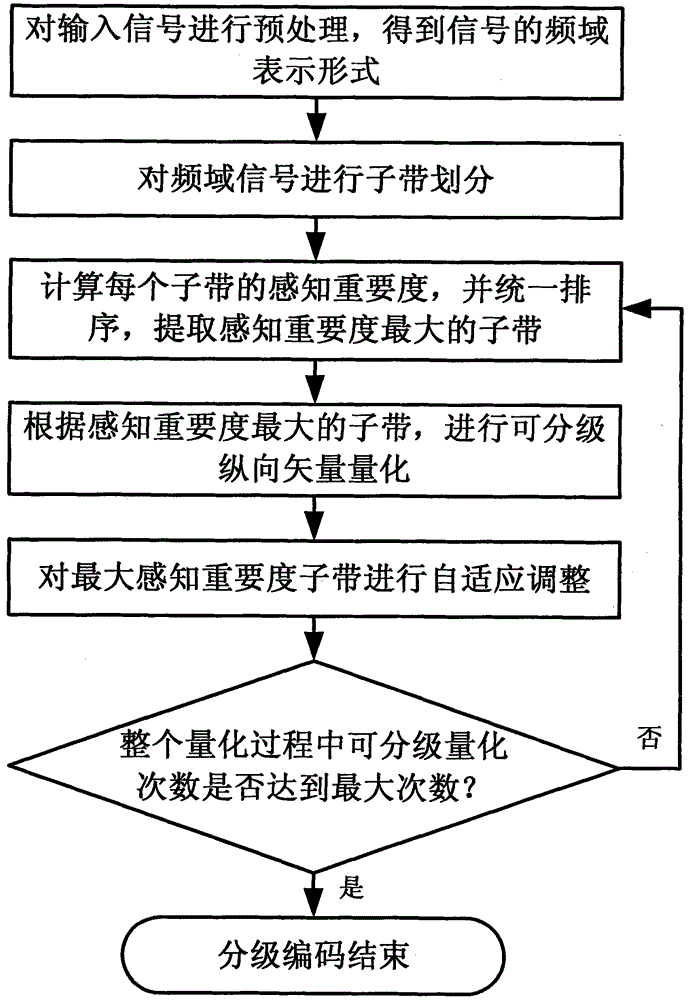
The invention relates to the technical field of audio coding, in particular to audio fine scalable coding method and system based on perception self-adaption bit allocation. The method comprises the following steps of: preprocessing input signals; carrying out subband division on frequency-domain signals; calculating the perception importance of each subband; uniformly sequencing the subband fromsmall to large according to the perception importance; extracting the subband with the largest perception importance for scalable longitudinal vector quantization; and then carrying out self-adaptionadjustment on the vector-quantized subband with the largest perception importance. The system comprises a preprocessing module, a subband division module, a perception importance calculating, sequencing and extracting module, a scalable quantizing and coding module, a self-adaption adjusting module and a scalable coding finish judging module. The invention realizes high-efficient fine scalable audio coding, preferably realizes the unification of quantization precision and quantization efficiency and also satisfies the requirement of high tone quality when improving coding efficiency.
Need to check novelty before this filing date? Find Prior Art

Description

technical field

[0001] The present invention relates to the technical field of audio coding, in particular to an audio fine hierarchical coding method and system based on perceptual adaptive bit allocation. Background technique

[0002] Scalable audio coding technology divides the code stream into a core layer and multiple enhancement layers. The core layer guarantees the minimum reconstruction quality of the signal, and the enhancement layer gradually improves the reconstruction quality by improving the signal-to-noise ratio or extending the frequency band. The received The more enhancement layers, the higher the decoding sound quality.

[0003] Scalable coding methods can adapt to network bandwidth fluctuations by directly discarding the enhancement layer code stream. The finer the grading granularity, the more effective it can adapt to network bandwidth fluctuations; on the other hand, the objective criterion for evaluating the performance of scalable audio coding is that...

Examples

Embodiment Construction

[0048] The present invention mainly takes the perceptual importance of sub-bands as a measure standard, and proposes an audio fine hierarchical coding method and system based on perceptual adaptive bit allocation.

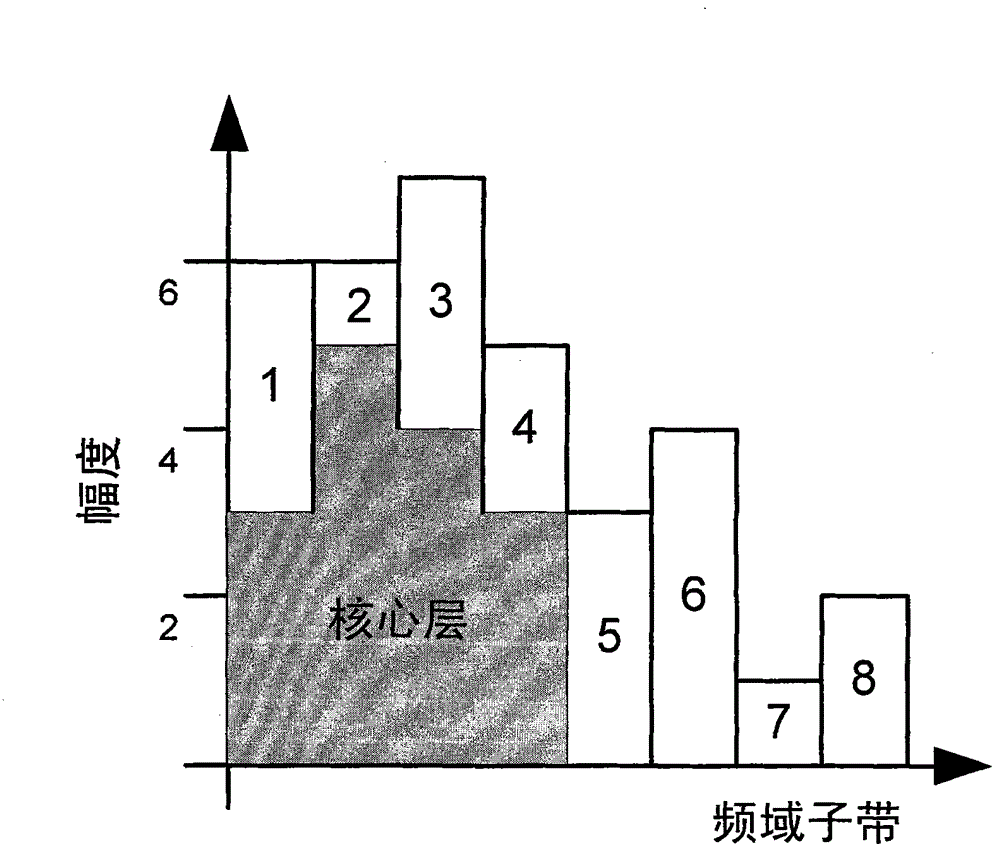
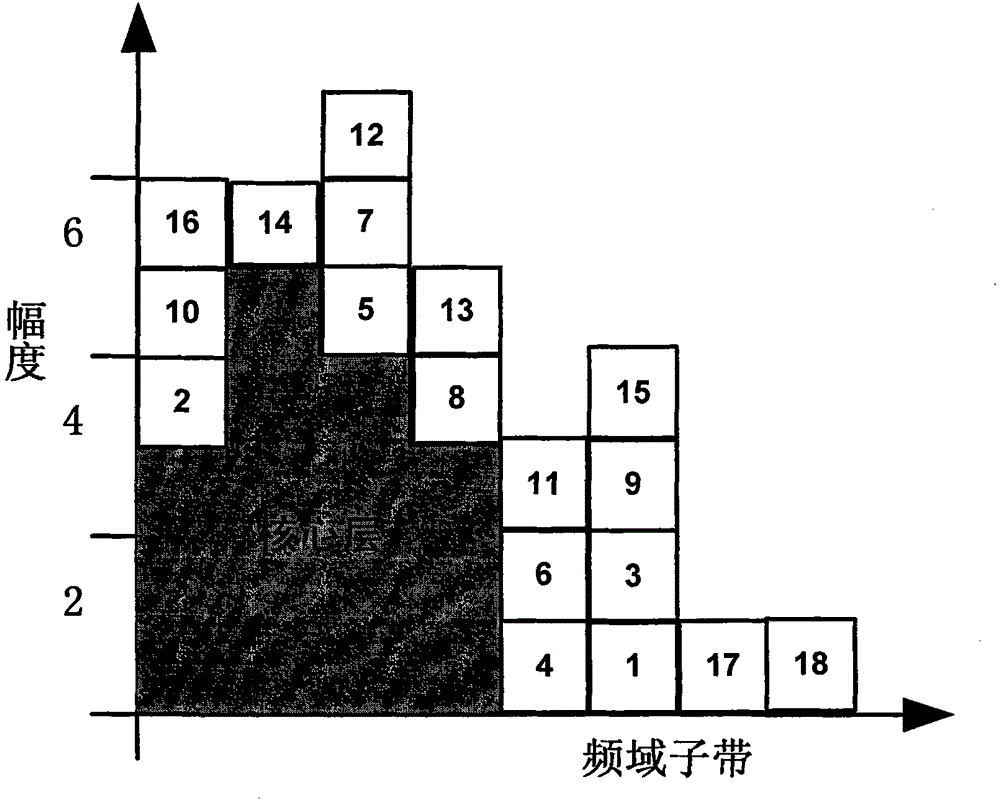
[0049] Compared with the one-time allocation of bits to the sub-band with the highest perceptual importance, the present invention increases the classification accuracy, and compared with the bit-by-bit allocation method, improves the coding efficiency. Starting from the perceptual characteristics of the human ear, the perceptual importance To measure the standard, the sub-bands are subjected to scalable vector quantization to improve the classification accuracy. The present invention will be described in detail below in conjunction with the accompanying drawings.

[0050] The audio fine hierarchical coding method based on perceptual adaptive bit allocation provided by the present invention specifically includes the following steps, such as figure 1 shown, includin...