
Signal regulating method for pedestrian crossing road section of bus prior passage
A technology for pedestrian crossing and bus vehicles, which is applied to the traffic control system, traffic control system, instruments and other directions of road vehicles, which can solve the problem of pedestrian crossing coordination, public transportation efficiency interference, and the crossing signal is not included in the bus signal priority control system, etc. question
- Summary
- Abstract
- Description
- Claims
- Application Information
AI Technical Summary
Problems solved by technology
Method used
Image

Examples
Embodiment Construction
[0026] Below in conjunction with accompanying drawing, the present invention will be further described.
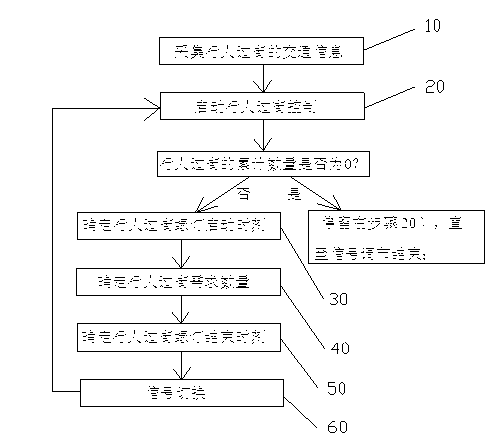
[0027] Such as figure 1 As shown, the signal regulation and control method for the pedestrian crossing section of the bus vehicle priority passage of the present invention comprises the following steps:
[0028] Step 10): Collect traffic information of pedestrians crossing the street. Step 10) includes step 101) and step 102).
[0029] Step 101): collecting static data, pedestrian crossing speed and dynamic real-time data. Among them, the static data includes: the length L of the pedestrian crossing, the width W of the pedestrian crossing, and the signal cycle duration C of the first intersection upstream of the pedestrian crossing 1 , the signal phase number i of the first intersection upstream of the crosswalk 1 , The signal cycle duration C of the first intersection downstream of the crosswalk 2 and the number of signal phases i at the first intersection downstream...
PUM
 Login to View More
 Abstract
Description
Claims
Application Information
 Login to View More