Sorting and grouping method for lithium ion batteries

A lithium-ion battery, matching technology, applied in secondary batteries, secondary battery testing, secondary battery repair/maintenance, etc., can solve problems such as high cost and complex battery sorting process, achieve long service life, reduce The occurrence of adverse phenomena and the effect of simple matching method

CN103579700AActive Publication Date: 2014-02-12DONGGUAN ADF BATTERY
5 Cites 26 Cited by

Patent Information

Authority / Receiving Office
CN · China
Current Assignee / Owner
Publication Date
2014-02-12

Smart Images

  • Figure 1
    Figure 1
  • Figure 2
    Figure 2
  • Figure 3
    Figure 3
Patent Text Reader

Abstract

The invention relates to the technical field of lithium ion battery manufacturing, and particularly relates to a sorting and grouping method for lithium ion batteries. The sorting and grouping method is widely applied to sorting and grouping of battery packs of various types of electronic and electrical equipment such as small digital electrical appliances, electric bicycles and electric automobiles. The sorting and grouping method comprises the following steps: firstly, spraying codes on or numbering single batteries, and collecting first capacity, voltage and internal resistance of the single batteries; and aging the single batteries, collecting second voltage, internal resistance and recovery capacity of the single batteries, carrying out data statistics on grouping factors, establishing the grading standard of each grouping factor of the single batteries, determining the level of each grouping factor of each single battery, and selecting the grouping factors according to practical conditions to carry out sorting and grouping. The sorting process is simple, the requirement on sorting equipment is simple, and thus the sorting and grouping cost is reduced; the method has the function of preferably selecting battery packs with long service life, unqualified battery cores can be eliminated, and thus undesirable effects of produced battery packs can be reduced.
Need to check novelty before this filing date? Find Prior Art

Description

technical field

[0001] The invention relates to the technical field of lithium-ion battery manufacturing, in particular to a lithium-ion battery sorting and grouping method, which is widely used in various electronic and electrical equipment such as small digital appliances, electric bicycles, electric vehicles and other battery sorting and grouping methods . Background technique

[0002] As a new type of energy storage device, lithium-ion batteries have attracted more and more attention because of their advantages such as high specific energy, high specific power, high working voltage, low self-discharge, good cycle performance and friendly manufacturing environment. . At present, in the lithium-ion battery production industry, it is common for the charging and discharging performance, cycle life and safety performance of single lithium-ion batteries to meet industry, national and international industry technical standards. However, once multiple single batteries are combi...

Examples

Embodiment Construction

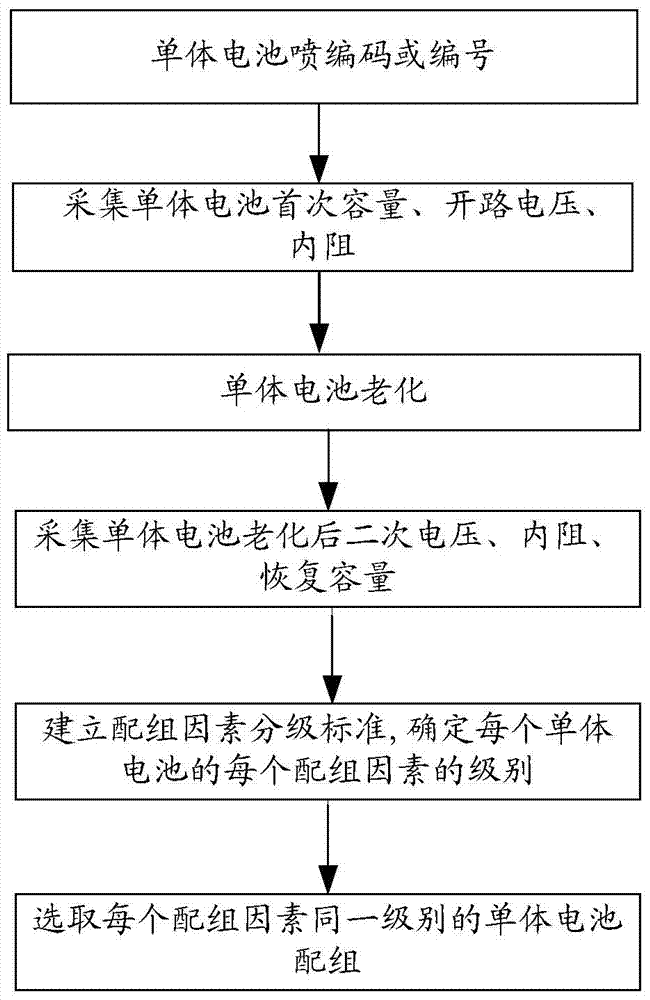
[0030] Such as figure 1 As shown, the sorting and grouping method of lithium-ion batteries of the present invention mainly includes the following steps:

[0031] 1) Coding or numbering each single battery of the same batch;

[0032] 2) Distinguish the capacity of the single battery after printing or numbering, select the single battery with a charge of 0% to 80%, measure and record the first voltage V of the above single battery 1 , internal resistance R 1 and capacity C 1 ;

[0033] 3) Put the above single battery into the aging device, and age it for 4 hours to 30 days at a temperature of 25°C to 80°C. After the aging is completed, collect the secondary voltage V of the aged single battery 2 , internal resistance R 2 and recovery capacity C 2 , at the same time according to the recovery capacity C 2 Establish a grading standard for the recovery capacity, and at the same time grade the recovery capacity of each single battery;

[0034] 3) Statistics of voltage change ...