
Drainage four-way inspection well to prevent water flow hedging
A technology for inspecting wells and water flow, which is applied in the field of sewage confluence drainage structures, rainwater, and drainage four-way inspection wells, and can solve problems such as turbulent flow, turbulent flow, and large water head loss in three-way inspection wells
- Summary
- Abstract
- Description
- Claims
- Application Information
AI Technical Summary
Problems solved by technology
Method used
Image

Examples
Embodiment 1
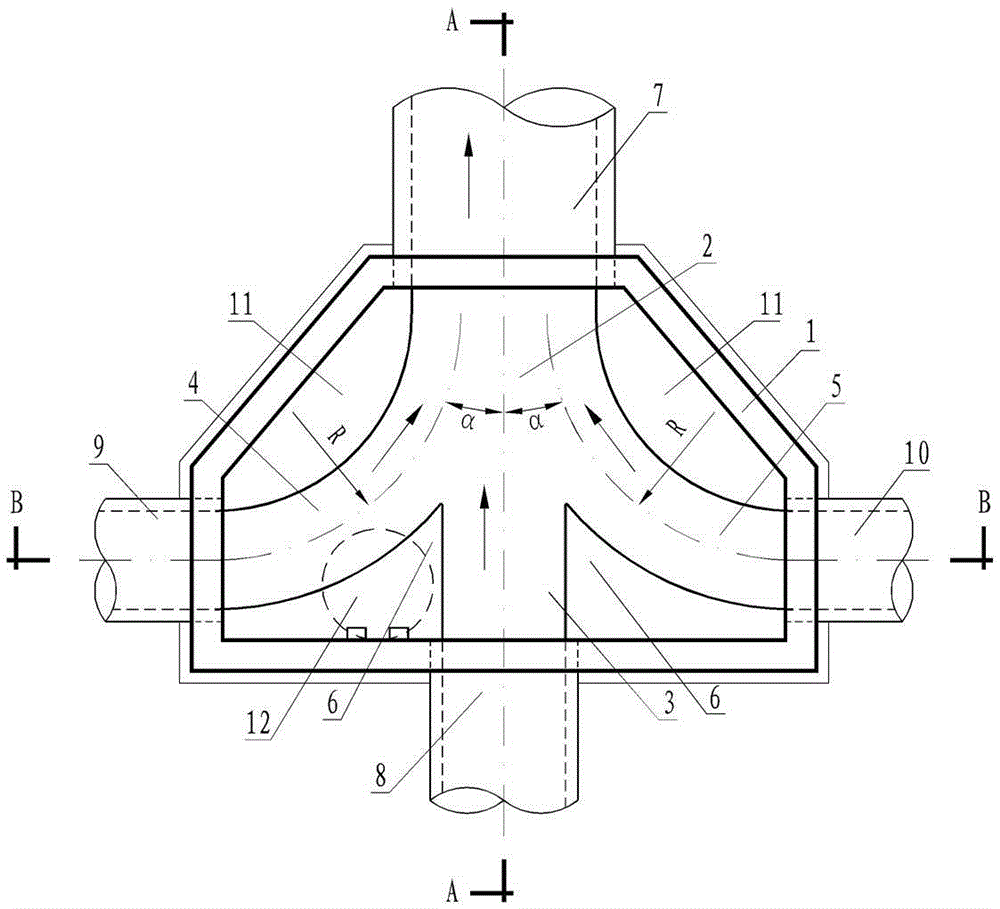
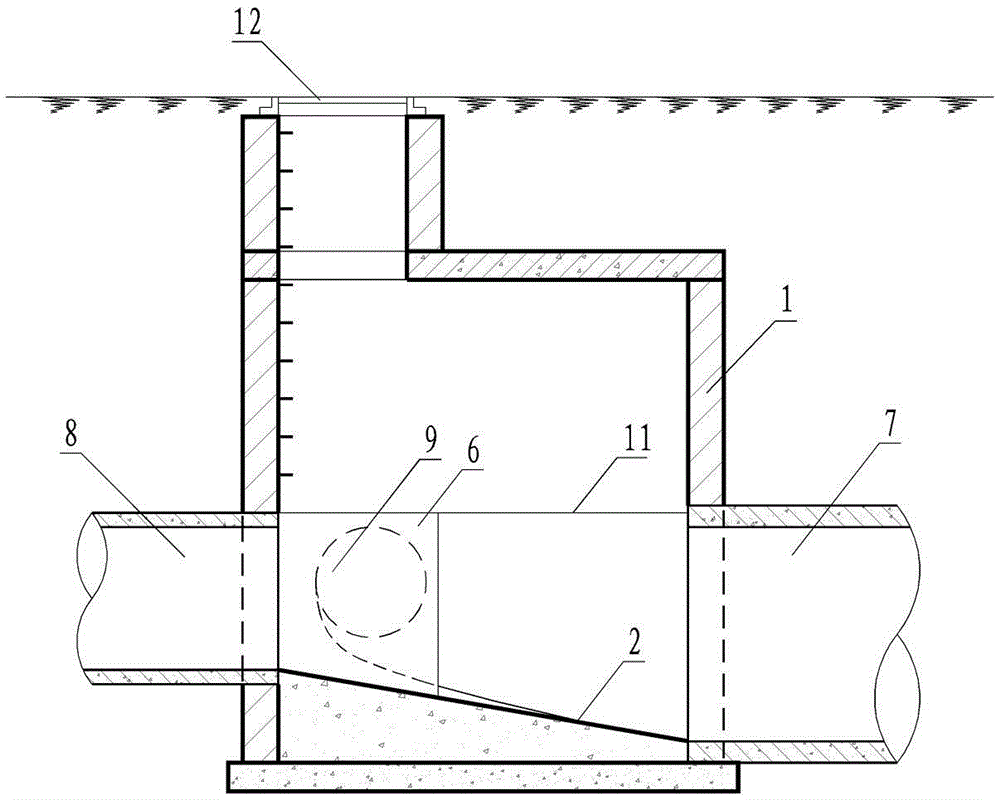
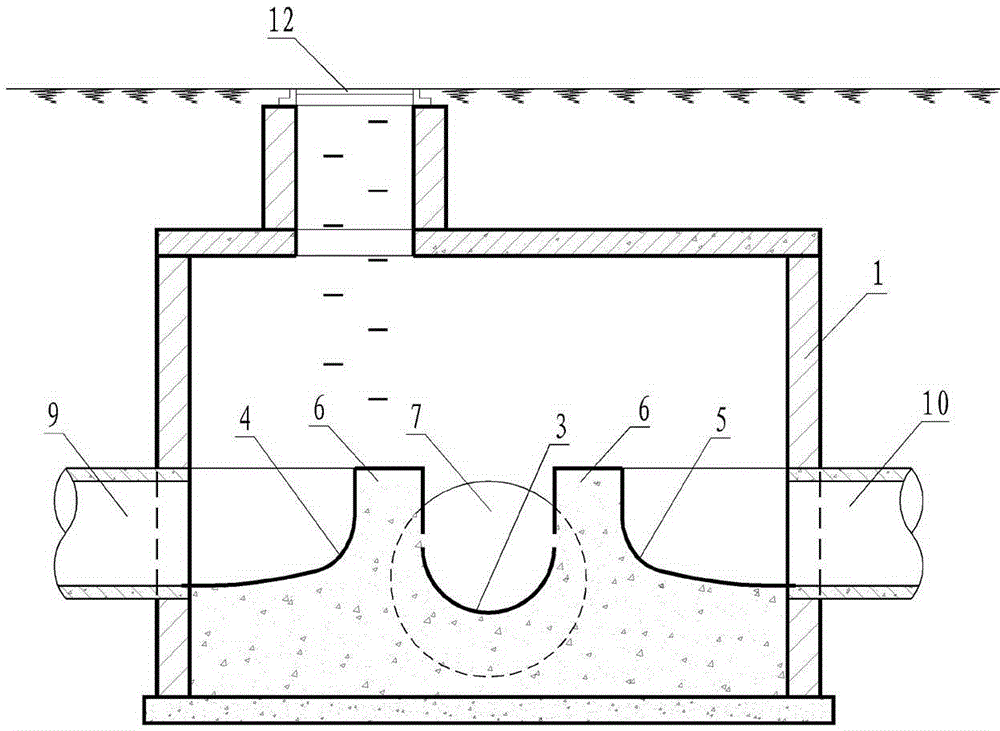
[0016] Embodiment 1: For the plan view of the masonry type four-way inspection well, see figure 1 According to the pipe diameters of the downstream pipe 7, the upstream pipe 8, the left branch pipe 9, and the right branch pipe 10, as well as the angle α between the branch pipes and the radius R, the dimensions of each part are determined. Connected, that is, the inner top of the water inlet and outlet pipes are the same height. Increasing the included angle α can reduce the size of the inspection well, but the water flow conditions will become worse. figure 1 The included angle α in is 20°. The well body 1 is built with bricks, and the distance between the knuckles of the well body 1 at the downstream pipe 7, the left branch pipe 9, and the right branch pipe 10 and the inner diameter of the pipe should be ≥ 150mm. Isolation platform 6 and workbench 11 are poured with formwork concrete, and the catchment trough 2, upstream trough 3, left trough 4, and right trough 5 should be...
Embodiment 2
[0017] Embodiment 2: In addition to the masonry type, the drainage four-way inspection well to prevent water flow hedging can also make the launder into plastic pipe fittings. The catchment launder 2 can be replaced by launder pipe fittings 21, which are arranged in the well body 1, and the upstream flow Groove 3, left trough 4, and right trough 5 can be replaced by upstream straight pipe 31, left curved pipe 41, and right curved pipe 51 respectively, which are arranged outside the well body 1 and correspond to the launder pipe fittings 21 respectively. The interface is connected, and the size of the well body 1 can be greatly reduced. The branch pipes on both sides and the upstream main pipe are separated by pipe fittings and flow into the inspection well at a small angle. The water flow condition is good, the well body size is relatively small, and the construction is convenient. For the plan view of the pipe-fitting four-way inspection well, see Figure 4 , the side branch...
PUM
 Login to View More
 Abstract
Description
Claims
Application Information
 Login to View More