
A signal processing method of giant magneto-impedance sensor for distance measurement
A sensor signal and giant magneto-impedance technology, which is applied in the field of distance measurement giant magneto-impedance sensor signal processing, can solve problems such as the need to improve measurement accuracy, limit the measurement range, and cannot solve the problem of multi-valued measurement results, and achieve the expansion of the measurement range , a wide range of applications, and the effect of solving multi-valued problems
- Summary
- Abstract
- Description
- Claims
- Application Information
AI Technical Summary
Problems solved by technology
Method used
Image

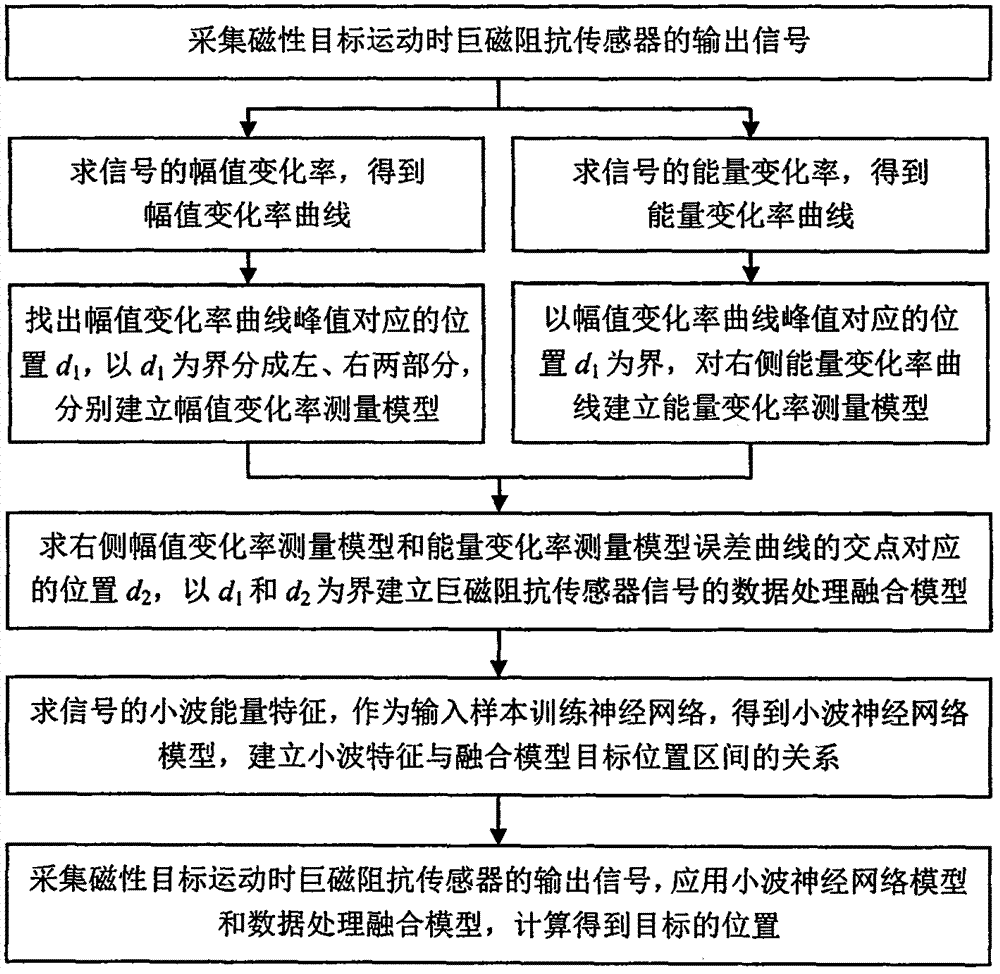
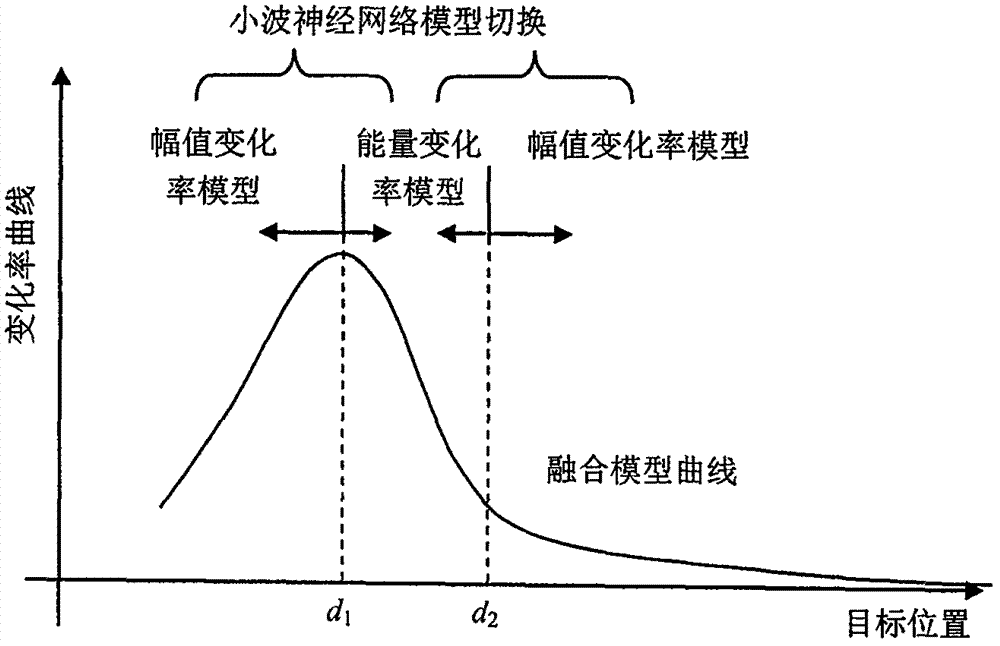
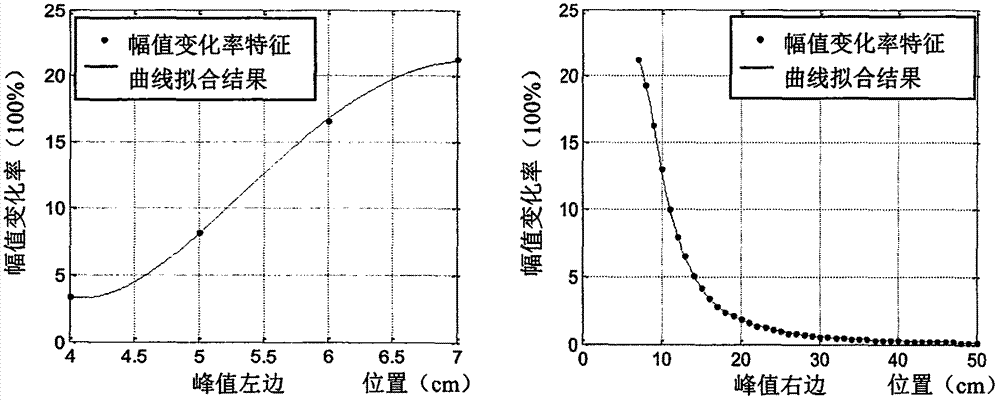
Examples
Embodiment 1
[0052] Embodiment one: for magnetic target A, the specific steps are as follows:
[0053] One, the giant magneto-impedance sensor obtains the distance signal when the magnetic target A moves according to a certain distance interval, and collects the output signal of the giant magneto-impedance sensor;
[0054] (1) Amplitude change rate
[0055] (1) Calculate the amplitude change rate of the signal to obtain the amplitude change rate curve;
[0056] Determine the amplitude change rate U of the magnetic target A at position i r (i):
[0057]
[0058] U(i) represents the amplitude of the output signal of the giant magnetoimpedance sensor when the corresponding target A is at position i, U(0) is the amplitude of the output signal of the giant magnetoimpedance sensor when there is only the ambient magnetic field, U r (i) is the amplitude change rate of the position i signal; with the target position as the abscissa, with the amplitude change rate as the ordinate, the amplitud...
Embodiment 2
[0134] Embodiment 2: Change target A to target B. Referring to the above steps, a brief description is as follows:
[0135] Compared with target A, the main difference between target B and target A is that the inherent magnetism has changed, and the influence on the giant magneto-impedance sensor is different at the same distance, which will lead to the change of the demarcation point and coefficient in the data processing model.
[0136] Collect the output signal of the giant magneto-impedance sensor when the target B is at different positions in a certain direction of motion, extract the amplitude and energy characteristics of the output signal, and obtain its amplitude change rate curve (see Figure 5 ), the energy change rate curve; find the position d corresponding to the peak value of the amplitude change rate curve 1 =10cm, the position d corresponding to the intersection point of the error curve of the energy change rate model and the amplitude change rate model 2 =2...
Embodiment 3
[0143] Embodiment 3: For the target A in Embodiment 1, replace the giant magneto-impedance sensor. Referring to the above steps, a brief description is as follows:
[0144] Different giant magneto-impedance sensors, even the same type of giant magneto-impedance sensors, have different characteristics of sensitive materials, and the degree of natural giant magneto-impedance effect will also be different. The amplitude and The energy change rate curve will also change, but it is only a change in quantity, and the basic change law remains unchanged.
[0145] Collect the output signal of the giant magneto-impedance sensor when the target A is at different positions in a certain direction of motion, refer to the above steps to obtain its amplitude and energy change rate curve, and calculate the dividing point d of the distance between the two targets 1 = 7cm and d 2 = 30cm (it can be seen that for a specific target, even if the giant magneto-impedance sensor is replaced, its dema...
PUM
 Login to View More
 Abstract
Description
Claims
Application Information
 Login to View More