
Improved distributed channel detection and sequential access method
A distributed channel and channel technology, which is applied in the field of distributed channel detection and sequential access, and can solve problems such as external transmission influence and mutual interference.
- Summary
- Abstract
- Description
- Claims
- Application Information
AI Technical Summary
Problems solved by technology
Method used
Image

Examples
Embodiment Construction
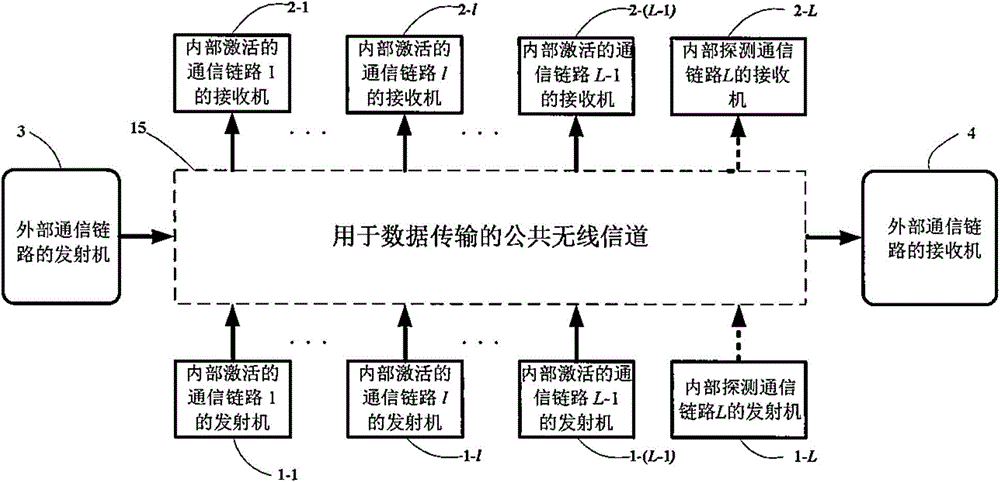
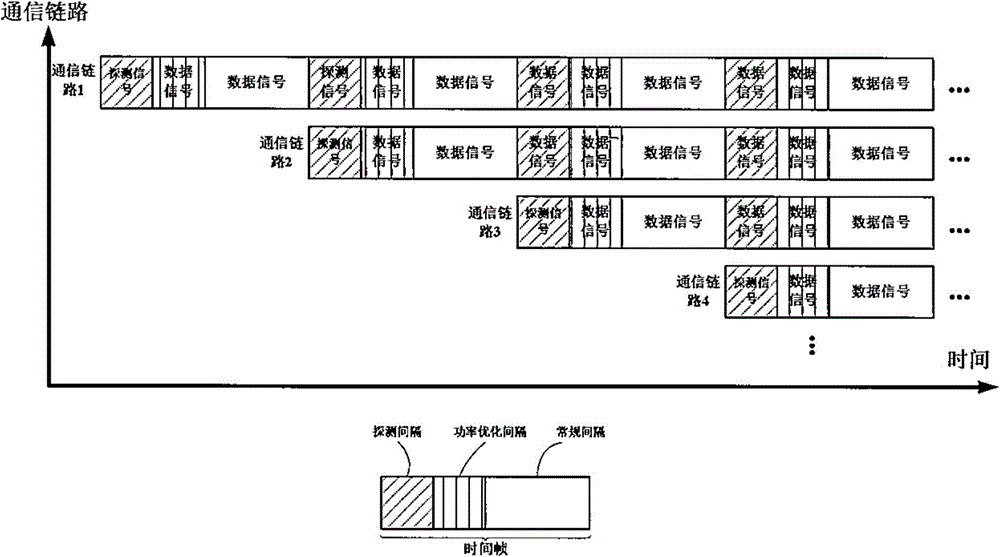
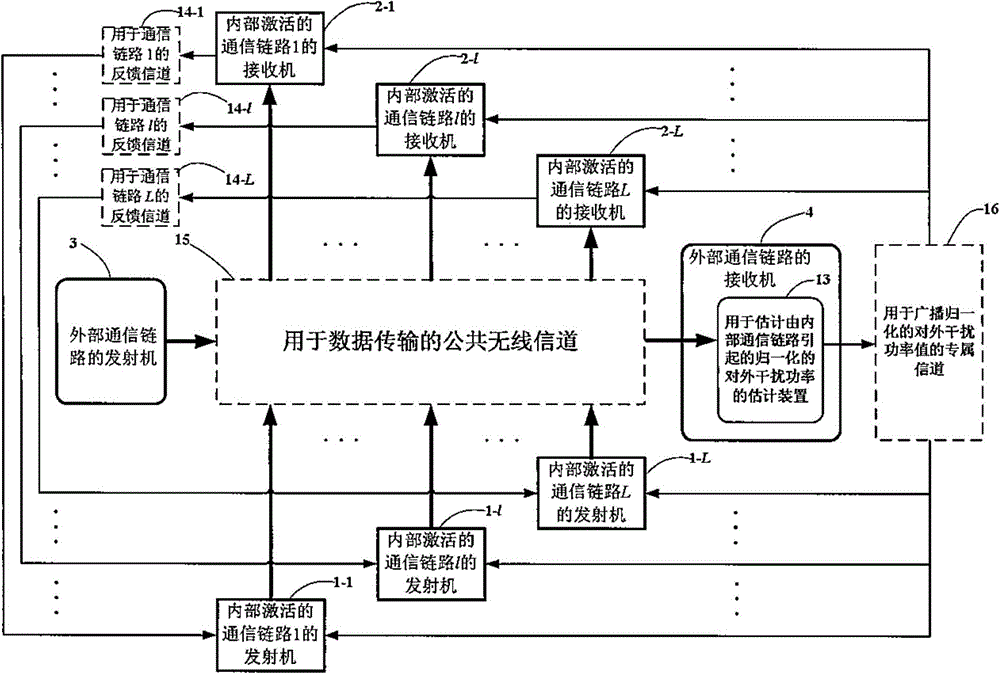
[0070] The present invention proposes an improved Distributed Channel Detection and Sequential Access (DSICO-SEA) scheme to expand the network by automatically stacking communication links in the same channel sequentially to obtain high spatial multiplexing efficiency . The basic idea of the present invention is to propose a distributed algorithm, which only uses local measurement values to determine the globally optimal maximum achievable SINR under the condition of power constraints. The following will describe in detail the problem of the global-based maximum achievable SINR under power constraints from the perspective of optimization, and how to derive the algorithm mathematically.
[0071] 1. Problem model
[0072] This problem model is suitable for the scenario of sequential access channel. Consider the following scenario: a common wireless channel (eg, a block of time-frequency resources) is shared by active wireless networks and external communication links. The...
PUM
 Login to View More
 Abstract
Description
Claims
Application Information
 Login to View More