
Multi-user communication method and multi-user communication device for code division multiple access
A technology for code division multiple access and multi-user communication, which is applied in the field of communication, and can solve the problem of non-orthogonal code division multiple access with poor performance, interference between users that cannot be randomized or averaged, and randomized issues such as normalization or averaging, to achieve the effect of improving multi-access performance
- Summary
- Abstract
- Description
- Claims
- Application Information
AI Technical Summary
Problems solved by technology
Method used
Image

Examples
Embodiment 1
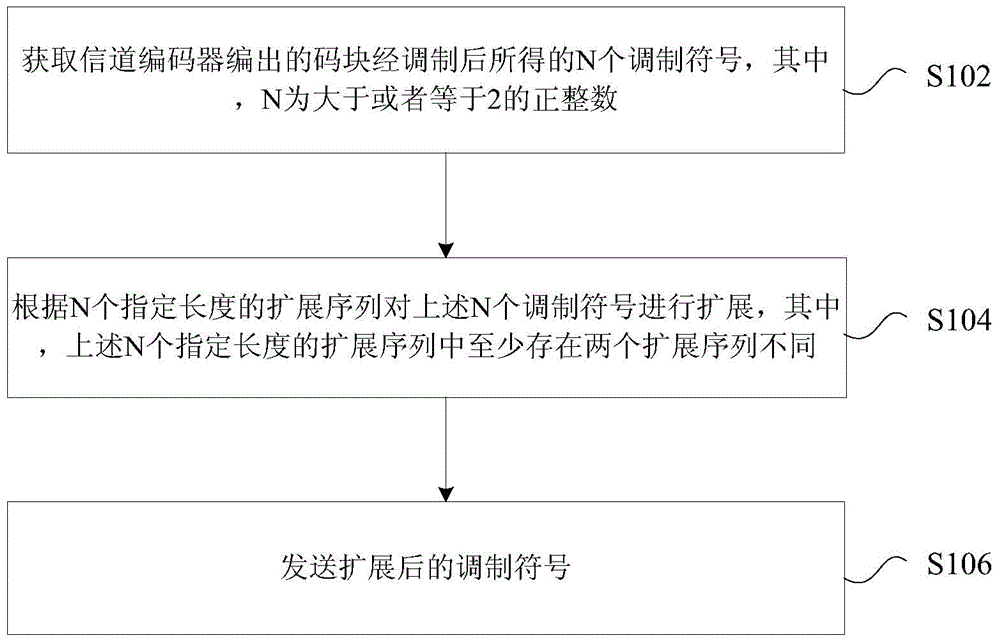
[0118] Figure 6 It is a flow chart of transmitter signal processing according to preferred embodiment 1 of the present invention, such as Figure 6 As shown, this embodiment provides a multi-user code division multiple access communication method and a corresponding transmitter and receiver. The transmitter (such as the terminal in the transceiver system, also known as the terminal transmitter) processes the signal such as Figure 6 As shown, the data bits to be sent are coded and modulated first to obtain several data symbols. Here, it is assumed that a code block obtained by the channel coder is modulated to obtain N data symbols, and the N data symbols use N non-identical The spread sequence is extended to obtain the extended symbol sequence, and N non-identical spreading sequences are used to spread to achieve the purpose of randomizing interference between users; the extended symbol sequence is then modulated by the carrier to form a transmission signal and then transmi...
Embodiment 2
[0132]Embodiment 2 of the present invention provides a multi-user code division multiple access communication method and a corresponding transmitter and receiver. The transmitter (such as the terminal in the transceiver system, also known as the terminal transmitter) processes the signal such as Figure 6 As shown, the data bits to be sent are coded and modulated first to obtain several data symbols. Here, it is assumed that a code block obtained by the channel coder is modulated to obtain N data symbols, and the N data symbols use N non-identical The spread sequence is extended to obtain the extended symbol sequence, and N non-identical spreading sequences are used to spread to achieve the purpose of randomizing interference between users; the extended symbol sequence is then modulated by the carrier to form a transmission signal and then transmitted.
[0133] The flow of the multi-user code division multiple access communication method on the transmitter side of the preferre...
Embodiment 3
[0142] The preferred embodiment of the present invention provides a multi-user code division multiple access communication method and a corresponding transmitter and receiver. The transmitter (such as the terminal in the transceiver system, also known as the terminal transmitter) processes the signal such as Figure 6 As shown, the data bits to be sent are coded and modulated first to obtain several data symbols. Here, it is assumed that a code block obtained by the channel coder is modulated to obtain N data symbols, and the N data symbols use N non-identical The spread sequence is extended to obtain the extended symbol sequence, and N non-identical spreading sequences are used to spread to achieve the purpose of randomizing interference between users; the extended symbol sequence is then modulated by the carrier to form a transmission signal and then transmitted.
[0143] The flow of the multi-user code division multiple access communication method on the transmitter side of...
PUM
 Login to View More
 Abstract
Description
Claims
Application Information
 Login to View More