
Doped CaFe2O4@alpha-Fe2O3 heterojunction composite photocatalyst, and preparation method and applications thereof
A doped, heterojunction technology, applied in the direction of metal/metal oxide/metal hydroxide catalysts, physical/chemical process catalysts, chemical instruments and methods, etc., can solve the problem of high cost, reduce the preparation cost, Reduced usage, cost-saving effects
- Summary
- Abstract
- Description
- Claims
- Application Information
AI Technical Summary
Problems solved by technology
Method used
Image

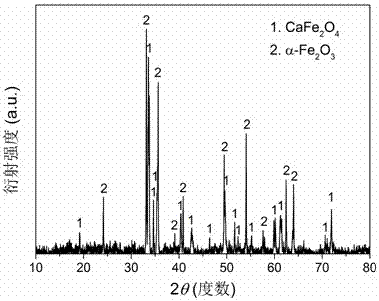
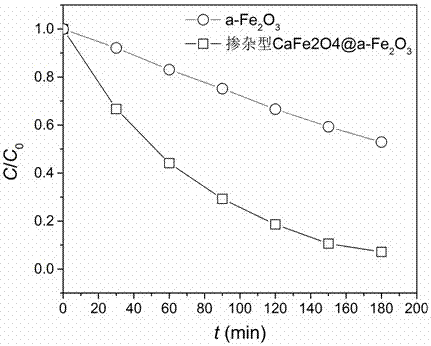
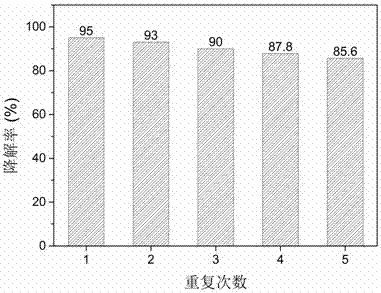
Examples
Embodiment 1
[0031] (1) Take 20 g of dried and ground converter sludge (wherein the mass percentage of TFe is 56.5%, and the mass percentage of CaO is 12.5%), add it to 200 mL of HCl solution with a concentration of 3 mol / L, and stir the acid in a water bath at 70 ° C. Decompose for 1 hour, stirring at a speed of 500 rpm, let the reacted solid-liquid mixture stand at room temperature for 10 hours, filter out insoluble matter to obtain a clear acid solution, and detect the concentration of Fe ions and Ca ions in the acid solution.
[0032] (2) Pour the acid solution obtained in step (1) into a beaker, add 5 mL of 30% hydrogen peroxide dropwise, stir for 1 h in a water bath at 70° C., add 40 g of sodium oxalate and continue stirring for 1 h to obtain a clear mixed solution.
[0033] (3) In the mixed solution of step (2), dropwise add NaOH solution with a concentration of 1mol / L to adjust the pH to 5, stir for 0.5h and then move it into the reaction kettle, heat water at 150°C for 8h, and cool...
Embodiment 2
[0038] (1) Take 20 g of dried and ground converter sludge (the mass percentage of Tfe is 56.5%, and the mass percentage of CaO is 12.5%), add it to 170 mL of HCl solution with a concentration of 3.5 mol / L, and stir in a water bath at 80 °C Acid hydrolysis for 2 hours, with a stirring speed of 400 rpm. The reacted solid-liquid mixture was allowed to stand at room temperature for 15 hours, and the insoluble matter was filtered off to obtain a clear acid solution. The concentrations of Fe ions and Ca ions in the acid solution were detected.
[0039] (2) Pour the acid solution prepared in step (1) into a beaker, add 5 mL of 30% hydrogen peroxide dropwise, stir for 0.5 h in a water bath at 80°C, add 40 g of sodium oxalate and continue stirring for 2 h to obtain a clear mixed solution .
[0040] (3) Add KOH solution with a concentration of 0.5mol / L dropwise to the mixed solution in step (2) to adjust the pH to 4.5, stir for 1 hour, then move it into the reaction kettle, heat it in w...
PUM
 Login to View More
 Abstract
Description
Claims
Application Information
 Login to View More