Cognitive wireless network cooperation frequency spectrum detection method based on sensing node credibility

A cognitive wireless network and sensing node technology, which is applied in the field of collaborative spectrum detection based on the trust of sensing nodes, can solve the problems of not improving the spectrum sensing performance of the fusion center, deteriorating the spectrum sensing performance, and reducing the sensing accuracy. The impact of sporadic errors on spectrum detection, the effect of saving network system overhead and improving detection performance

CN106961311AInactive Publication Date: 2017-07-18NANTONG UNIVERSITY
0 Cites 0 Cited by

Patent Information

Authority / Receiving Office
CN · China
Patent Type
Applications(China)
Current Assignee / Owner
Publication Date
2017-07-18
Estimated Expiration
Not applicable · inactive patent

Smart Images

  • Figure 1
    Figure 1
  • Figure 2
    Figure 2
  • Figure 3
    Figure 3
Patent Text Reader

Abstract

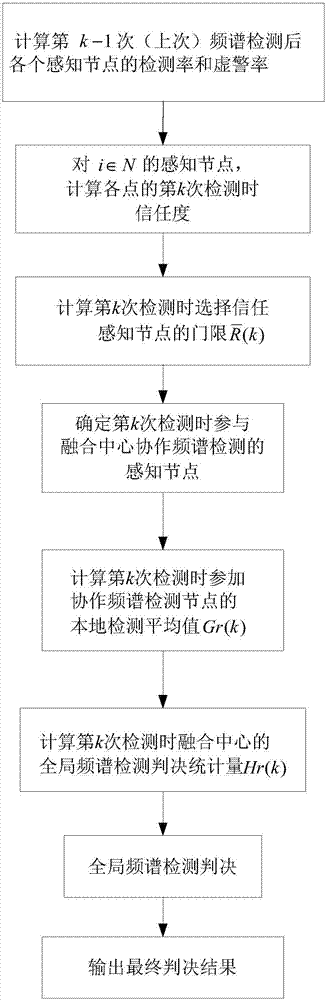
The invention relates to a cognitive wireless network cooperation frequency spectrum detection method based on sensing node credibility, and the method comprises the steps: selecting a sensing node with the higher credibility to participate in the cooperation through setting a proper credibility threshold; designing a reasonable global frequency spectrum detection judgment statistic and judgment threshold for frequency spectrum detection judgment, thereby eliminating the impact on the cooperation frequency spectrum detection performances from a low-reliability node and fault or malicious nodes, reducing the network system expenditure, and prolonging the life cycle of a network. Specifically, the method employs the steps that each sensing node transmits a respective obtained local frequency spectrum detection result to a fusion center; the fusion center calculates the credibility of the corresponding sensing node according to the detection rate and false alarm rate of each sensing node, selects the node with the high credibility to participate in the cooperation, prevents the low-credibility sensing node and the fault or malicious nodes from participating in the cooperation frequency spectrum detection, selects the proper historical information length and a proper weighting factor, and reduces the impact on the frequency spectrum detection from an accidental error when the sensing nodes carry out the local detection.
Need to check novelty before this filing date? Find Prior Art

Description

technical field

[0001] The invention relates to a spectrum sensing and detection technology in a cognitive wireless communication network, and more particularly to a cooperative spectrum detection technology based on the trust degree of sensing nodes in a cognitive wireless network environment. Background technique

[0002] With the continuous growth of wireless data services, the available wireless spectrum resources are becoming more and more scarce. On the other hand, the current utilization of wireless spectrum resources is very unbalanced, and there are a large number of licensed frequency bands with low spectrum utilization. Cognitive Radio (CR) is one of the technical means for intelligently sensing the spectrum environment and efficiently utilizing the wireless spectrum, which has attracted widespread attention.

[0003] In a cognitive wireless network, in order to avoid interference to the primary (authorized) user, the cognitive user needs to continuously, accurat...

Examples

Embodiment Construction

[0033] The present invention will be further described below with reference to the accompanying drawings and specific embodiments.

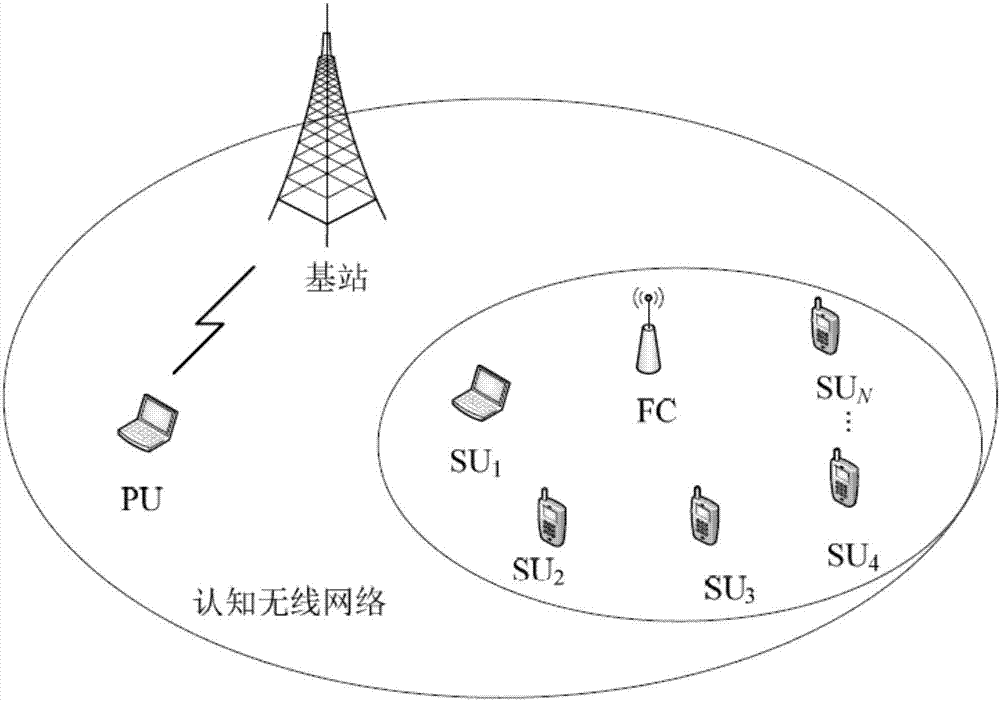
[0034] like figure 1 , in a cognitive wireless network system including at least one primary user, N cognitive users and a fusion center, the cognitive user detects the surrounding spectrum environment, and there are two detection results: 1. The spectrum of the detection segment in the network Busy, the primary user is using the spectrum; 2. The spectrum of the detection segment in the network is idle, and the primary user is not using the spectrum.

[0035] The sensing node i uses an energy detection algorithm (actually any single-node spectrum detection method can be used, such as matched filter detection, cyclostationary detection, eigenvalue detection, etc.) to the received signal x i Whether there is a primary user signal s(t) in (t), perform hypothesis testing to obtain the local detection result d i . If the primary user signal s(t) ex...