
Method for realizing space division multiplexing by multi-system FSK incoherent detection in MIMO communication
A non-coherent detection and space division multiplexing technology, applied in the field of communication, can solve problems such as limited algorithm performance, MIMO channel correlation characteristics, high signal SNR requirements, and affecting multi-antenna signal demodulation, so as to reduce the need for phase change tracking , reduce estimation complexity, and avoid the effect of coherent detection requirements
- Summary
- Abstract
- Description
- Claims
- Application Information
AI Technical Summary
Problems solved by technology
Method used
Image


Examples
Embodiment
[0046] A method for realizing space division multiplexing by multi-ary FSK non-coherent detection in MIMO communication, comprising the following steps:
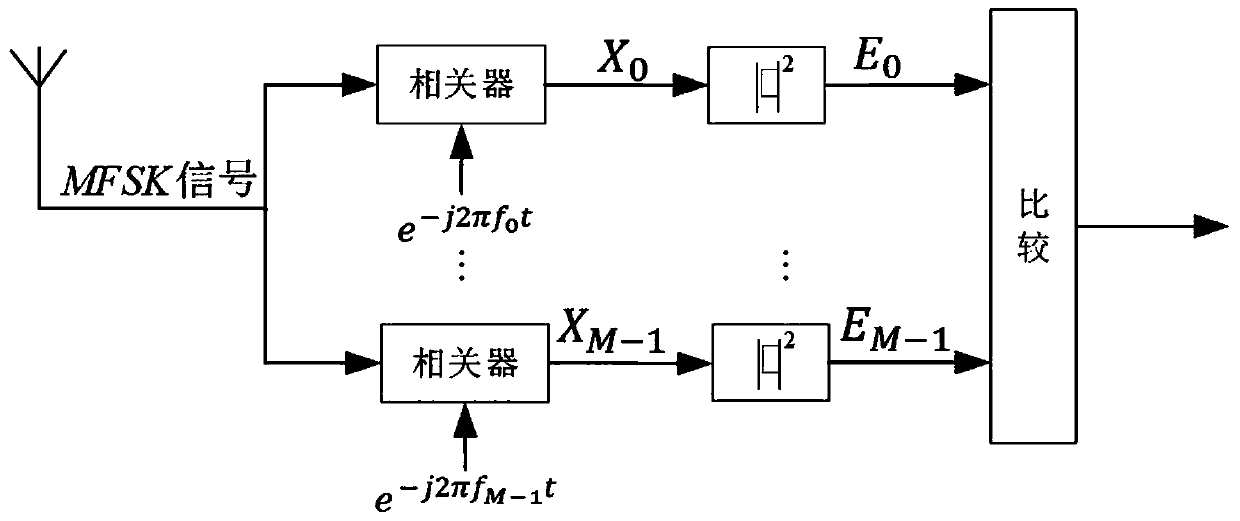
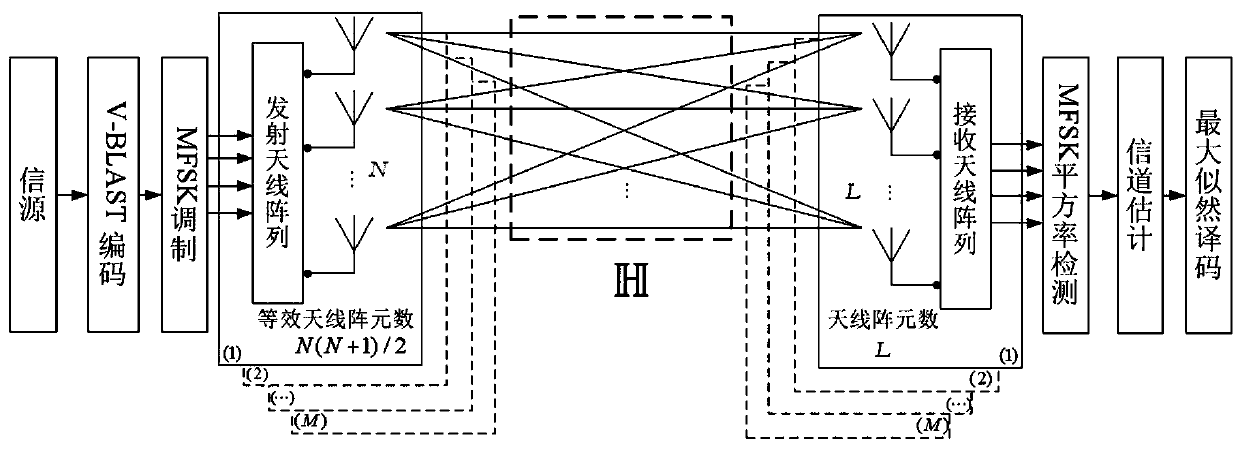
[0047] 1) Modulate the signal and send it: V-BLAST-MIMO system composed of multiple transmit antennas and multiple receive antennas, such as figure 1 As shown, the transmitter uses MFSK modulated by M-ary orthogonal signals to modulate independent pilot sequences X on multiple antennas. 0 (t) and data stream X w (t), pilot sequence X0 (t) using a known random multi-ary code;
[0048] 2) Through the channel: For a MIMO system with N sending and M receiving, the wireless channel fading matrix is:
[0049]
[0050] in It is the angle offset caused by Doppler, and the received signal can be expressed as Y=HX+N 0 , where Y represents the received signal matrix with a dimension of L×T, and X represents the transmitted signal matrix with a dimension of N×T, N 0 Represents the noise matrix;
[0051] 3) MFSK energy detectio...
PUM
 Login to View More
 Abstract
Description
Claims
Application Information
 Login to View More