System and method for grinding part weld joint based on vision guide robot

A vision-guided and robotic technology, which is applied to the parts of grinding machine tools, the control of workpiece feed movement, and the machine tools suitable for grinding the edge of workpieces, etc., can solve the problems that are not conducive to the health of workers, the quality of products cannot be guaranteed, and the efficiency of enterprises. high-quality production

CN110253373AInactive Publication Date: 2019-09-20BEIJING INSTITUTE OF PETROCHEMICAL TECHNOLOGY
8 Cites 14 Cited by

Patent Information

Authority / Receiving Office
CN · China
Current Assignee / Owner
Publication Date
2019-09-20
Estimated Expiration
Not applicable · inactive patent

Smart Images

  • Figure 1
    Figure 1
  • Figure 2
    Figure 2
  • Figure 3
    Figure 3
Patent Text Reader

Abstract

The invention relates to a system and method for grinding a part weld joint based on a vision guide robot. The system comprises a laser sensor, an image collection module, an upper computer, the robot and a floating grinding head. The laser sensor, the image collection module and the floating grinding head are mounted on the sixth-axis tail end of the robot, the laser sensor is used for collecting the relative position of the robot and a part, the image collection module is used for collecting image information of the part at the specific position, and the upper computer is used for processing the image information so as to determine the weld joint position, and controlling the robot to drive the floating grinding head to grind the weld joint. According to the system, the laser sensor carries out automatic positioning of the collected image, accuracy and uniqueness of the image collecting position each time can be ensured, the system can achieve full-automatic grinding, the work efficiency is high, operation is concise, worker operation is facilitated, the ground product quality is ensured, and efficient and high-quality production of the enterprise is facilitated.
Need to check novelty before this filing date? Find Prior Art

Description

technical field

[0001] The invention relates to the technical field of robot grinding, in particular to a system and method for grinding component welds by a robot based on vision guidance. Background technique

[0002] With the rapid development of the manufacturing industry, the large-scale shipping ships have made the large-scale port machinery equipment an inevitable trend. Typical large-scale components such as box girders and trusses are the links with the largest workload in port machinery manufacturing. At this stage, my country's port machinery enterprises mainly rely on manual grinding for the welding seam of large components. The degree of automation is low, the grinding efficiency is low, and the grinding operation environment in which the workers are located is harsh, which is not conducive to the health of the workers. In addition, the quality of manual grinding largely depends on the worker's operational skill level. Different workers have different grinding ...

Examples

Embodiment Construction

[0045] In order to make the purpose, technical solution and advantages of the present invention clearer, the technical solution of the present invention will be described in detail below. Apparently, the described embodiments are only some of the embodiments of the present invention, but not all of them. Based on the embodiments of the present invention, all other implementations obtained by persons of ordinary skill in the art without making creative efforts fall within the protection scope of the present invention.

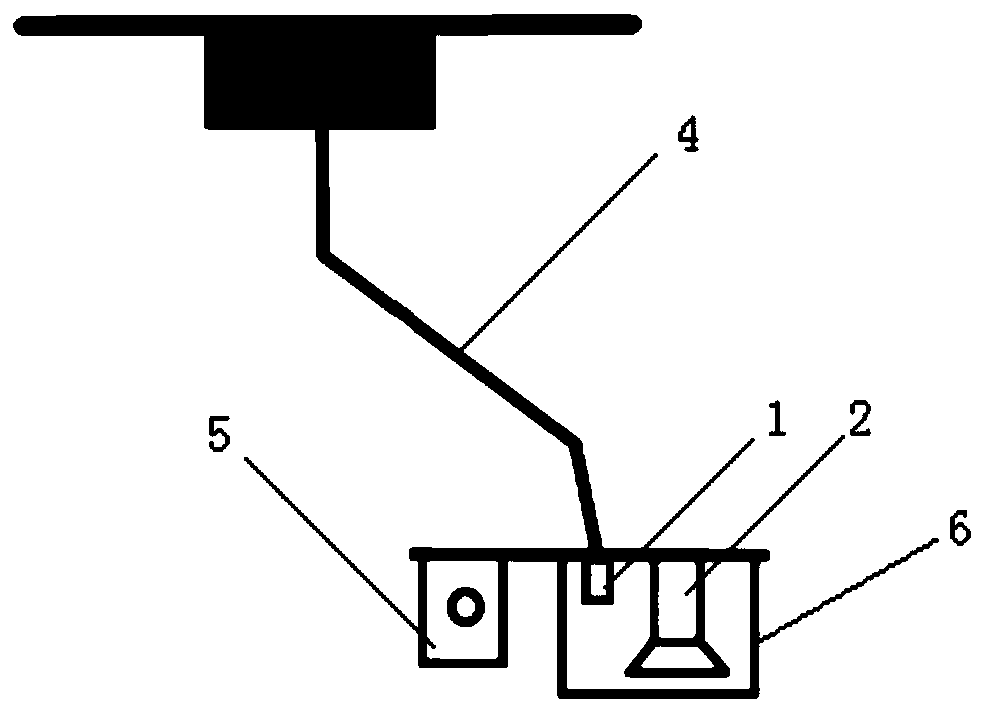
[0046] figure 1 It is a structural schematic diagram provided by an embodiment of the vision-guided robot grinding component weld seam system of the present invention.

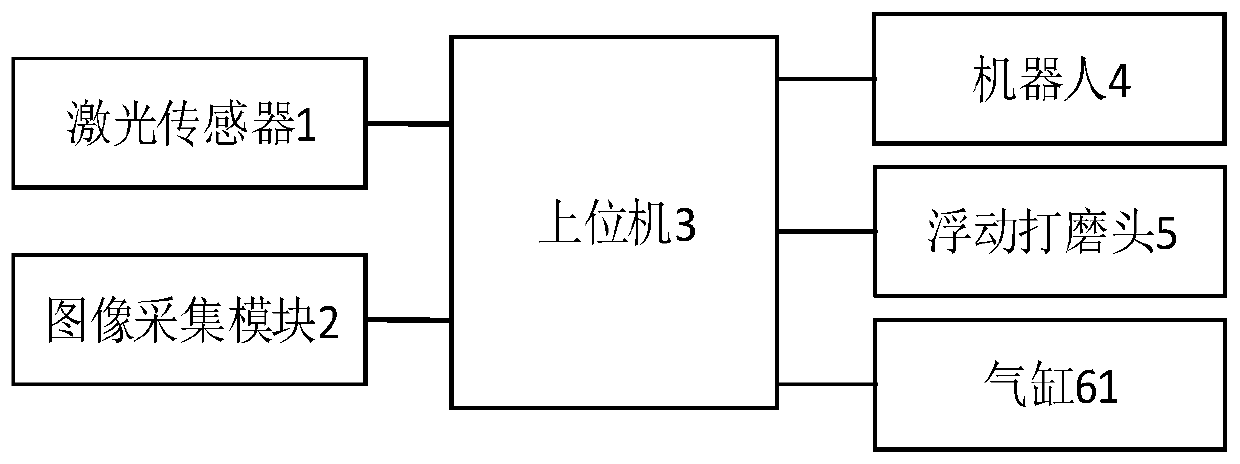
[0047] like figure 1 and figure 2 As shown, the vision-guided robot-based system for grinding component welds described in this embodiment includes:

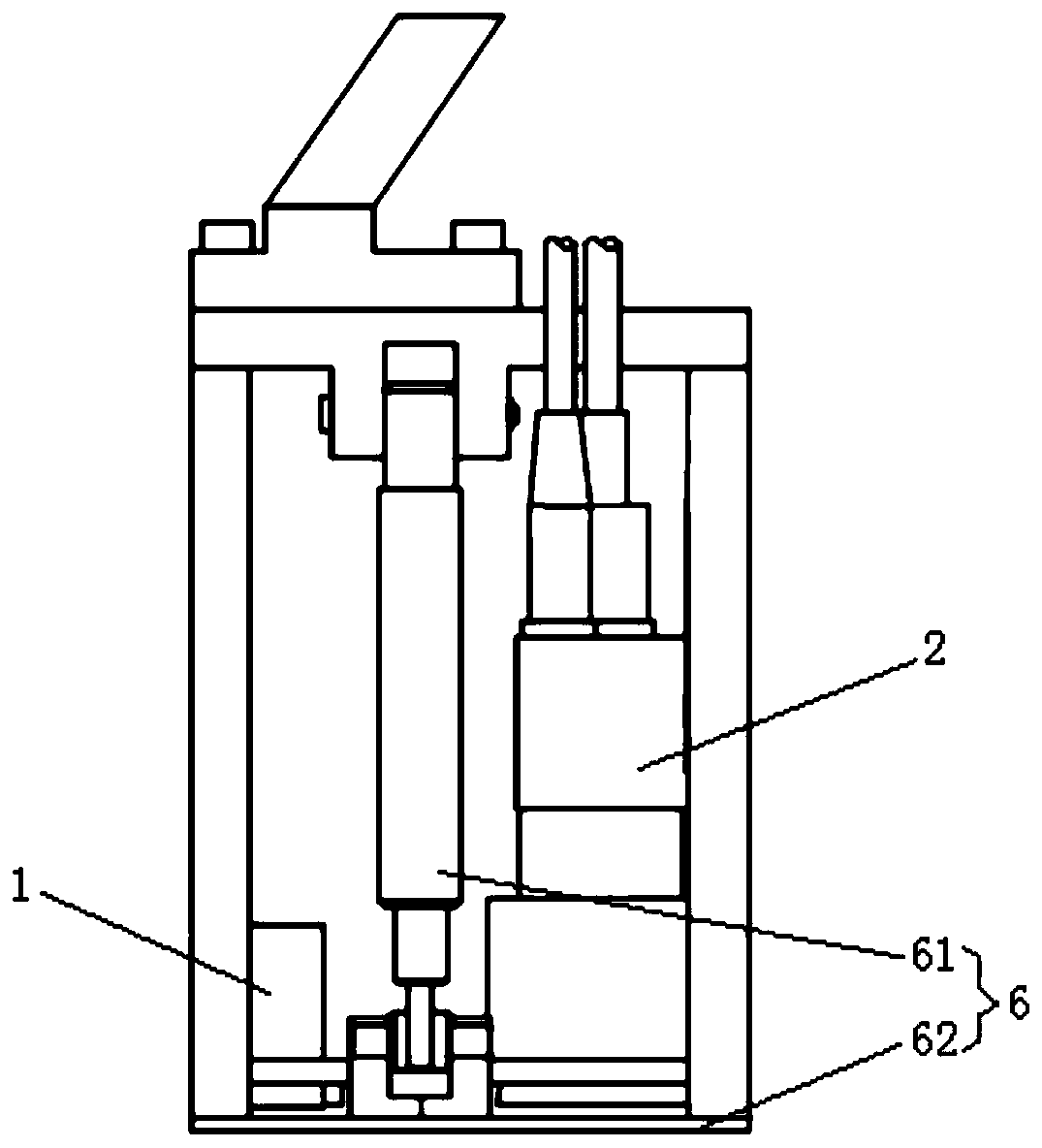
[0048] Laser sensor 1, image acquisition module 2, host computer 3, robot 4 and floating grinding head 5;

[0049] Wherein, the laser senso...