
Antibodies binding to nkg2d
A technology for antibodies and binding domains, applied in the field of treating diseases, activating T cells and/or NK cells, producing the antibodies, vectors and host cells, and multispecific antigen-binding molecules
- Summary
- Abstract
- Description
- Claims
- Application Information
AI Technical Summary
Problems solved by technology
Method used
Image

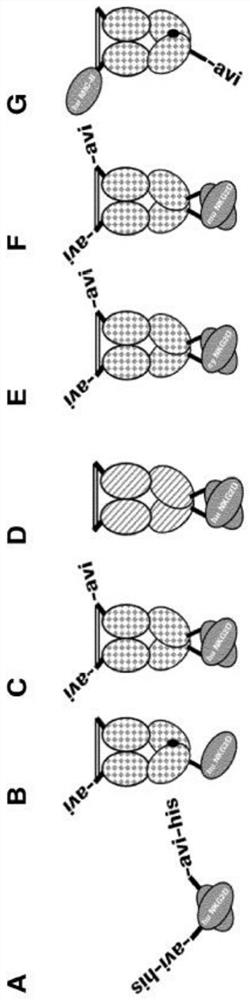
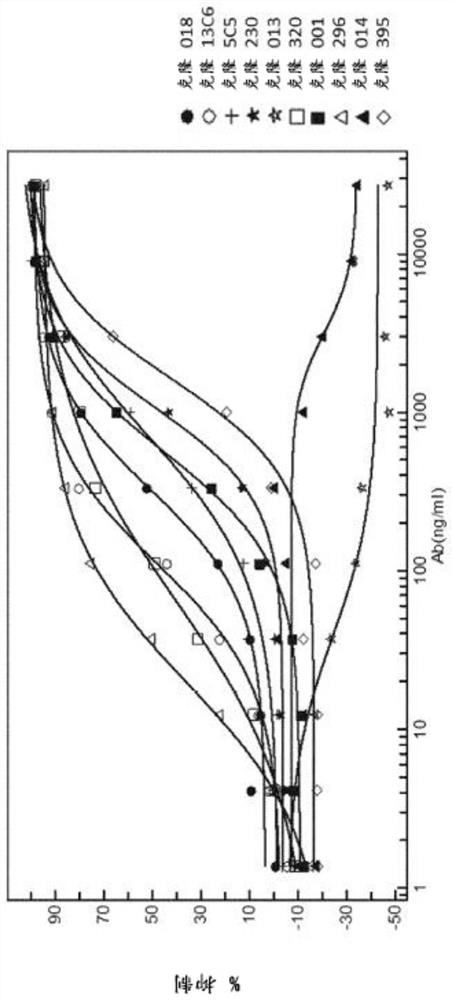
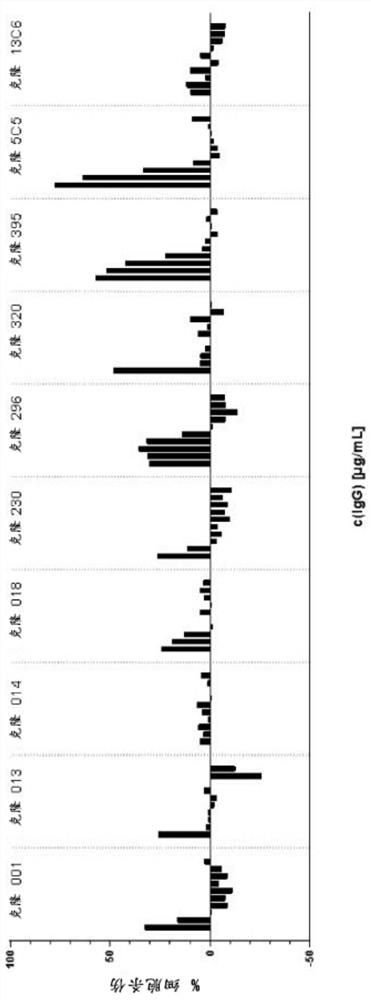
Examples
example 1
[0765] Example 1. General methods and tools
[0766] recombinant DNA technology
[0767]DNA was manipulated using standard methods, as described in Sambrook, J., et al., Molecular cloning: A laboratory manual; Cold Spring Harbor Laboratory press, Cold spring Harbor, New York, 1989. Molecular biology reagents were used according to the manufacturer's instructions. General information on the nucleotide sequences of human immunoglobulin light and heavy chains is given in the following reference: Kabat, E.A. et al., (1991) Sequences of Proteins of Immunological Interest, Fifth Edition, NIH Publication No 91- 3242.
[0768] DNA sequencing
[0769] DNA sequence was determined by double-strand sequencing.
[0770] gene synthesis
[0771] When required, desired gene segments were generated by PCR using appropriate templates or by automated gene synthesis from synthetic oligonucleotides and PCR products at Geneart AG (Regensburg, Germany). The gene segment flanked by a sing...
example 2
[0776] Example 2. Production of anti-NKG2D antibodies by phage display
[0777] Generating Universal Fab Libraries
[0778] Two universal phage-displayed antibody libraries in Fab format were generated based on human germline genes. The library was randomly distributed among the CDR3 of the light chain (L3) and the CDR3 of the heavy chain (H3) using random primers of different lengths spanning these CDRs, and assembled from 3 fragments by "splicing by overlap extension" (SOE) PCR . After a sufficient number of full-length randomized Fab fragments had been assembled, they were digested with NcoI / Nhel along with similarly treated acceptor phagemid vectors. Fab library inserts were ligated to phagemid vectors, and the purified ligation was used for transformation into E. coli TG1. Phagemid particles displaying the Fab library were rescued using the helper phage VCSM13 and purified by PEG / NaCl purification for selection.
[0779] Selection of anti-NKG2D binders from a univ...
example 3
[0790] Example 3. Production of anti-NKG2D antibodies by immunization of transgenic rabbits
[0791] Animal Care, Rabbit Immunization and Organ Resection
[0792] In addition to the above-mentioned antibodies produced by phage display, other antibodies were also derived from transgenic rabbits expressing humanized antibody libraries after immunization with NKG2D antigen (see, for example, WO 2000 / 46251, WO 2002 / 12437, WO 2005 / 007696, WO2006 / 047367, WO 2007 / 019223 and WO 2008 / 027986, all of which are hereby incorporated by reference in their entirety). Animals were housed in AAALAC-accredited animal facilities according to Appendix A, Guidelines for Housing and Care of Animals. All animal immunization protocols and experiments have been approved by the Government of Upper Bavaria (license number 55.2-1-54-2532-90-14) and were carried out in accordance with the German Animal Welfare Act and Directive 2010 / 63 of the European Parliament and of the Council.
[0793] Using reco...
PUM
 Login to View More
 Abstract
Description
Claims
Application Information
 Login to View More