
Choice of wavelengths for multiwavelength optical imaging
a multi-wavelength optical imaging and wavelength choice technology, applied in the field of optical imaging, can solve the problem of unclear whether the spatial resolution provided by optical imaging is adeuate, and achieve the effect of improving image quality
- Summary
- Abstract
- Description
- Claims
- Application Information
AI Technical Summary
Benefits of technology
Problems solved by technology
Method used
Image

Examples
Embodiment Construction
In accordance with the present invention, there is provided a method for selecting wavelengths for multiwavelength optical imaging.
Tissue Chromophores
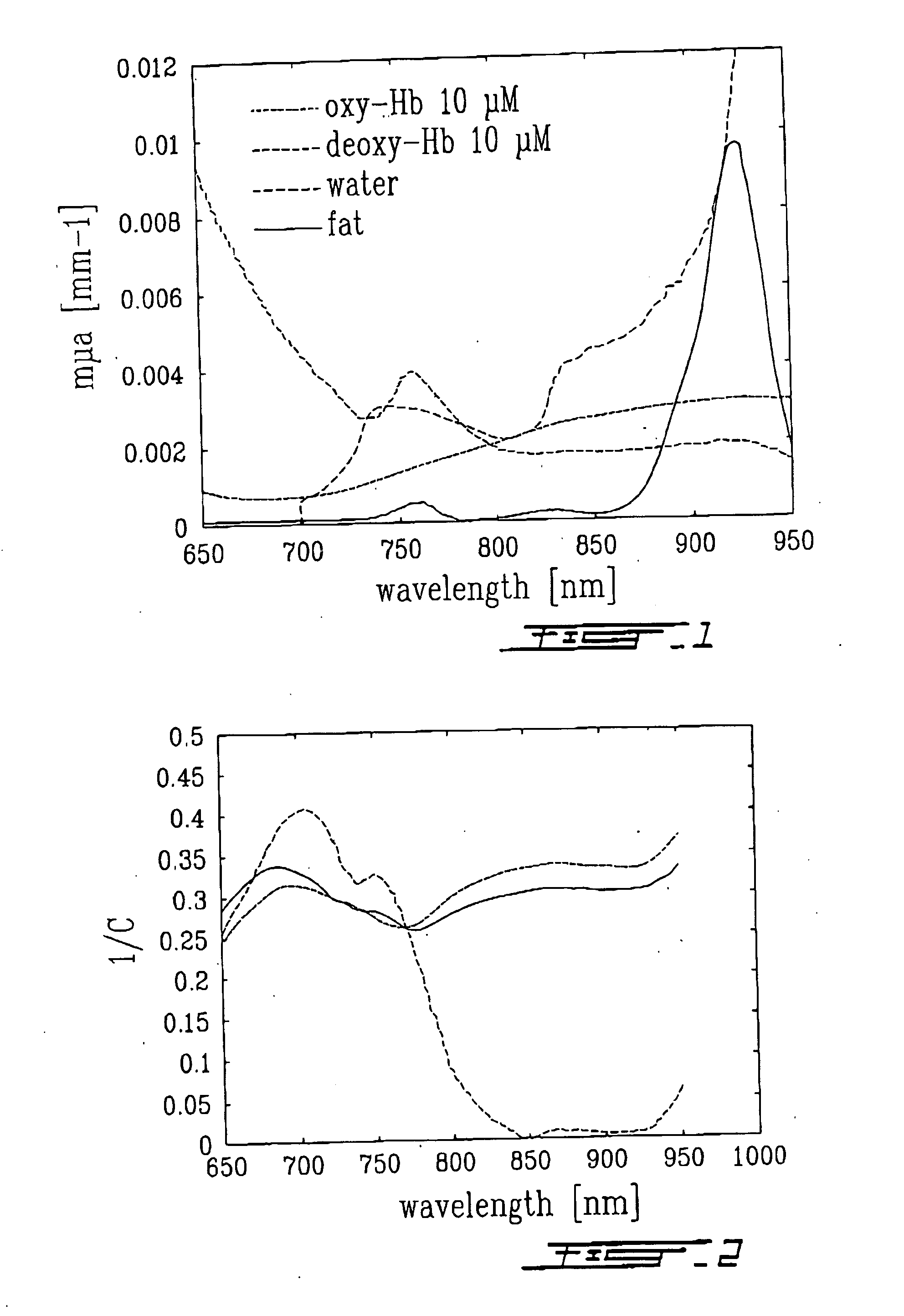
The dominant near infrared chromophores contained in breast tissue are considered to be hemoglobin (Hb) in its oxygenated (oxy-Hb) and deoxygenated (deoxy-Hb) forms, water and lipids. FIG. 1 shows the absorption spectra of oxy-Hb (at 10 μM concentration), deoxy-Hb (at 10 μM concentration), pure water (100% concentration), lipid (absorption spectrum of olive oil has been used to estimate the absorption spectrum of fat). There are other interesting near infrared chromophores, such as glucose and cytochrome c oxidase, but their absorption contribution in the breast is considered negligible compared to the aforementioned chromophores.
Physiological Information
Potentially useful physiological information about the breast tissue can be obtained from concentrations,[], of the chromophores. The total hemoglobin concentration, [HbT], de...
PUM
 Login to View More
 Abstract
Description
Claims
Application Information
 Login to View More