Data processing apparatus and method for performing floating point multiplication

Active Publication Date: 2006-06-01
ARM LTD
View PDF9 Cites 5 Cited by
  • Summary
  • Abstract
  • Description
  • Claims
  • Application Information

AI Technical Summary

Benefits of technology

[0036] Hence, in accordance with the present invention, a very efficient technique is provided for incorporating the necessary rounding prior to the summation of the 2n-bit vectors, with the properties of the half adder form being exploited to enable a rounding increment value to be injected without the requirement for a full adder. Further, the invention enables an efficient detection of a result which is in the subnormal range before rounding, in situations where such determination would be difficult and / or prohibitively costly earlier in the flow of steps (i.e. where the computed result exponent is immediately below the minimum normal exponent).
[0043] When determining whether rounding is appropriate, it is usual to assess all of the bits of the 2n-bit result to the right of the guard bit position to determine whether any of those bits are set. If any of those bits are set, then a sticky bit value is set, whereas if all of the bits are not set, then the sticky bit value is not set. The sticky bit can then be used along with the least significant bit and the guard bit of the result to determine whether rounding should take place or not. However, if it is necessary to await the production of the 2n-bit final result before calculating the sticky bit value, then it is clear that a final determination as to whether rounding should take place or not will be delayed awaiting the generation of the sticky bit. In one embodiment of the present invention, this delay is overcome through the provision of sticky bit generation logic operable to determine from a number of least significant bits of the pair of 2n-bit vectors a first sticky value associated with the first rounded result and a second sticky value associated with the second rounded result. In accordance with this embodiment, the first and second sticky values are produced using the pair of 2n-bit vectors, hence avoiding the need to await for the 2n-bit result to be produced. The sticky bit generation logic takes advantage of properties of the half adder form in order to determine whether the first and second sticky values should be set or not.

Problems solved by technology

As the cycle time reduces, the delays incurred through the use of the full adders described above are likely to become unacceptable.
In typical graphics processing the “flush-to-zero” mode is sufficiently adequate to make subnormal handling in hardware too costly and undesirable.
If an approach is to be taken where the rounding takes place without waiting for the final result to be produced, detection of a value in the subnormal or catastrophic underflow range becomes more complicated, particularly when near the subnormal / normal boundary, since the unrounded result value is not computed.

Method used

the structure of the environmentally friendly knitted fabric provided by the present invention; figure 2 Flow chart of the yarn wrapping machine for environmentally friendly knitted fabrics and storage devices; image 3 Is the parameter map of the yarn covering machine
View more

Image

Smart Image Click on the blue labels to locate them in the text.
Viewing Examples
Smart Image
  • Data processing apparatus and method for performing floating point multiplication
  • Data processing apparatus and method for performing floating point multiplication
  • Data processing apparatus and method for performing floating point multiplication

Examples

Experimental program
Comparison scheme
Effect test

Embodiment Construction

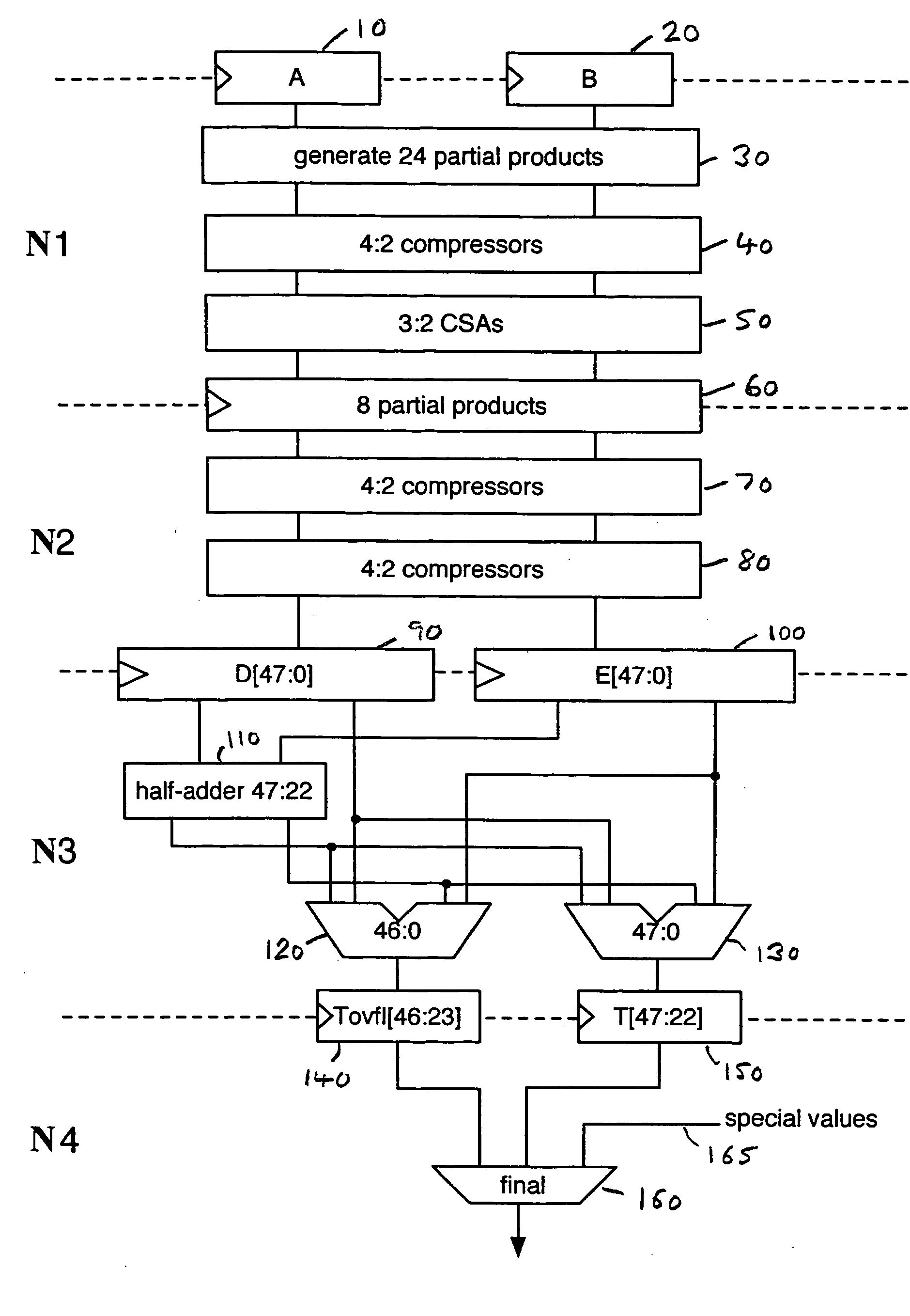
[0058]FIG. 2 is a block diagram illustrating logic provided within a data processing apparatus of one embodiment of the present invention to multiply first and second n-bit significands of two floating point operands in order to produce an n-bit final result. For the sake of illustration, it is assumed that the input operands are single precision floating point operands, and accordingly each operand consists of a 1-bit sign value, an 8-bit exponent value and a 23-bit fraction value. The 23-bit fraction value will be converted into a 24-bit significand and the 24-bit significands from both floating point operands will be provided to the registers 10, 20, respectively.

[0059] As shown in FIG. 2, the multiplier has a 4-stage pipeline. Most of the fourth stage is used for forwarding, hence for example allowing the multiplier result to be forwarded to a separate addition pipeline in order to enable multiply-accumulate operations to be performed. Given that most of the fourth stage is use...

the structure of the environmentally friendly knitted fabric provided by the present invention; figure 2 Flow chart of the yarn wrapping machine for environmentally friendly knitted fabrics and storage devices; image 3 Is the parameter map of the yarn covering machine
Login to View More

PUM

No PUM Login to View More

Abstract

A data processing apparatus and method are provided for multiplying first and second n-bit significands of first and second floating point operands to produce an n-bit result. Multiplier logic is used to multiply the first and second n-bit significands to produce a pair of 2n-bit vectors, and half adder logic is used to produce from a plurality of most significant bits of the pair of 2n-bit vectors a corresponding plurality of carry and sum bits representing those plurality of most significant bits. Further, exponent determination logic determines a product exponent and also determines if that product exponent correspond to a predetermined exponent value. First adder logic performs a sum operation in order to generate a first result equivalent to the addition of the pair of 2n-bit vectors with an increment value injected at a first predetermined rounding position appropriate for a non-overflow condition, the increment value being either a rounding increment value such that the first result produced is a first rounded result or a logic zero value such that the first result produced is a first unrounded result. The rounding increment value is used unless the exponent determination logic has determined that the product exponent corresponds to the predetermined exponent value in which case the logic value zero is used as the increment value. The first adder logic uses as the m most significant bits of the pair of 2n-bit vectors the corresponding m carry and sum bits, the least significant of the m carry bits being replaced with the increment value prior to the first adder logic performing the first sum operation. The second adder logic performs a second sum operation in order to generate a second rounded result equivalent to the addition of the pair of 2n-bit vectors with a rounding increment value injected at a second predetermined rounding position appropriate for an overflow condition. The second adder logic uses as the m−1 most significant bits of the pair of 2n-bit vectors the corresponding m−1 carry and sum bits, the least significant of the m−1 carry bits being replaced with the rounding increment value prior to the second adder logic performing the second sum operation. The n-bit result is then derived from either the first rounded result, the second rounded result or a predetermined result value.

Description

BACKGROUND OF THE INVENTION [0001] 1. Field of the Invention [0002] The present invention relates to a data processing apparatus and method for performing floating point multiplication, and in particular to a data processing apparatus and method for multiplying first and second n-bit significands of first and second floating point operands to produce an n-bit result. [0003] 2. Description of the Prior Art [0004] A floating point number in a defined normal range can be expressed as follows: ±1x*2y [0005] where: x=fraction [0006] 1.x=significand (also known as the mantissa) [0007] y=exponent [0008] Floating-point multiplication consists of several steps: [0009] 1. Evaluating the input operands for special cases (in particular NaNs (Not-a-Number cases), infinities, zeros, and in some implementations subnormals). If a special case is detected, other processing may be required in place of the sequence below. [0010] 2. Adding the exponents. The product exponent is the sum of the multiplic...

Claims

the structure of the environmentally friendly knitted fabric provided by the present invention; figure 2 Flow chart of the yarn wrapping machine for environmentally friendly knitted fabrics and storage devices; image 3 Is the parameter map of the yarn covering machine
Login to View More

Application Information

Patent Timeline
no application Login to View More
IPC IPC(8): G06F7/52
CPCG06F7/487G06F7/49915G06F7/49936G06F7/49963
InventorLUTZ, DAVID RAYMONDHINDS, CHRISTOPHER NEAL
OwnerARM LTD