
Low-odor dimethicone copolyol sulfosuccinate surfactant compositions
a dimethicone copolyol and surfactant technology, applied in the field of sulfosuccinate surfactants having low odor characteristics, can solve the problems of care and cosmetic products, surfactants typically exhibit a characteristic odor,
- Summary
- Abstract
- Description
- Claims
- Application Information
AI Technical Summary
Benefits of technology
Problems solved by technology
Method used
Image

Examples
Embodiment Construction
[0013] The term “low-odor dimethicone copolyol” refers herein to dimethicone copolyol type compounds that are substantially free of propionaldehyde and acid-releasable precursors of propionaldehyde. The term “low-odor” as applied to surfactant compositions of this invention means that the discernible sensory odor characteristic of the composition is improved, and deemed cosmetically desirable, relative the discernible odor of a counterpart composition having a relatively high content of propionaldehyde, or acid precursors thereof (e.g., greater than about 3200 ppm).
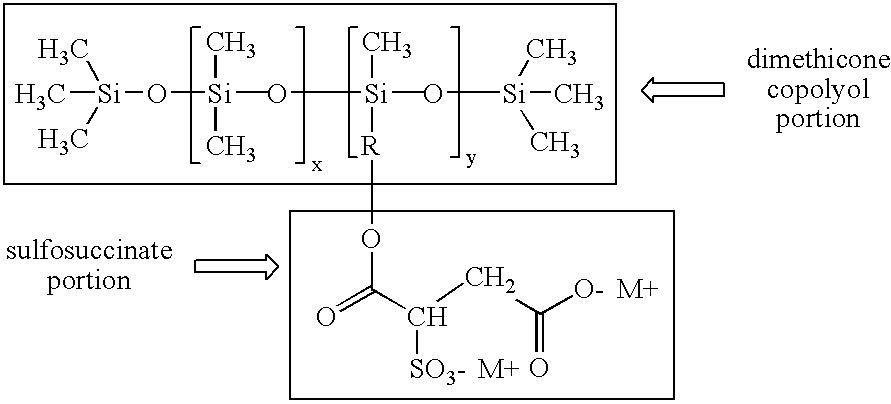
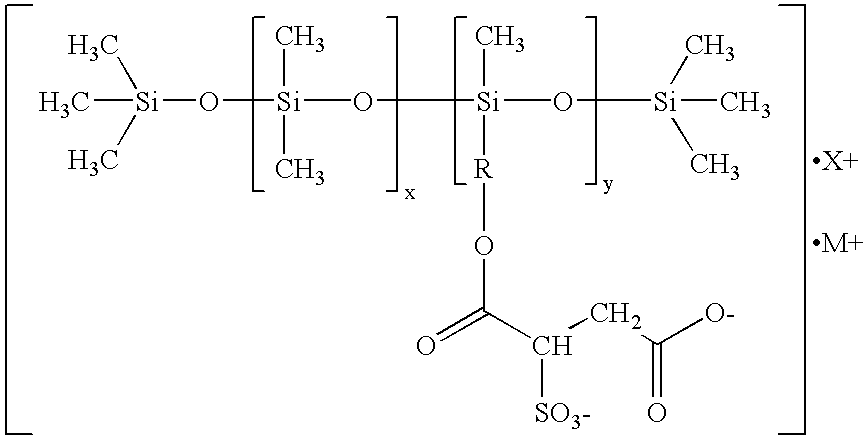
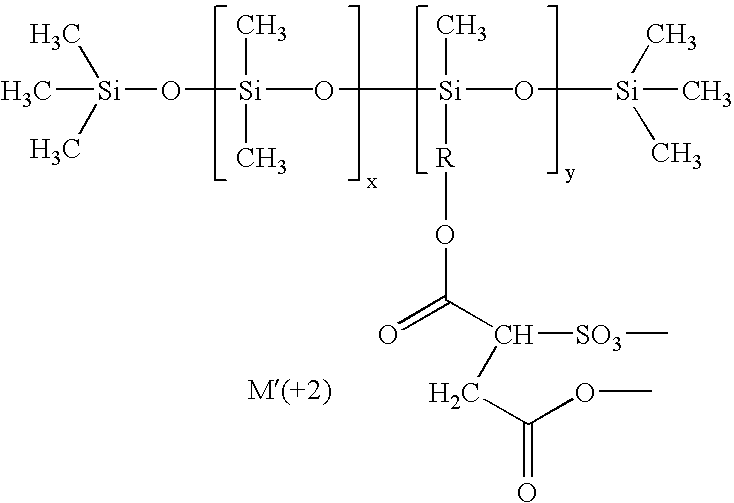
[0014] The dimethicone copolyol sulfosuccinate compositions of the present invention preferably are prepared by reacting the ethoxylated polyether side chains of a dimethicone copolyol with maleic anhydride to form a monoester. The side chains involved in this reaction are a polymer or copolymer of ethylene oxide, propylene oxide, butylene oxide, tetrahydrofuran, and / or glycerol. Preferably, the side chains involved in t...
PUM
| Property | Measurement | Unit |
|---|---|---|
| Composition | aaaaa | aaaaa |
| Odor threshold (mass) | aaaaa | aaaaa |
| Equivalent weight | aaaaa | aaaaa |
Abstract
Description
Claims
Application Information
 Login to View More