Pipeline-based reconfigurable mixed-radix FFT processor

a processor and mixed-radix technology, applied in the field of processors, can solve the problems of long computation time and excessive hardware cost, only achieving 50% of the utilization rate of butterfly elements, and a large amount of computation time and hardware cost, so as to save computing time and hardware cos

US20080155003A1Active Publication Date: 2008-06-26NAT CHIAO TUNG UNIV
8 Cites 17 Cited by

Patent Information

Authority / Receiving Office
US · United States
Patent Type
Applications(United States)
Current Assignee / Owner
Publication Date
2008-06-26

Smart Images

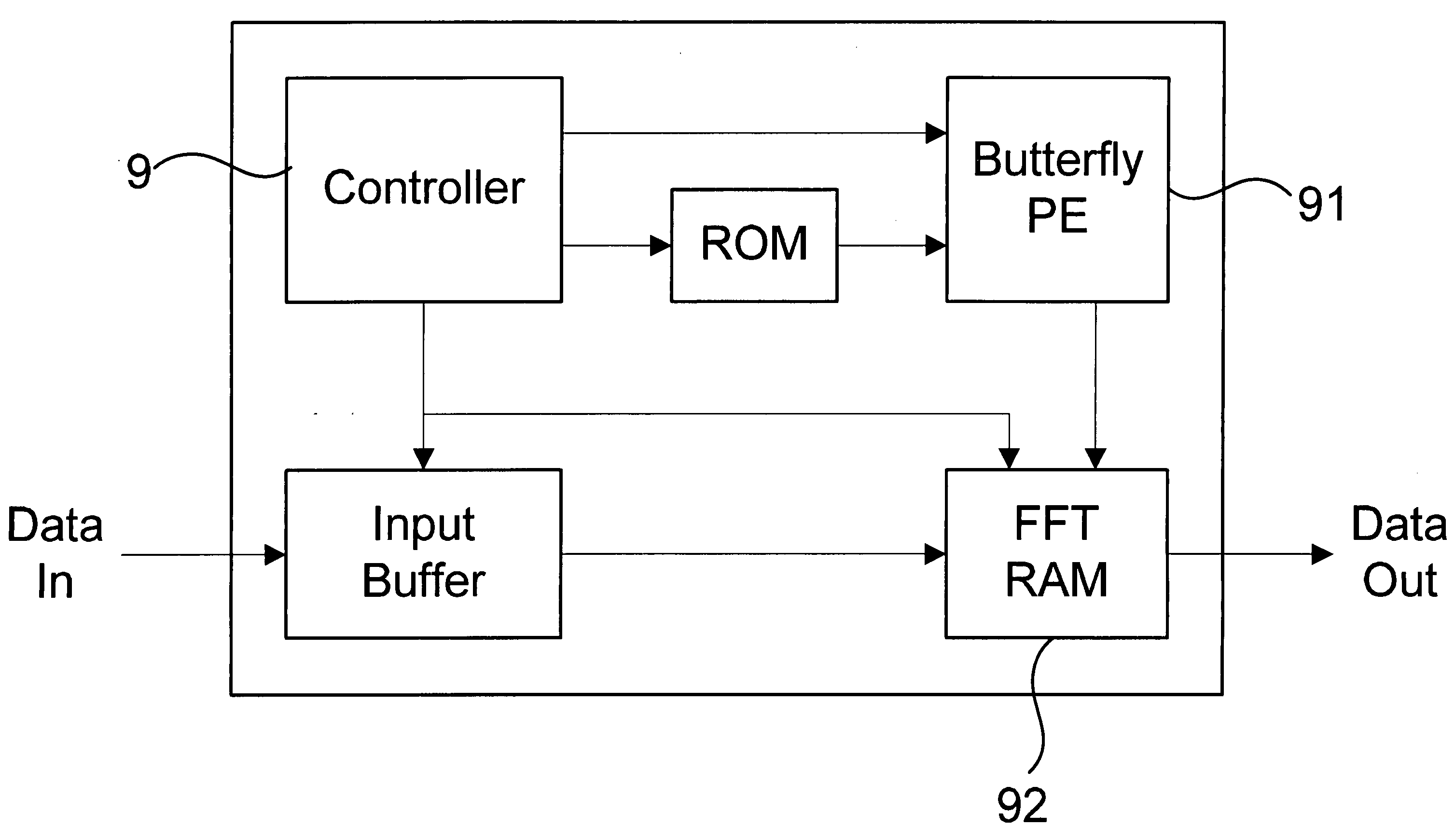
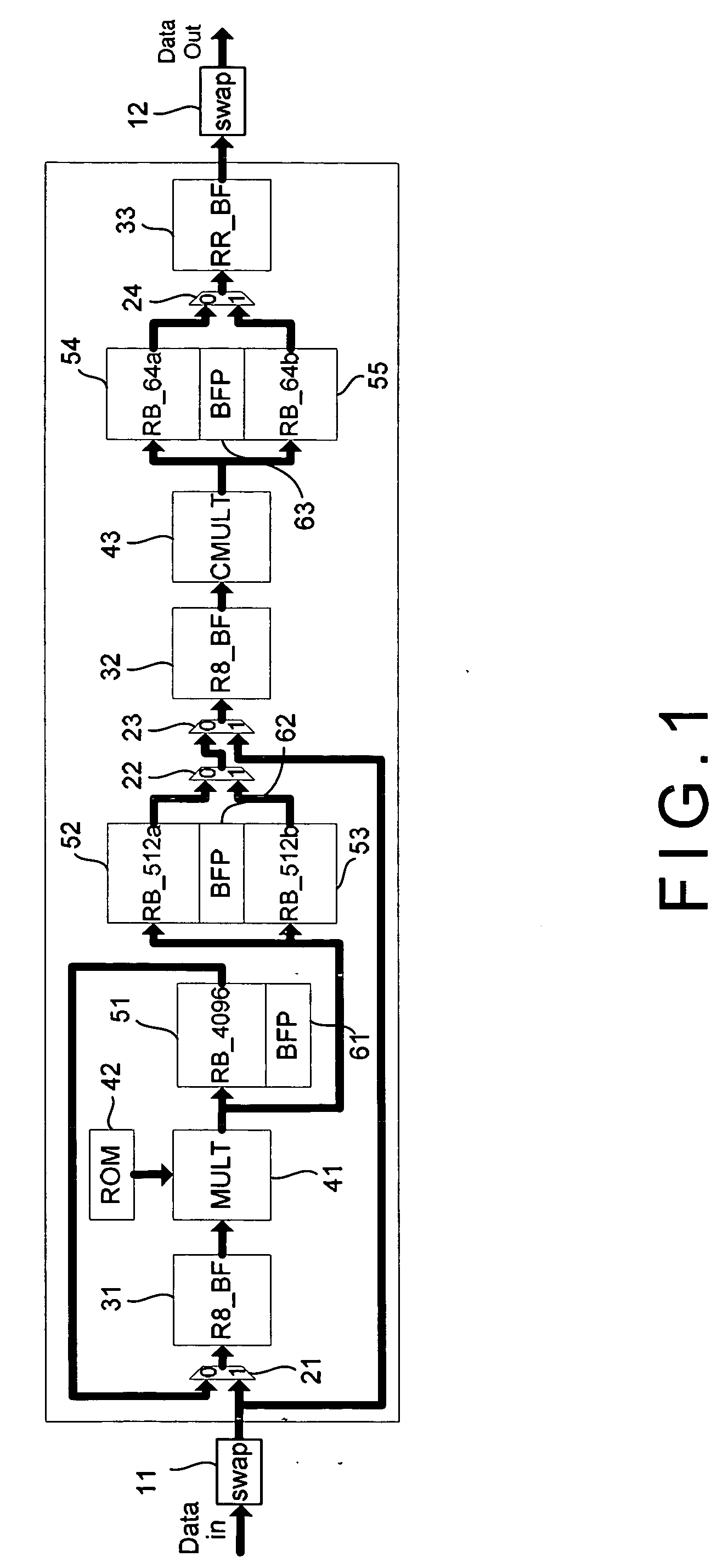
  • Figure 1
    Figure 1
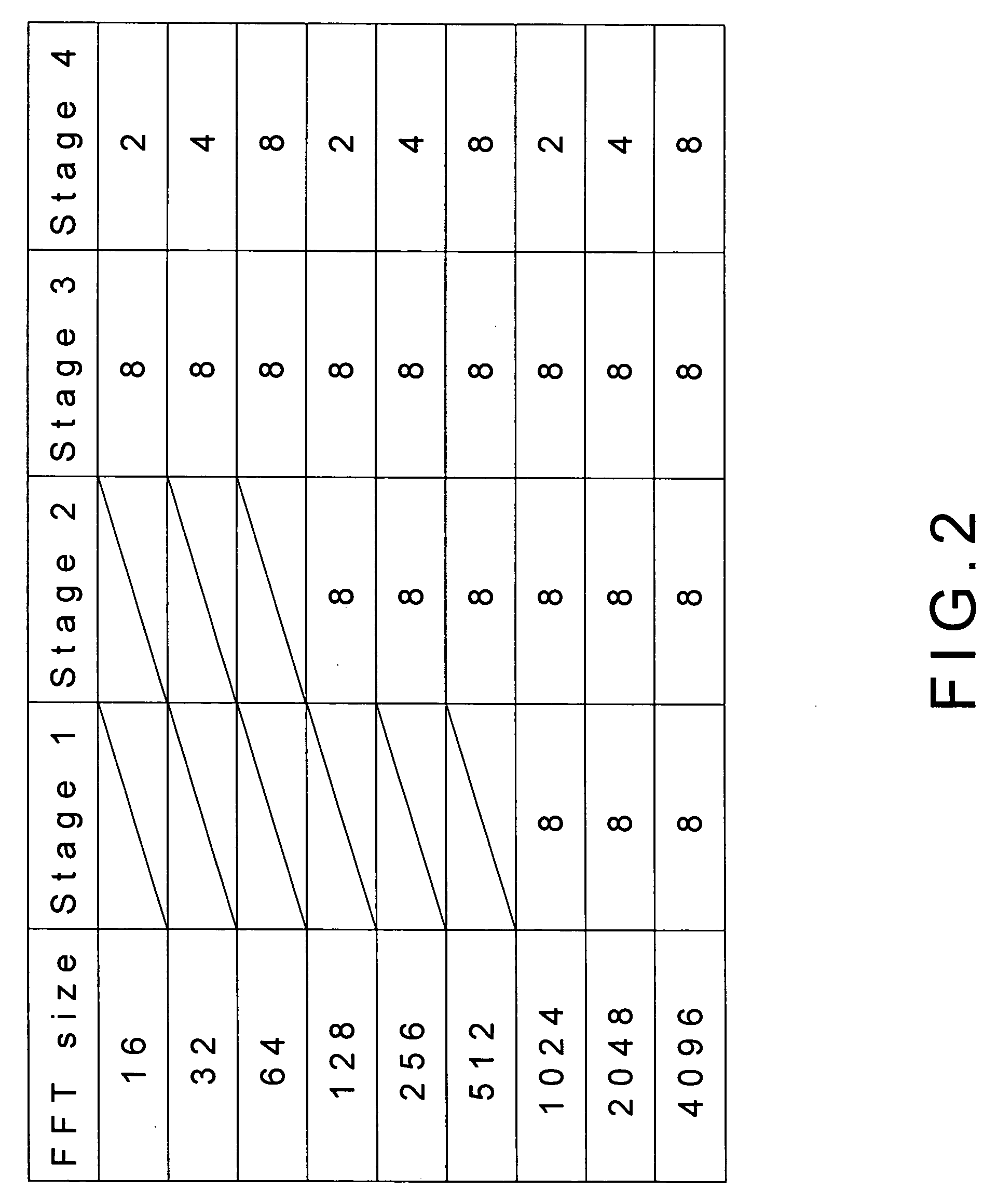
  • Figure 2
    Figure 2
  • Figure 3
    Figure 3
Patent Text Reader

Abstract

The present invention discloses a fast Fourier transform (FFT) processor based on multiple-path delay commutator architecture. A pipelined architecture is used and is divided into 4 stages with 8 parallel data path. Yet, only three physical computation stages are implemented. The process or uses the block floating point method to maintain the signal-to-noise ratio. Internal storage elements are required in the method to hold and switch intermediate data. With good circuit partition, the storage elements can adjust their capacity for different modes, from 16-point to 4096-point FFTs, by turning on or turning off the storage elements.
Need to check novelty before this filing date? Find Prior Art

Description

FIELD OF THE INVENTION

[0001] The present invention relates to a processor; more particularly, relates to designing a fast Fourier transform processor in the digital signal processing domain.DESCRIPTION OF THE RELATED ARTS

[0002] A discrete Fourier transform (DFT) is widely employed in analyses, designs, and implementations of signal processing algorithms and systems. Yet, a computational complexity of direct evaluation of an N-point DFT is O(N2), which results in a long computation time and excessive hardware cost. However, considerable symmetry exists in operations and coefficients required to compute a DFT. Such symmetry is exploited to reduce the number of operations required and thus reduces the time required for FFT computation. Collectively, the resulting efficient computation algorithms are called fast Fourier transform (FFT).

[0003] Mainly, the FFT is a way of computing the DFT by decomposing the computation into successively smaller DFT computations. In this process, both the sy...

Examples

Embodiment Construction

[0040]The following description of the preferred embodiment is provided to understand the features and the structures of the present invention.

[0041]Please refer to FIG. 1 to FIG. 15 which, according to a preferred embodiment of the present invention, are a structural view and a block diagram of the preferred embodiment; views showing a block diagram of a 128-point fast Fourier transform (FFT) and a required number of storage elements for various N-point FFT; a view showing the circuit diagram of multiplication by 1 / √{square root over (2)}; views showing block diagrams of a general radix-8 butterfly and a reconfigurable butterfly; a view showing a relationship between control signals and the reconfigurable butterfly; views showing block diagrams of a two-input register and an RB_64 with various capacity; views showing data flows of an register bank for 16-word mode and 128-word mode; a view showing control zones of the register bank; and a view showing a block diagram of a reconfigu...