[0005]The invention makes use of the fact that many hotels already have a
building management system with a corresponding data
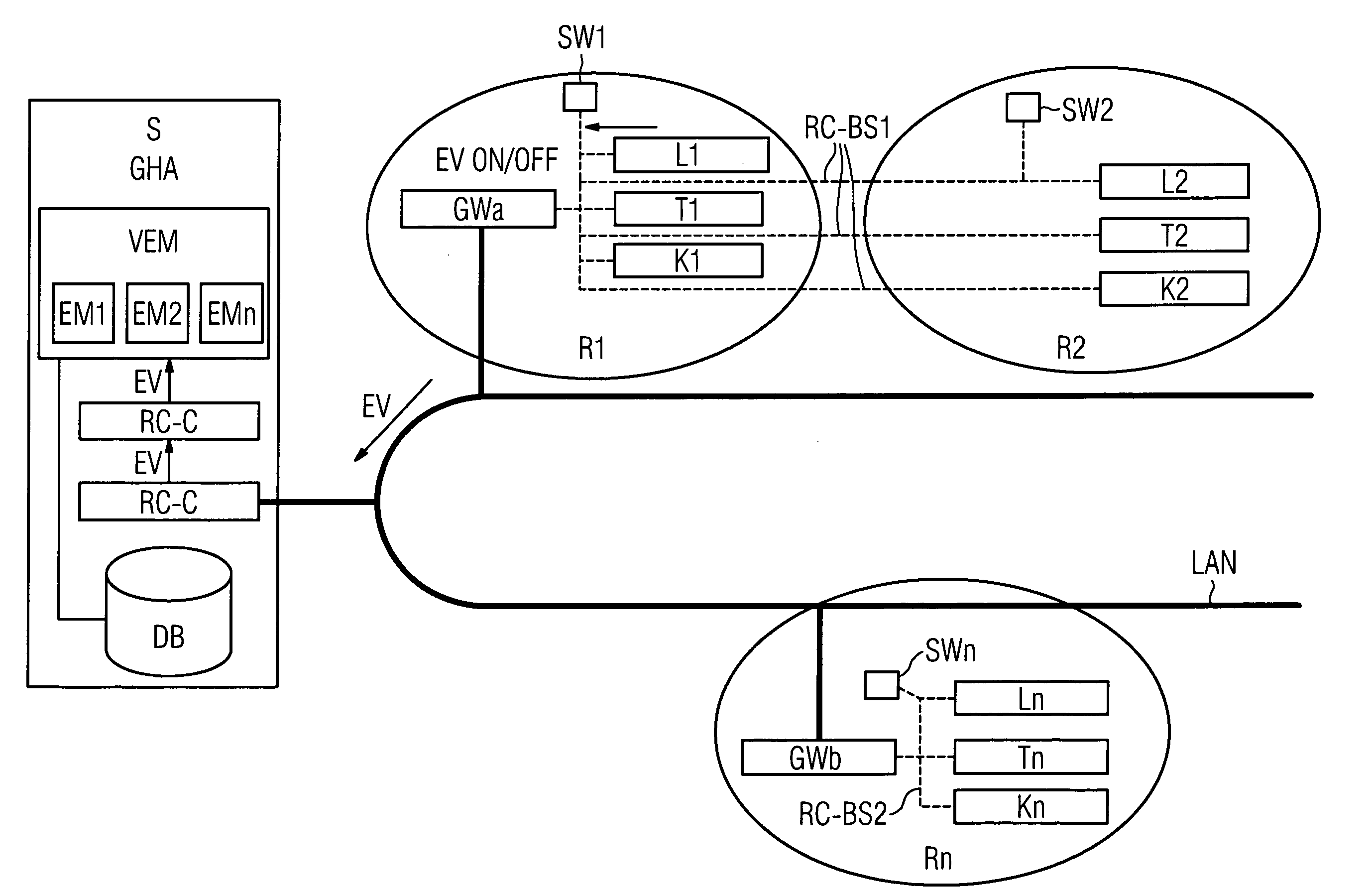
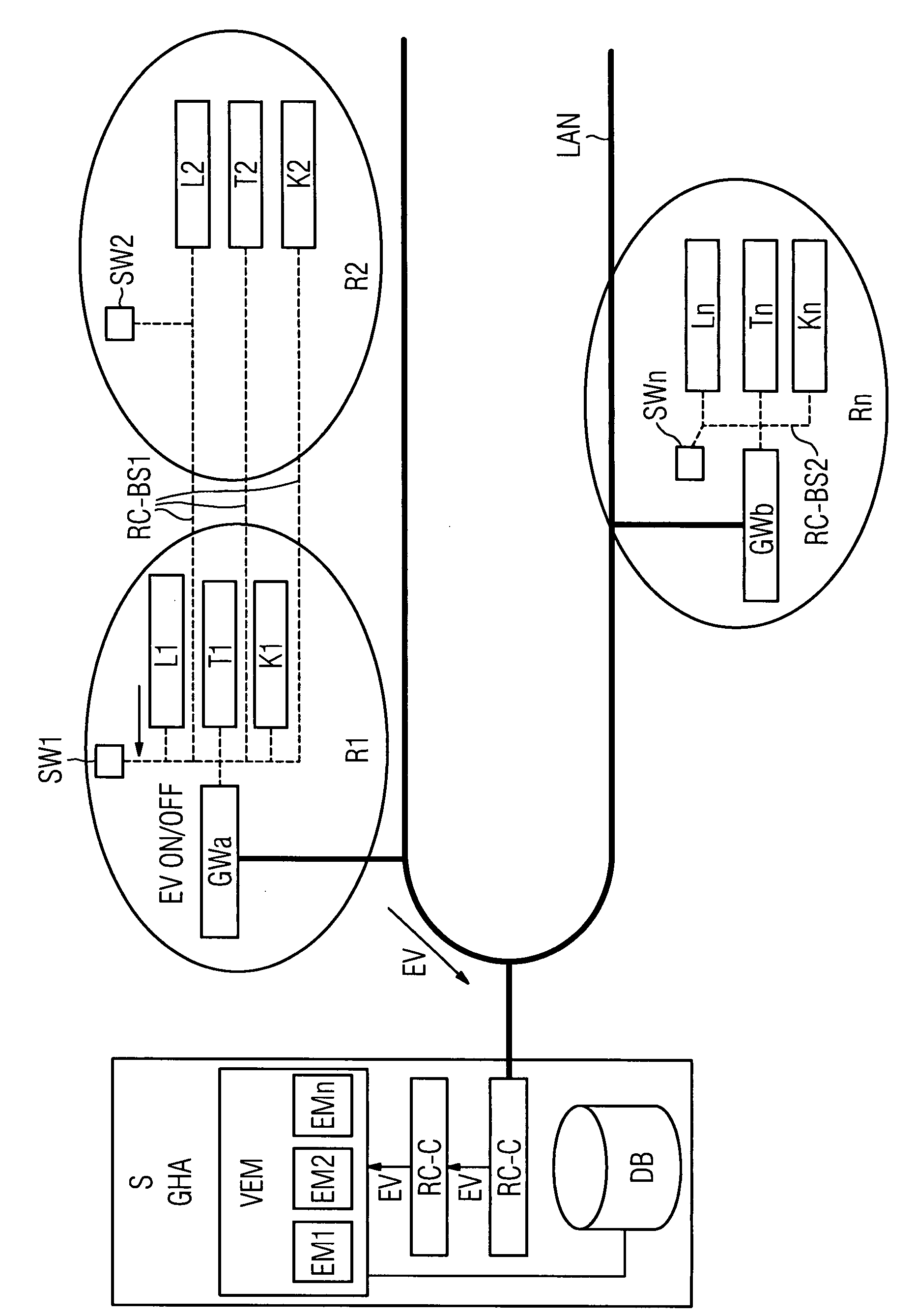
bus. Such a data
bus, for example an EIB (European Installation
Bus), networks switching devices (for example light switches) and loads (for example lights, air-conditioning units, blinds etc.) in a building, with the result that the individual load is not switched on and off using a separate circuit but rather the individual switching devices (light switches, heating
thermostat etc.) transmit only switching commands into the network which are evaluated and executed by the corresponding loads or switching devices connected upstream of the latter. According to the invention, these switching commands or
resultant “response messages” or “status messages”, which are also referred to as “events”, may be recorded in a central device, for example a computer /
server in a hotel reception. This makes it possible to register the switched-on duration of individual loads, for example the lighting or
heating system of a
hotel room, and to multiply it by the
specific energy consumption (that is to say the electrical power) of the load, with the result that the energy consumption can be registered without having to provide a corresponding separate measuring unit for each room.
[0009]Either a statement of a change in an operating state, a statement of an
operating time of the energy load or both may be used as the state information. If the
operating time is registered in this case in the switching device itself, the strain on the control center is relieved, and, in addition, there is thus no need to report every individual switching operation to the control center. In the situation in which every switching operation is reported to the control center, the individual switching devices may be of simpler design, a real-time
clock which is contained in the control center (for example the
server) anyway advantageously being able to be used to determine the switched-on duration of a (an electrical) load (energy load).
[0011]The method can be used in a particularly advantageous manner in the case of those loads which have a virtually
constant power consumption and a relatively high
specific energy consumption during operation, for example lighting devices, heating systems and / or air-conditioning devices, whereas small loads (for example
clock radios) or rarely used loads (for example trouser presses) can be excluded from the registering operation. The devices mentioned last then also do not need to be connected using a “network-compatible” switching device, thus making it possible to reduce the costs of the
building management system or the installation
bus.
[0015]The state information is advantageously acquired using a switching device which is installed in the part of a building. As a result, the cabling in the part of a building and in the entire building can have a simple structure and can be cost-effective.
[0017]A statement of the energy consumption which has been determined can be advantageously also used to control at least one further energy load in the part of a building. This makes it possible, for example, to automatically reduce a desired value for a
heating system if all of the lighting devices in a
hotel room are switched off in the
evening (that is to say in a defined
time zone) because “sleep” is then assumed. The control center advantageously has a
database in which at least one operating state is linked to the specific statement of the consumption. This makes it possible, for example, to link the “full load” operating state of a registered heating unit to a statement of higher consumption and to link a “half-load” operating state of the same unit to a more specific statement of lower consumption. This makes it possible to register energy consumption in a more accurate manner.


 Login to View More
  Login to View More