
Short Messaging Service Over 3GPP Long Term Evolution
a short messaging and long-term evolution technology, applied in the field of short messaging services over 3gpp long-term evolution, can solve the problems of long migration step, no clear solution for providing sms in lte, and no gan based solution adopted, so as to maximize the reuse of existing solutions and minimize the effort needed for system integration
- Summary
- Abstract
- Description
- Claims
- Application Information
AI Technical Summary
Benefits of technology
Problems solved by technology
Method used
Image

Examples
first embodiment
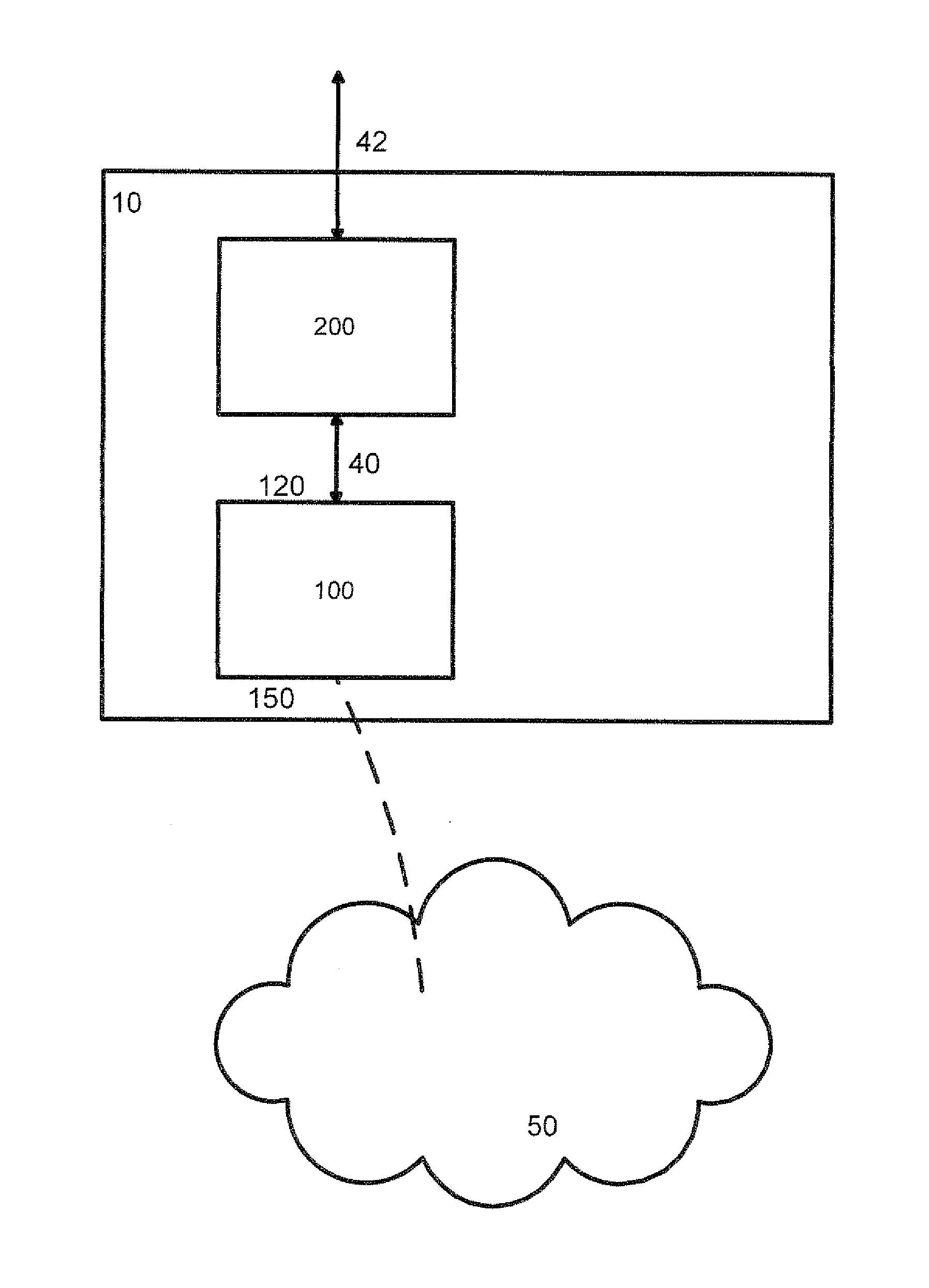
[0029]the present invention is directed to a network entity and will now be described with reference to FIG. 1 in order to facilitate the understanding of the invention.
[0030]The network entity 10 represented in FIG. 1 is a network entity for handling messages in a communications network and comprises a controller entity 200 and an adapter entity 100. A network entity according to the present invention for handling messages may be realized in a variety of examples interchangeable with each other. In one example, the network entity 10 is a network node or a network device; in another example, the network entity 10 may be distributed over several network nodes or network devices or it may be comprised within a network node or network device. The network entity may be implemented in hardware, software or any suitable combinations thereof. In one embodiment of the present invention as illustrated in the following, the network entity 10 comprises a mobile switching centre MSC or at least...
second embodiment
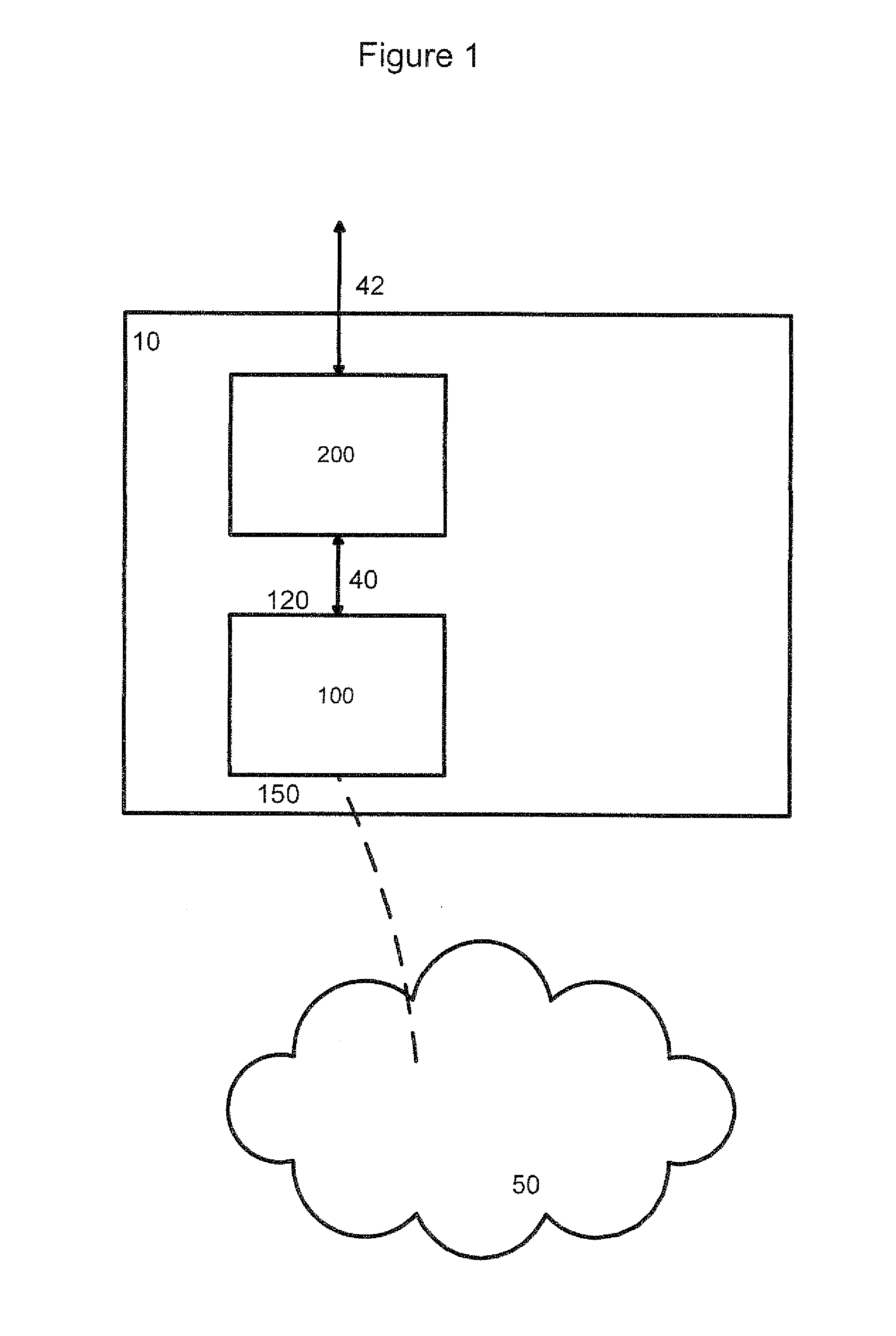
[0064]Reference will now be made to FIG. 2 depicting the present invention directed to a system for handling user messages in a communications network. The system comprises a first network entity 20 and a second network entity 10.
[0065]The first network entity 20 handles call session control functions in an IMS system. Call session control functions are those functions responsible for establishing connections for communications between user devices, wherein the communication can be voice, messages like SMS or IM, packets exchanged between applications, exchanged multimedia content, etc. . . . .
[0066]The second network entity 10 is an entity for handling user messages and comprises an IP multimedia subsystem side 150 for exchanging messages with the first network entity 20.
[0067]The network entity 10 further comprises a controller entity side 120 for exchanging short message services according to a radio network interface of a circuit switched network and an adapter entity 100 config...
third embodiment
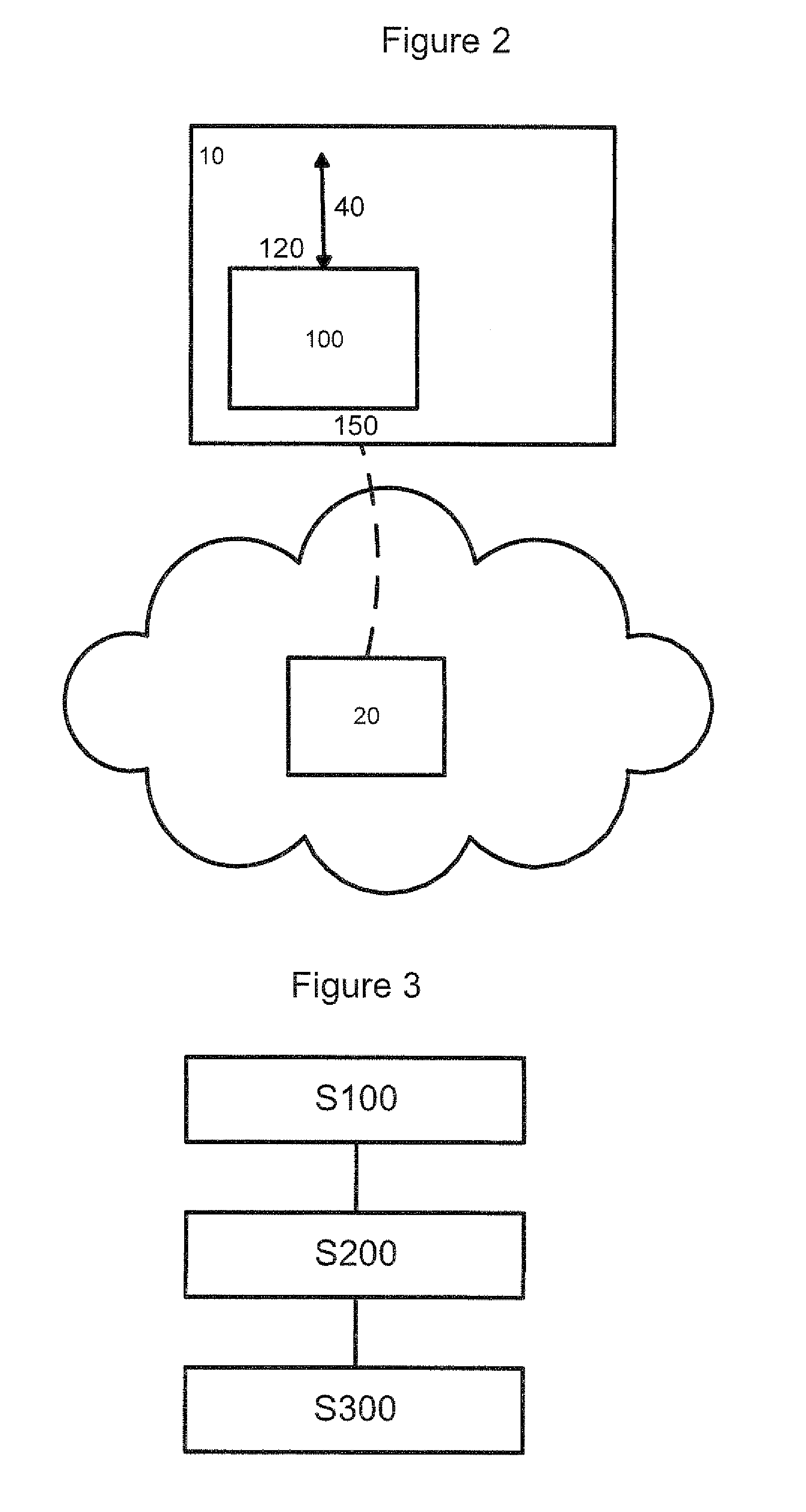
[0073]Reference will now be made to FIG. 3 illustrating a method for handling messages in a communications network according to the present invention. FIG. 3 is a flowchart representing different steps of the method, wherein the steps can be implemented as processes running in parallel software implementation or hardware implementation. The parallel implementation however is not the only one foreseen, since those steps or processes could also share the same resources (e.g. the same processor, memory and other required components), and wherein each process or step is assigned the resources in a scheduled manner or in an as needed basis.
[0074]More specifically, the method depicted in FIG. 3 foresees the step S100 of exchanging short messages through a radio network interface of a circuit switched network.
[0075]In step S200, the method foresees exchanging messages through an IP multimedia subsystem. Finally, in step S300 the method foresees performing message adaptation. More specifica...
PUM
 Login to View More
 Abstract
Description
Claims
Application Information
 Login to View More