Steady state measurement and analysis approach to profiling auditory evoked potentials from short-latency to long latency

a technology of evoked potentials and measurement methods, applied in bioelectric signal measurement, medical science, diagnostics, etc., can solve problems such as the inability to predict the evoked response of transient evoked potentials, the difficulty of identifying some, if not all, of the component waves, and the potential ambiguities of wave identification

US20120157877A1Active Publication Date: 2012-06-21INTELLIGENT LEARNING SYST +1
7 Cites 1 Cited by

Patent Information

Authority / Receiving Office
US · United States
Patent Type
Applications(United States)
Current Assignee / Owner
Publication Date
2012-06-21

Smart Images

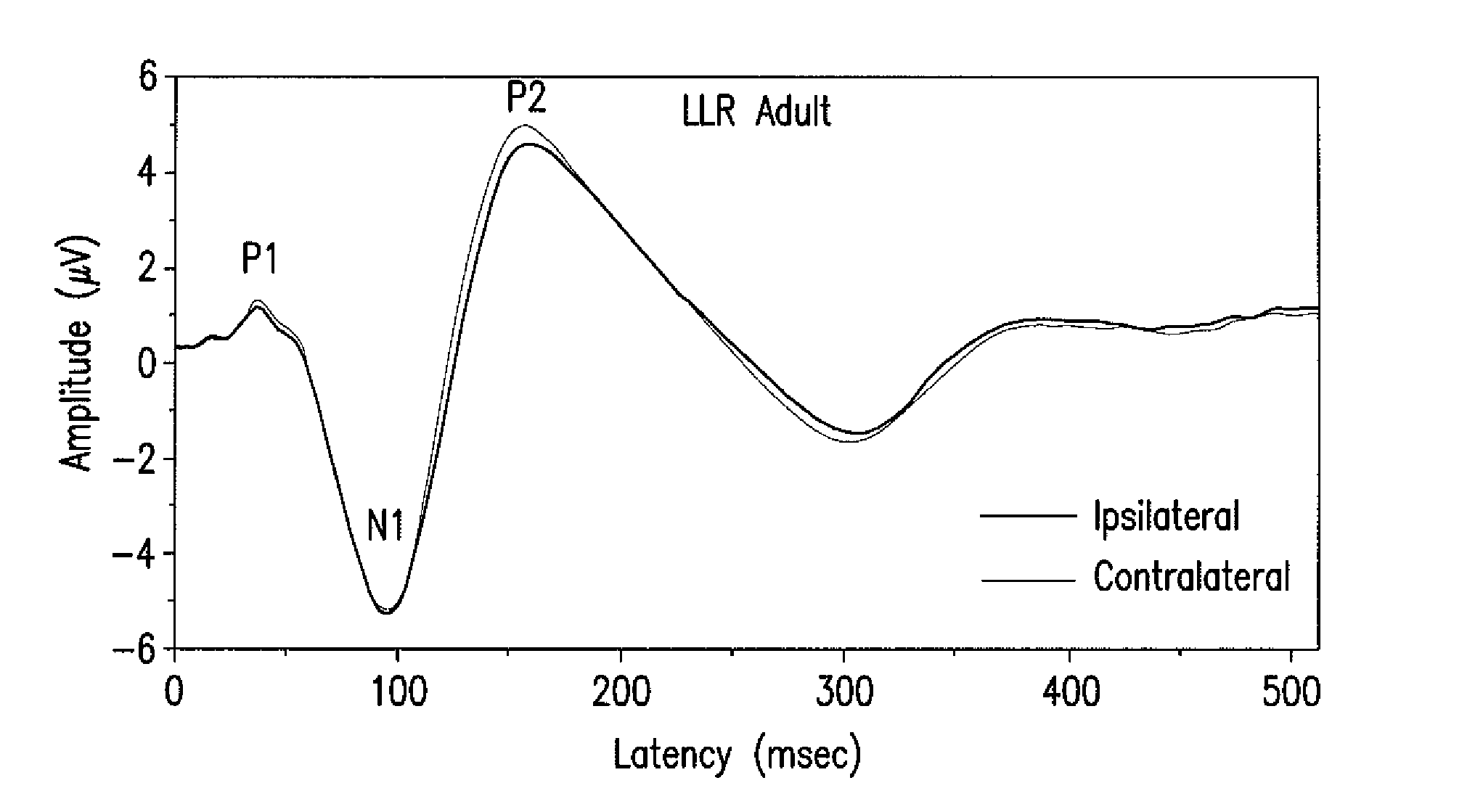
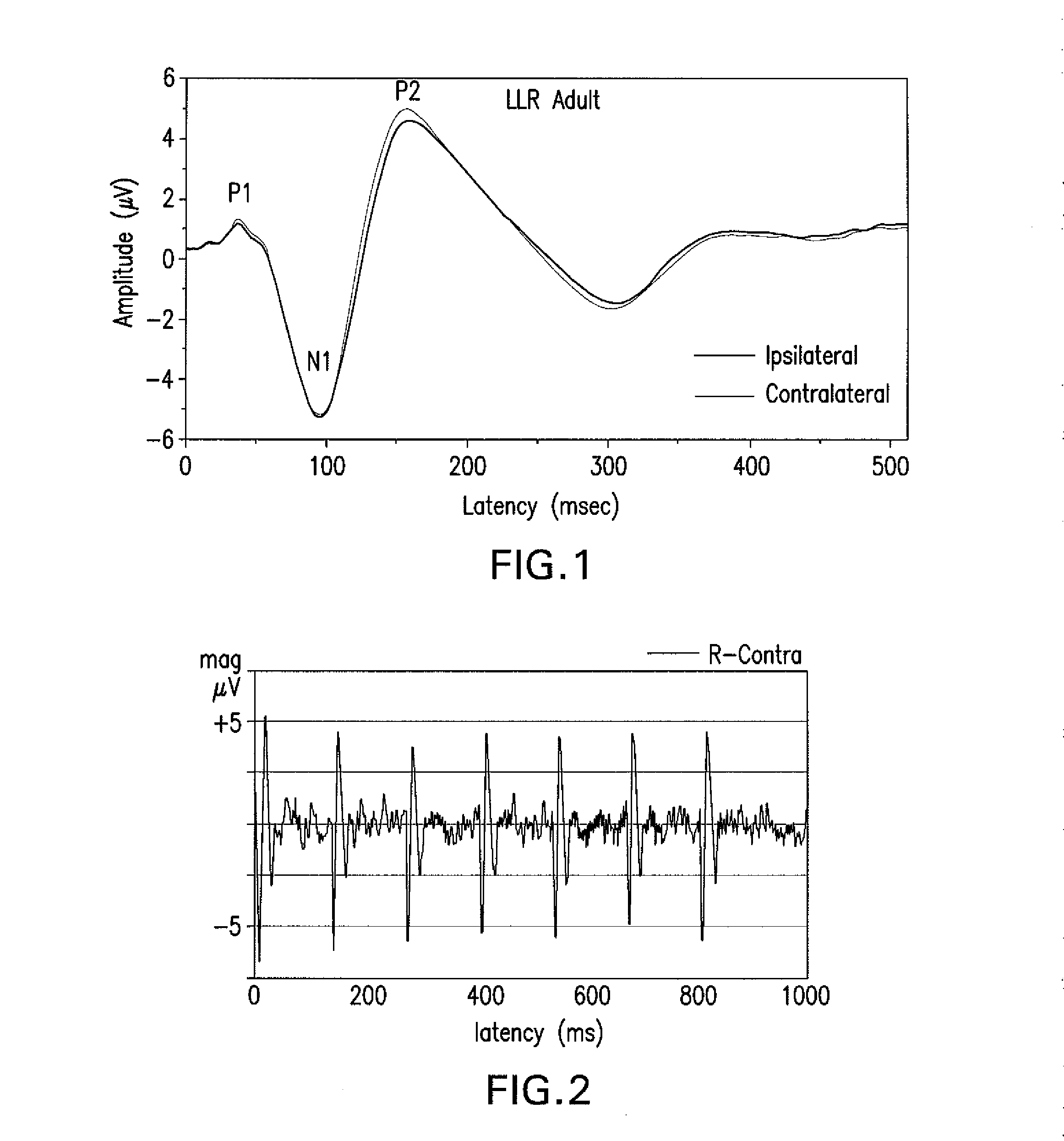
  • Figure 1
    Figure 1
  • Figure 2
    Figure 2
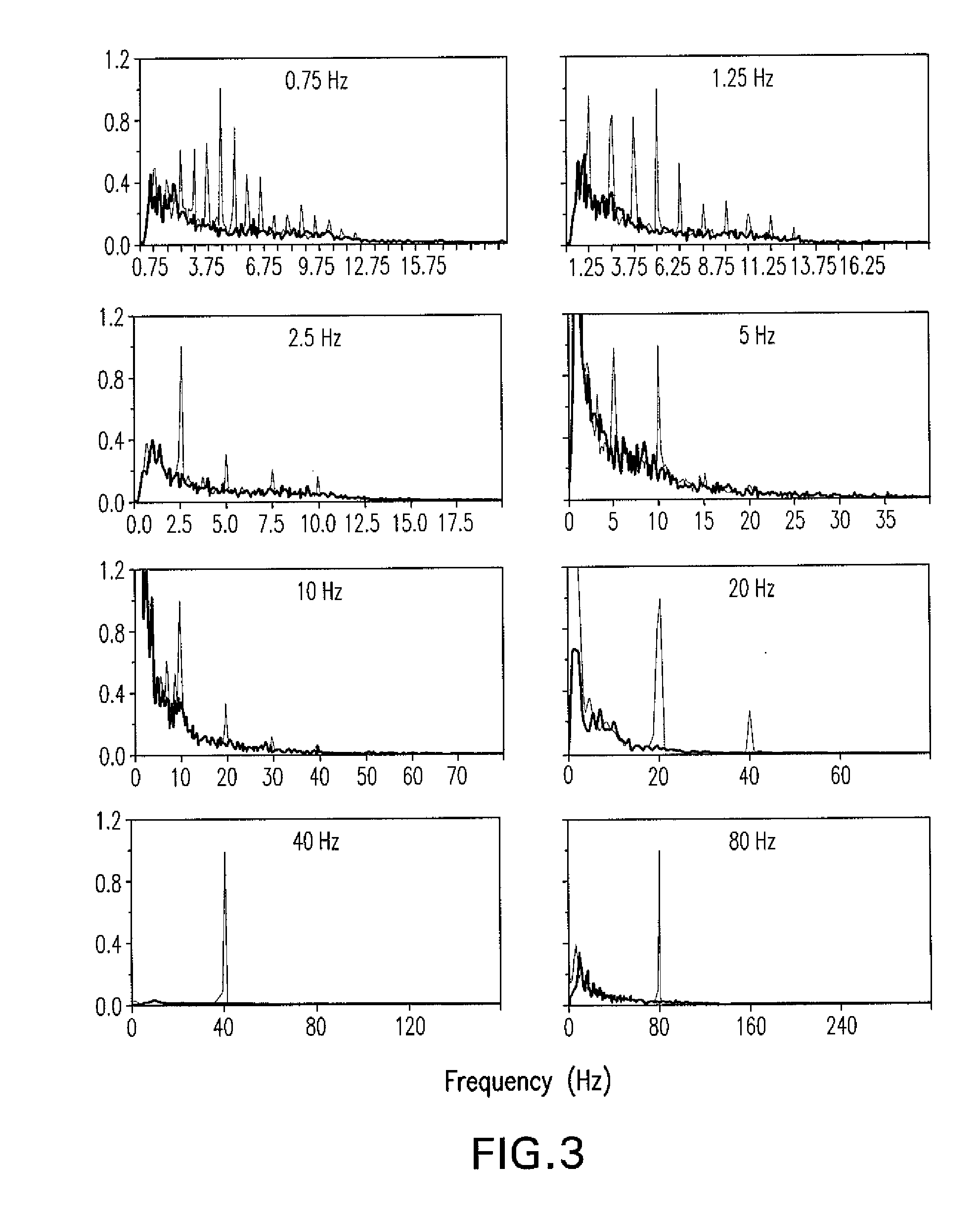
  • Figure 3
    Figure 3
Patent Text Reader

Abstract

The present invention relates to methods and systems for profiling evoked potentials in brain electrical activity which apply steady state response concepts to analysis of longer latency responses reflective of activity of brain regions beyond the brainstem, up to an including the cortex. The use of repeated stimuli within a single analysis window produces a quasi steady-state response and permits a high-resolution spectral analysis. Response amplitudes were measured at repetition rates from 80 to below 1 Hz, using trains of repeated tone-burst stimuli. An amplitude measure introduced and defined as the harmonic sum was incorporated into the spectral power of the response carried by both the fundamental frequency, and the harmonics thereof. Additionally, time ensemble averaging can be employed to improve signal to noise ratio.
Need to check novelty before this filing date? Find Prior Art

Description

CROSS REFERENCE TO RELATED APPLICATIONS

[0001] The present application is a continuation of International Patent Application No. PCT / US2010 / 037312, filed Jun. 10, 2010, published in English on Dec. 9, 2010 as WO10 / 141764, and claims priority to U.S. Provisional Application Ser. No. 61 / 183,826, filed Jun. 3, 2009, the contents of which are hereby incorporated by reference in their entireties.1. INTRODUCTION

[0002] The present invention relates to auditory evoked potentials which serve to assess central nervous system function by evaluating peripheral and central auditory function, and which provide a global view of the integrity of the auditory pathway. Particularly, the present invention provides a method to profile auditory steady-state response amplitudes over a wide range of stimulus repetition rates (or modulation frequencies), including those that were expected to represent the general ranges of traditional transient (obligatory) auditory evoked potentials. Additionally, the presen...

Examples

Embodiment Construction

[0025]Reference will now be made in detail to the exemplary embodiments of the present invention, which are illustrated in the accompanying drawings. The system and corresponding method of the present invention will be described in conjunction with the detailed description of the system.

[0026]The methods and systems presented herein may be used for profiling auditory evoked potentials in brain electrical activity which apply steady state response concepts to analysis of longer latency responses reflective of activity of brain regions beyond the brainstem, up to an including the cortex.

[0027]Conventional auditory evoked potential techniques employ transient stimuli which evoke a multi-phasic transient response that does not reflect or relate directly to the stimulus spectrum. An example of an auditory evoked potential obtained via the traditional approach is illustrated in FIG. 1 in which a brief 1 kHz sinusoidal pulse was administered at less than 1 / s at 70 db SPL, which is a modera...