
Method and Apparatus for Money Transfer to an Account
a technology for money transfer and account, applied in the field of method and apparatus for money transfer to an account, to facilitate real-time account validation, facilitate initiation of, processing or funding and facilitate the effect of facilitating the initiation of c2a money transfer
- Summary
- Abstract
- Description
- Claims
- Application Information
AI Technical Summary
Benefits of technology
Problems solved by technology
Method used
Image

Examples
Embodiment Construction
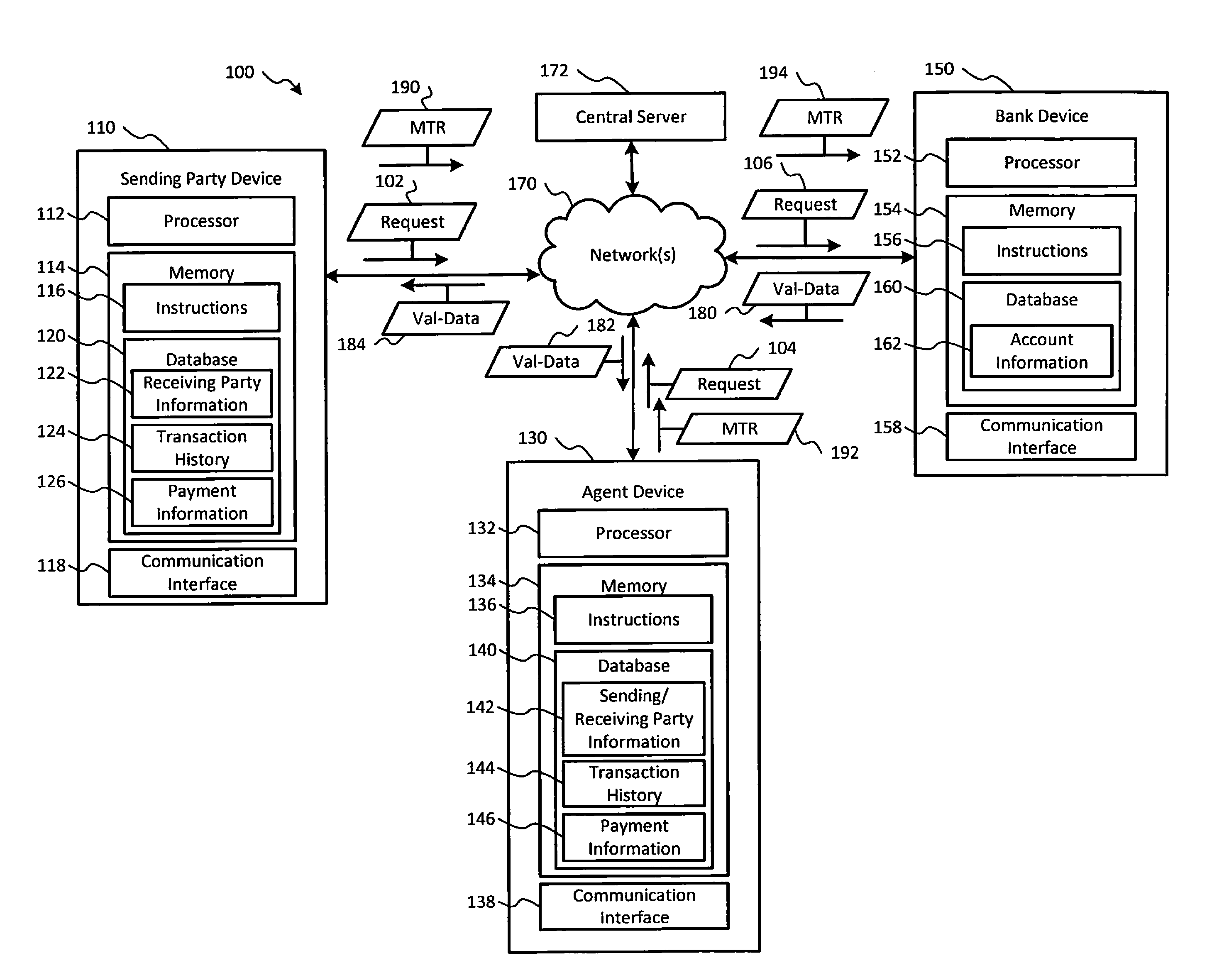
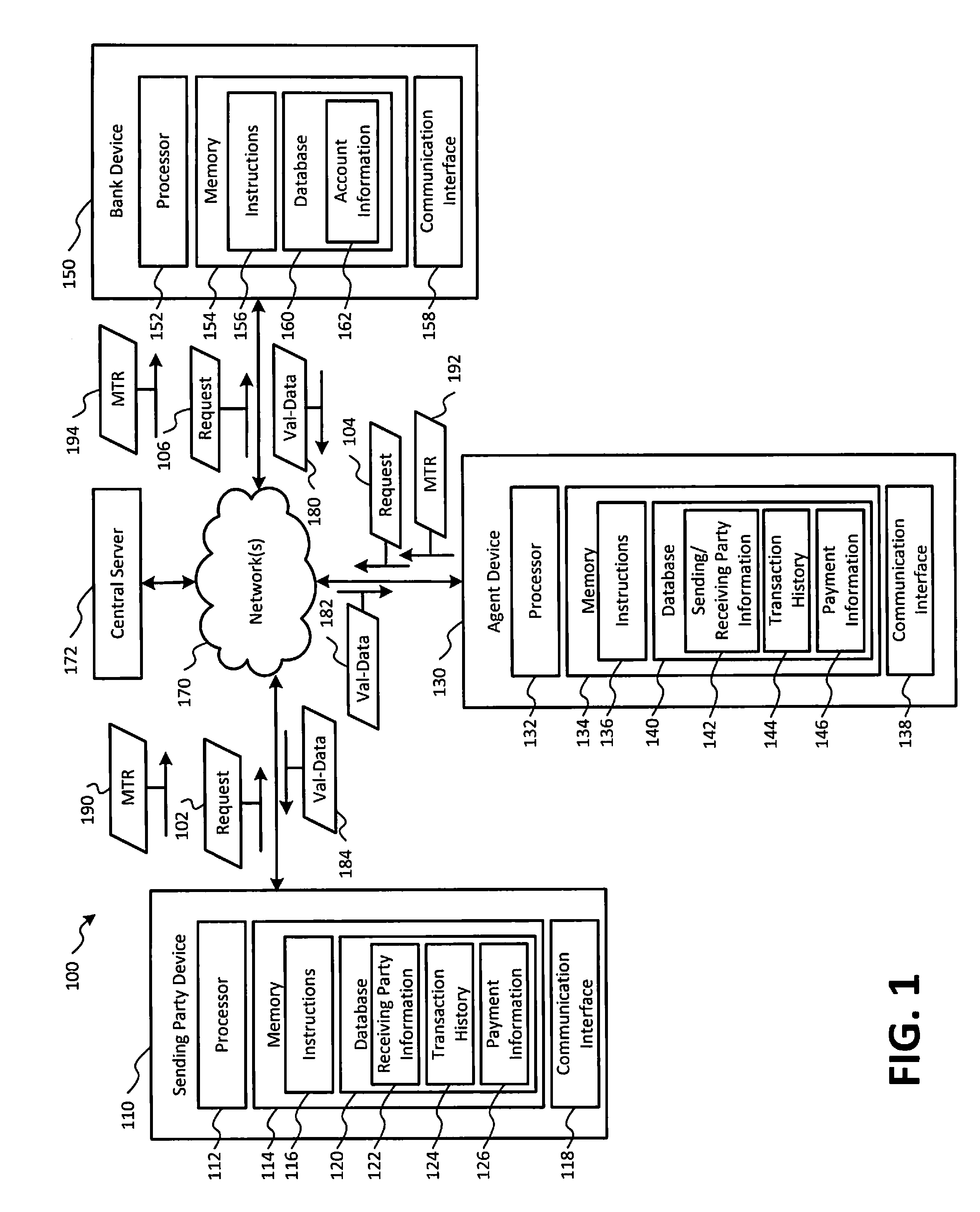
[0017]Referring to FIG. 1, a block diagram of an exemplary system for initiating, processing, and funding a money transfer transaction is shown and designated 100. As shown in FIG. 1, the system 100 includes a sending party device 110, an agent device 130, a banking device 150, and a central server 172. The sending party device 110, includes a processor 112, a memory 114, and a communication interface 118. The memory 114 may include read only memory (ROM) devices, random access memory (RAM) devices, one or more hard disk drives (HDDs), flash memory devices, solid state drives (SSDs), other devices configured to store data in a persistent or non-persistent state, or a combination of different memory devices. The memory 114 may store instructions 116 that, when executed by the processor 112, cause the processor 112 to perform operations described in connection with the sending party device 110 with reference to FIGS. 1-4.
[0018]The communication interface 118 may be configured to commu...
PUM
 Login to View More
 Abstract
Description
Claims
Application Information
 Login to View More