Inter-Channel Interference Management for Optical Super-Channels

US20160080087A1Active Publication Date: 2016-03-17MITSUBISHI ELECTRIC RES LAB INC
5 Cites 29 Cited by

Patent Information

Authority / Receiving Office
US · United States
Current Assignee / Owner
Publication Date
2016-03-17

Smart Images

  • Figure 1
    Figure 1
  • Figure 2
    Figure 2
  • Figure 3
    Figure 3
Patent Text Reader

Abstract

The transmission of data from a transmitter to a receiver over an optical super-channel including a set of sub-channels of different frequencies includes partitioning the data into a set of data streams including one data stream for each sub-channel and partitioning each data stream into a set of sub-streams. Each sub-stream of each data stream is encoded with different forward error correction (FEC) codes to produce a set of encoded sub-streams for each data stream, and the set of encoded sub-streams of each data stream are superimposed with different powers to produce a set of encoded data streams. The set of encoded data streams is multiplexed to produce an optical signal transmitted over the set of sub-channels of the optical super-channel.
Need to check novelty before this filing date? Find Prior Art

Description

FIELD OF THE INVENTION

[0001] This invention relates generally to coherent optical communications systems, and more particularly to transmitting data over an optical super-channel.BACKGROUND OF THE INVENTION

[0002] Coherent optical communications enable data to be transmitted over long haul optical transmission networks, typically greater than 2,000 km, at high data rates. A coherent detector requires that a received phase-modulated optical signal is digitized. Digitizing the received signal requires a high-speed analog-to-digital converter (ADC). However, an increase in serial ADC sampling rates is difficult to implement for single-wavelength coherent detection at data rates greater than 100 Gbit / s.

[0003] A super-channel transmission technique is an evolution in dense wavelength division multiplexing (DWDM), in which multiple optical carriers are combined on a single super-channel to realize a higher data rate in total, and is brought into service in a single operational cycle. Rather t...

Examples

Embodiment Construction

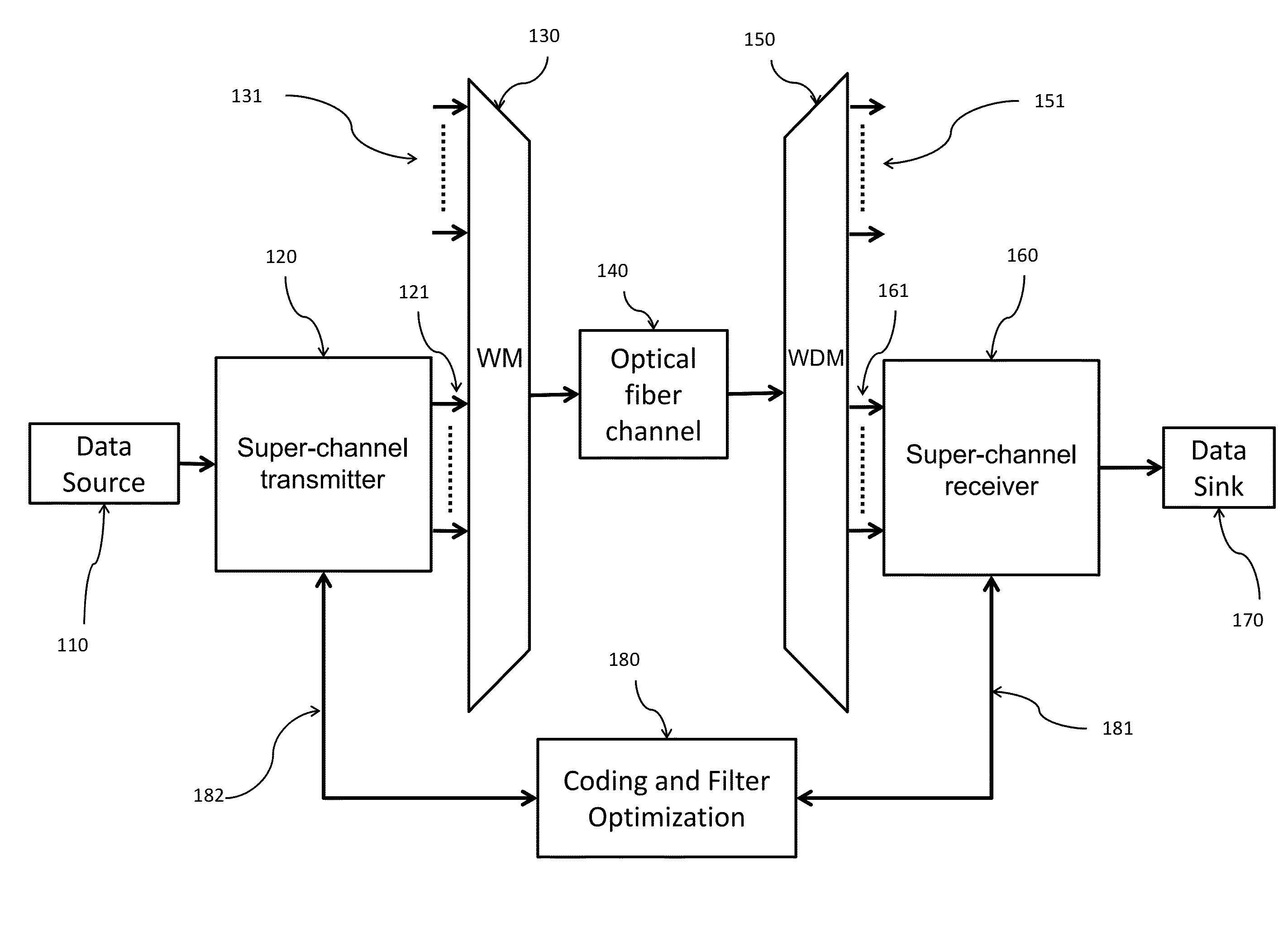
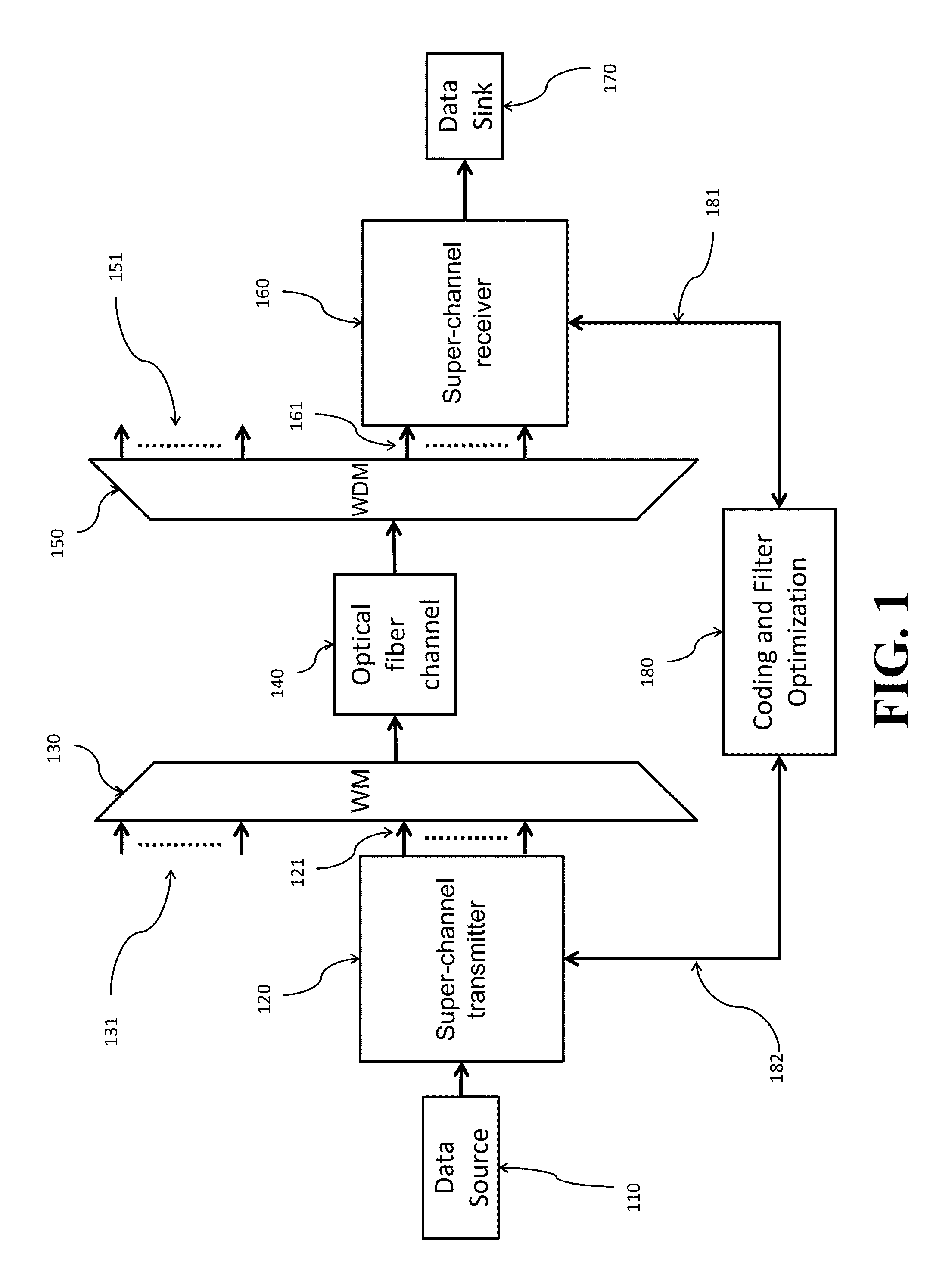
[0027]FIG. 1 shows a block diagram of a super-channel transmission system for transmitting data to a receiver over an optical fiber channel. A sender transmits digital data from data source 110 by a super-channel transmitter 120, which generates a set of data streams to be transmitted over a set of sub-channels of different wavelengths 121. The data streams are combined by an optical wavelength multiplexer (WM) 130, possibly with other independent wavelengths 131 to form an optical signal for transmitting over the optical fiber channel 140.

[0028]On the receiver side, the optical signal is first separated according to multiple wavelengths 151, 161 by an optical wavelength de-multiplexer (WDM) 150. Some of those wavelengths 151 are not related to a super-channel receiver 160. From the other related wavelengths 161, the super-channel receiver 160 recovers the transmitted data 110 to a data sink 170. Some embodiments of the invention use a control block 180 to optimize the super-channel...