
2h-chromene derivatives as analgesic agents
- Summary
- Abstract
- Description
- Claims
- Application Information
AI Technical Summary
Benefits of technology
Problems solved by technology
Method used
Image

Examples
example 1
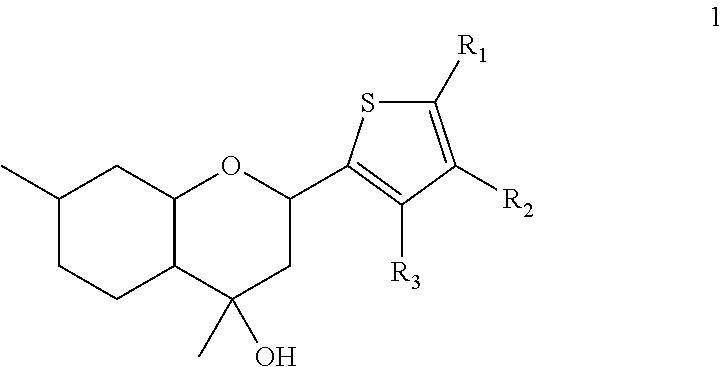
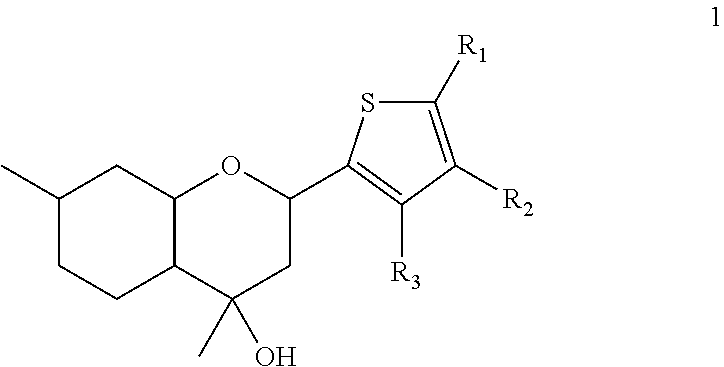
of 4,7-dimethyl-2-(thiophene-2-yl)octahydro-2H-chromene-4-ol 1a
[0024]
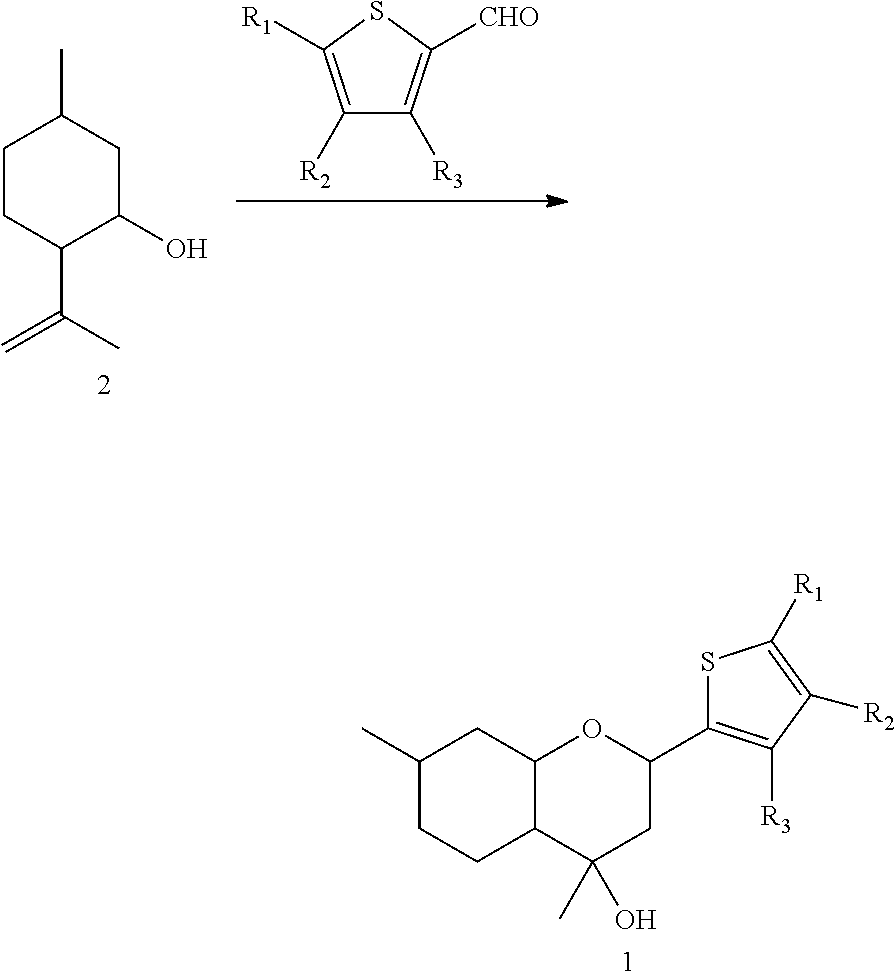
[0025]A solution of 0.29 g thiophene-2-carbaldehyde in 3 ml CH2Cl2 was added to a suspension of 1.3 g of K10 clay in 5 ml CH2Cl2, then a solution of 0.400 g isopulegol 2 in 3 ml CH2Cl2 was added. The solvent was evaporated and the reaction mixture was kept at room temperature during 60 min. Then 10 ml of EtOAc was added, the catalyst was filtered and the solvent was evaporated. The resulting mixture was separated at a column with 13 g silica gel (eluent: solution of 0 to 100% ethyl acetate in hexane). 0.543 g (yield 78%) of compound 1a was obtained. NMR 1H spectrum of compound 1a corresponds to the spectrum, published in the literature [4].
example 2
of 4,7-dimethyl-2-(3-methylthiophene-2-yl)octahydro-2H-chromene-4-ol 1b
[0026]
[0027]Similar to Example 1, interaction of 0.300 g isopulegol 2 with 0.25 g 3-methylthiophene-2-carbaldehyde in the presence of 1.1 g K10 clay during 120 min resulted in 0.381 g (yield 70%) of compound 1b.
[0028]Spectrum NMR 1H (CDCl3): 0.88-0.97 (m, 1H, Ha-8); 0.92 (d, J (16, 9a)=6.6 Hz, 3H, H-16); 1.03 (dddd, J (7a, 7e)=J (7a, 8a)=12.8 Hz, J (7a, 6a)=12.1 Hz, J (7a, 8e)=3.3 Hz, 1H, Ha-7); 1.11 (ddd, J (10a, 10e)=J (10a, 9a)=12.2 Hz, J (10a, 1a)=10.8 Hz, 1H, Ha-10); 1.28 (d, J (15, 4a)=0.7 Hz, 3H, H-15); 1.31 (ddd, J (6a, 7a)=12.1 Hz, J (6a, 1a)=10.2 Hz, J (6a, 7e)=3.3 Hz, 1H, Ha-6); 1.40-1.53 (m, 2H, Ha-9, OH); 1.72 (ddddd, J (8e, 8a)=12.9 Hz, J (8e, 7a)=J (8e, 9a)=J (8e, 7e)=3.3 Hz, J (8e, 10e)=2.0 Hz, 1H, He-8); 1.85 (ddq, J (4a, 4e)=12.7 Hz, J (4a, 3a)=11.7 Hz, J (4a, 15)=0.7 Hz, 1H, Ha-4); 1.91-1.97 (m, 1H, He-7); 1.95 (dd, J (4e, 4a)=12.7 Hz, J (4e, 3a)=2.4 Hz, 1H, He-4); 1.99 (dm, J (10e, 10a)=12.2 H...
example 3
of 4,7-dimethyl-2-(5-methylthiophene-2-yl)octahydro-2H-chromene-4-ol 1c
[0029]
[0030]Similar to Example 1, interaction of 0.300 g isopulegol 2 with 0.25 g 5-methylthiophene-2-carbaldehyde in the presence of 1.1 g K10 clay during 120 min resulted in 0.386 g (yield 71%) of compound 1c.
[0031]Spectrum NMR 1H (CDCl3): 0.87-0.96 (m, 1H, Ha-8); 0.92 (d, J (16, 9a)=6.6 Hz, 3H, H-16); 1.02 (dddd, J (7a, 7e)=J (7a, 8a)=12.8 Hz, J (7a, 6a)=12.2 Hz, J (7a, 8e)=3.3 Hz, 1H, Ha-7); 1.09 (ddd, J (10a, 10e)=J (10a, 9a)=12.3 Hz, J (10a, 1a)=10.8 Hz, 1H, Ha-10); 1.25 (d, J (15, 4a)=0.8 Hz, 3H, H-15); 1.28 (ddd, J (6a, 7a)=12.2 Hz, J (6a, 1a)=10.2 Hz, J (6a, 7e)=3.3 Hz, 1H, Ha-6); 1.39-1.52 (m, 2H, Ha-9, OH); 1.72 (ddddd, J (8e, 8a)=12.8 Hz, J (8e, 7a)=J (8e, 9a)=J (8e, 7e)=3.3 Hz, J (8e, 10e)=2.0 Hz, 1H, He-8); 1.86 (ddq, J (4a, 4e)=12.7 Hz, J (4a, 3a)=11.7 Hz, J (4a, 15)=0.8 Hz, 1H, Ha-4); 1.93 (dddd, J (7e, 7a)=12.8 Hz, J (7e, 6a)=J (7e, 8a)=J (7e, 8e)=3.3 Hz, 1H, He-7); 1.99 (dm, J (10e, 10a)=12.3 Hz...
PUM
| Property | Measurement | Unit |
|---|---|---|
| Toxicity | aaaaa | aaaaa |
Abstract
Description
Claims
Application Information
 Login to View More